
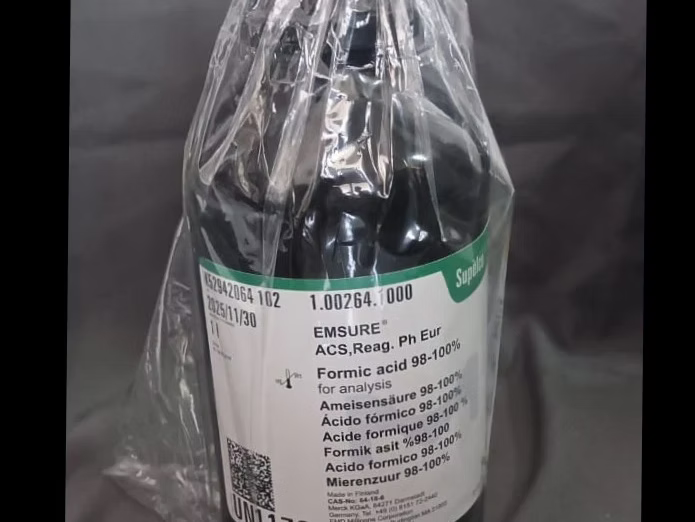
Formic Acid - A Colorless Compound That Can Preserve Food
Bagikan
Formic acid has another name as methanoic acid. This substance is corrosive and causes skin sensitivity.
This compound is colorless and emits a pungent odor. It is generally found in the venom of several ant species.
This article will discuss the structure of formic acid and its uses in industry. Let's look at the review.
What is Formic Acid?
Formic acid is a carboxylic acid containing one carbon. This content can be found in bee and ant venom, which is a useful organic synthesis reagent.
This compound is used as a preservative and antibacterial for animal feed. In addition, it can be a protic solvent, metabolite, solvent and astringent.
Formic Acid Structure
Formic acid has the chemical formula CH2O2. Formic acid has other names such as formiate acid or methanoic acid, and aminic acid.
The following is information related to the structure of folic acid
-
Density 1.22 g/cm³
-
Molecular Weight / Molar Mass 46.03 g/mol
-
Boiling point 100.8 °C
-
Melting point 8.4 °C
-
Chemical Formula CH2O2
Physical and Chemical Properties of Formic Acid
a. Physical Properties of Formic Acid
Formic acid has physical properties that are easily visible to the naked eye. These characteristics are useful for material identification.
-
Aroma: pungent and penetrating
-
Appearance: colorless liquid
-
Bond unit: covalent 1
-
Bond acceptor: hydrogen 2
-
Complexity: 10.3
-
Solubility: soluble in water
b. Chemical Properties of Formic Acid
Formic acid reduces mercury chloride to produce a white precipitate. The chemical equation that occurs is as follows:
HCOOH + 2HgCl2 → Hg2Cl2 + 2HCl + CO2
Formic acid reacts with phosphorus pentachloride to form formyl chloride, phosphoryl chloride and hydrogen chloride.
HCOOH + PCl5 → HCOCl + POCl3 + HCI
Advantages of Formic Acid
Formic acid is a substance that can extend the shelf life of food products. In addition, it is an effective cleaning agent for industrial equipment. Another advantage is that it does not harm the environment.
Formic acid also has the potential to become a source of renewable energy in the future. All these potentials make it an important component in industrial processes.
Applications of Formic Acid
-
Natural preservative: It is used as a natural preservative in the food industry.
-
Cleaning agent: Formic acid is used as a cleaning agent for industrial equipment and machinery.
-
Coagulant: It is used as a coagulant in the production of textiles and leather. Coagulant is a chemical to help the precipitation process of particles that cannot precipitate on their own.
-
Pesticides and herbicides: In agriculture it can be used as pesticides and herbicides. It is also used as an animal feed preservative.
-
Medical industry: Useful for topical treatment for warts and other skin diseases.
-
Chemical synthesis: It is used as a reagent in the production of various chemicals, including format salts, formaldehyde, and methanol.
-
Energy industry: It is being investigated as a potential hydrogen source for fuel cells.
Formic acid is a substance that is dangerous to health if it comes into contact with skin, eyes, or is swallowed. If exposed through vapor inhalation, it causes respiratory problems such as coughing and shortness of breath. If exposed for too long, it causes bronchitis.
Formic acid can cause vomiting because it can disrupt digestive problems. If in large quantities, it causes kidney and liver damage. If exposed for a long time, it results in systemic toxicity, which can easily lead to coma and even death.
Use personal protective equipment to protect yourself from formic acid exposure. Store it in a safe place to prevent accidental exposure.