
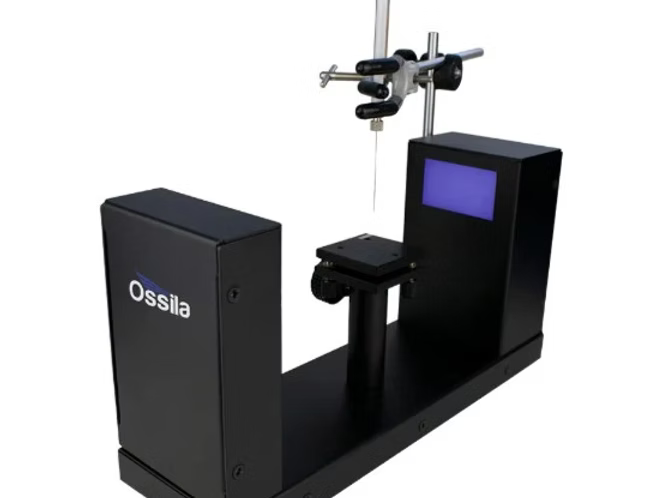
Contact Angle Goniometer - Non-Contact Liquid Droplet Measurement Tool
Bagikan
Have you ever wondered how to measure fluid droplets? Of course, you don't measure with a ruler and so on. Liquids easily change shape when exposed to force. One way to measure liquids is to make them form an angle <90° and observe them through a camera. From there, you can do it using a contact angle goniometer.
This article will discuss the use of a Contact Angle Goniometer.
What is a Contact Angle Goniometer?
A Contact Angle Goniometer is a tool used to measure the contact angle of droplets on a surface. This measurement is useful for wet surfaces.
When a liquid begins to spread over a surface, its contact angle becomes <90°. Perfect wetting occurs if the droplet is flat or the contact angle is 0°.
By hanging a droplet from the tip of a needle, comparing the droplet model with images captured by the system, which can be used for optical tensiometer measurements.
Components of a Contact Angle Goniometer
A Contact Angle Goniometer consists of several main components, including:
-
high-resolution camera
-
monochromatic light source
-
Adjustable sample stage
-
Syringe clamp
a. High-Resolution Camera
A camera with 1920 x 1080 resolution is capable of capturing 30 frames per second. This analysis allows for in-depth observation through software.
The manual lens focus allows you to control image sharpness. Simply turn the lens until you get focus.
File size is a concern, this software is capable of setting the resolution and frame rate much lower, which saves your storage space.
b. Monochromatic Light Source
Monochromatic backlight uses electrical power to help accurately detect droplet edges using the Canny edge detection algorithm.
Bright and uniform rectangular panels create larger pixel brightness changes than usual, which ensures discoverable edges. This helps to quickly and accurately measure contact angles and surface tension.
c. Adjustable Sample Stage
The adjusted sample stage will allow for a flat surface and prevent droplet movement during deposition. The stage can be lowered and raised without affecting the height, making measurements and adjustments easy to position the platform as close as possible.
If you want to do so, a fine adjustment level allows for a slight tilt towards the camera. This helps align the baseline.
d. Syringe Clamp
Intuitive software allows you to record videos to measure contact angles and surface tension. This device performs edge detection that uses fitting techniques to calculate droplet properties.
How a Contact Angle Goniometer Works
A contact angle is formed when a drop of liquid is placed on a material surface. Surface tension and the liquid's pull to the surface cause the droplet to form a dome.
If the droplet is small and the liquid's surface tension is high, it will form a perfect hemisphere.
If a liquid droplet is on a surface, the perimeter of the droplet will shrink, and the contact angle will become larger.
Applications of Contact Angle Goniometer
This measuring tool is fundamental in material measurements. The forms of its application are as follows:
a. Thin Film Enhancement
One of the challenges in research is scaling OLED fabrication from laboratory to commercial scale. Deposition techniques are used to make devices larger.
This method is used by researchers who make devices using a spin coater to create larger devices with a slot die coater. To achieve this, new inks with different wetting properties are needed.
The end result achieved is the ability to identify solutions that will wet the surface and form a uniform and rapid thin film.
b. Material and Solvent Compatibility
When processing solutions on thin-film electronic devices, new material layers are usually deposited on previously deposited layers. The choice of solvent and processing technique will determine whether this is possible or not.
If the first layer on the support is soluble in a solvent similar to the second layer, damage can occur. This measurement helps you determine whether the stored solution penetrates the layer where the solution is deposited.
c. Substrate Cleaning
Part of the contact angle of a droplet is determined by the surface on which it is deposited. Therefore, the goniometer becomes a tool to determine the cleanliness of the medium and ensure there is no unwanted dust or dirt.
d. Hydrophobic Coatings
Sometimes coatings are developed to force liquids to wet on contact, especially for those who do not want the solution to wet the surface. Therefore, the purpose of a hydrophobic coating is to create a high contact angle between the liquid and the substrate.
How to Use a Contact Angle Goniometer
The use of this measuring tool can follow the steps below, especially if you are using Ossila.
-
Open the Ossila Contact Angle software.
-
Click the 'Camera' icon. The camera viewfinder will appear in the center of the screen.
-
Place your sample in the center of the vertical tilt stage.
-
Adjust the stage height until the sample is visible at the bottom of the image.
-
Rotate the camera lens until the sample is in focus on the display.
-
To change the default video settings, click the settings or 'Gear' icon –
-
Set the recording duration (video length) and speed (frame rate). Make sure your video length accounts for the time it takes to dispense the droplet and the spreading time you want to observe.
-
Prepare to dispense a drop of water.
-
Click the 'Camera' or 'Record' icon to capture.
-
Dispense the droplet.
-
Once you have finished recording, press 'Stop Camera' to turn off the camera.