
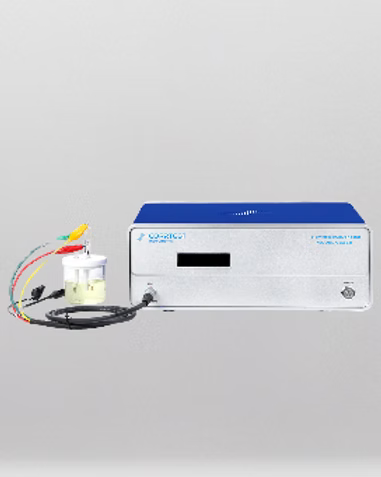
Carbon Black Deposition on Nickel Foam & Electrochemical Testing (CV, EIS, GCD) with Parstat Potentiostat from Telkom University
Bagikan
What Is Deposition?
Deposition is the process of coating or depositing a material onto a substrate surface to form a thin layer with specific characteristics. In this context, carbon charcoal is deposited onto nickel foam to improve conductivity, active surface area, and electrochemical performance.
The deposition method used can determine the quality, thickness, and homogeneity of the carbon layer, thus affecting the electrode's performance in energy storage applications, such as supercapacitors, batteries, and electrochemical sensors. The deposition of carbon charcoal on nickel foam aims to increase the efficiency of electron transfer and electrochemical reactions by creating a more conductive and stable electrode surface.
Electrochemical Testing with Parstat Potentiostat
After deposition, electrodes are tested using a Parstat Potentiostat to evaluate their performance through three main methods:
-
Cyclic Voltammetry (CV)
CV testing is used to analyze the redox characteristics and capacitance of carbon-based electrodes.
-
Determine the redox potential of carbon charcoal-based electrodes
-
Analyze the active electrode surface area based on the voltammogram curve
-
Measure specific capacitance, especially for supercapacitor and battery applications
-
Assess the stability of electrode charge and discharge cycles
Key CV Parameters:
-
Potential range: -1 to +1 (depending on the electrode system)
-
Scan rate: 5 – 200 mV/s
-
Electrolyte: KOH, H2SO4, or other electrolyte solutions
-
-
-
Electrochemical Impedance Spectroscopy (EIS)
EIS testing is an important technique for understanding electrochemical processes on an electrode.
-
·Assess charge transfer resistance (Rct) → The smaller the Rct value, the better the electrode conductivity.
-
Analyze ion diffusion in the electrode → An important factor in energy storage efficiency.
-
Test the stability of the electrode-electrolyte interface in battery and supercapacitor applications.
Key EIS Parameters:
-
Frequency range: 0.01 Hz – 100 kHz
-
Equivalent circuit model for data analysis
-
-
-
Galvanostatic Charge-Discharge (GCD)
This test is used to evaluate the electrode's ability to store and release energy.
-
Measure the specific capacitance of the electrode
-
Determine coulombic efficiency (%) which is the ratio between stored and released charge
-
Analyze electrode cycle stability, important for battery and supercapacitor applications
Key GCD parameters:
-
Constant current: 0.5 – 10 mA/cm2
-
Charge and discharge duration: to evaluate the electrode
-
Discharge profile: to see if the material has capacitive or pseudocapacitive properties
-
-
Advantages of Carbon Charcoal Deposition on Nickel Foam & Electrochemical Testing
-
High conductivity → Increases electron transfer efficiency.
-
Large electrode surface area → Maximizes electrochemical reactions.
-
Good cycle stability → Ensures long-term electrode durability.
-
Comprehensive electrochemical analysis → Through CV, EIS, and GCD to understand electrode performance.
Instrument Specifications and Measurement Range
-
Brand : Corrtest Instruments
-
Type : Bipotentiostat (2 independent working electrode channels)
-
Model : CS2350M
-
Current Range : ±1 A per channel
-
Potential Range : ±10 V per channel
-
Voltage Accuracy : ≤0.1% of full scale ±1 mV
-
Current Accuracy : ≤0.1% of full scale
-
CV &LSV Scan Rate : 0.001 mV/s to 10,000 V/s
-
Dimensions : 36 × 30 × 16 cm
-
Weight : 6.5 kg
-
Applications : battery testing, electrochemical sensors, electrodeposition, RDE/RRDE experiments
How to Use Deposition & Electrochemical Testing Services
-
Free consultation regarding suitable deposition methods & testing parameters.
-
Submit samples of carbon charcoal or nickel foam-based electrodes.
-
Deposition process is carried out according to the chosen technique.
-
Electrochemical testing is performed with a Parstat Potentiostat.
-
Analysis results report is provided in spectrum format & data interpretation.