
Graphene Nanoplatelet as Heat Conductor for Solar Cell PV
Bagikan
Li-Ion batteries are now required not only to have large power capacity, but also to be lightweight. Using lightweight Li-Ion batteries can reduce excessive load and component damage.
But did you know that there is one material that can provide lightweight properties to solar power plant (PLTS) batteries? This material is graphene nanoplatelet. What are the characteristics of this material?
What is Graphene Nanoplatelet?
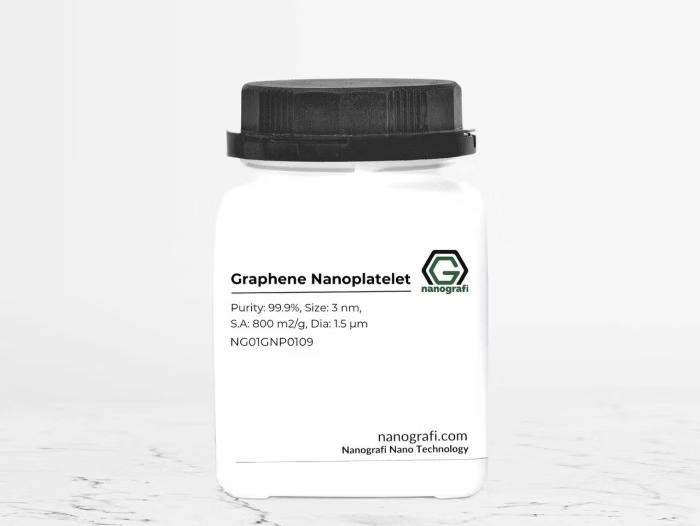
Graphene nanoplatelet (GNP) is made from graphene material. Nanoplatelets are formed with many layers with a thickness in nanometers and a diameter in microns. These layers are bound to each other through Van Der Waals attractive forces.
Graphene is formed when carbon atoms come together to form bonds with each other and create a hexagonal honeycomb-shaped structure. In this case, each carbon atom shares electrons. This forms stronger bonds between carbon atoms.
Carbon Atoms with a Honeycomb-like Shape
Graphene is a super-thin carbon atom arranged in a honeycomb pattern. Meanwhile, graphene nanoplatelet is a small flat piece of several layers of graphene.
One GNP alone consists of 5 to 10 stacked layers of graphene with a thickness of 0.34 nm, so the total thickness is 1.7 nm to 17 nm. Meanwhile, the size of the object varies greatly from nanometer to micrometer scale.
Large GNP size is very good at conducting heat and electricity, while small HNP is more easily reacted with other materials. However, there are zigzag or armchair edges that can affect the properties of GNP.
Properties of Graphene Nanoplatelet
Graphene nanoplatelets are made to improve mechanical properties such as stiffness, surface hardness, and strength due to their unique morphology. This material is a good electrical and thermal conductor due to its pure graphite composition.
Other characteristics and properties of graphene nanoplatelets are as follows:
-
Thickness = 6-8 nm
-
Bulk density = 0.03 to 0.1 g/cc
-
Oxygen content = <1% by weight
-
Carbon content = >99.5% by weight
-
Residual acid content = <0.5% by weight
-
Form = black granules
-
Thermal conductivity = 3,000 watt/m-K (parallel to surface), 6 watt/m-K (perpendicular to surface)
-
Thermal expansion = 4-6 x 10-⁶ m/m/deg-K, 0.5-1.0 x 10⁶ m/m/deg-K
-
Tensile Modulus = 1,000 GPa
-
Tensile Strength = 5 GPa
-
Electrical conductivity = 10⁷ siemens/m, 10² siemens/m
Advantages of Graphene Nanoplatelets
a. High Thermal Conductivity
Graphene sheets that form nanoplatelets are conductive to heat and electricity. Unlike carbon fibers that have low thermal resistance, this results in higher thermal conductivity compared to other carbon fibers.
Based on a study from Hanyang University, composites using high content (~50 wt%) graphene nanoplatelets uniformly dispersed with low-viscosity polyamide 6 (PA6) resin.
The measured thermal conductivity of the composite showed thermal percolation when the GNP content exceeded 30% by weight, with in-plane thermal conductivity increasing by 1315% compared to pure PA6.
b. High Electrical Conductivity
Graphene nanoplatelet sheets form an effective conduction network at low loading levels. Unlike other additive materials, nanoplatelets do not negatively impact the base resin. Mechanical and aesthetic properties are also non-abrasive.
c. Reduced Permeability
Graphene nanoplatelets can reduce permeability when incorporated into polymer films or other solid parts. The high aspect ratio of platelets makes them effective at low loading levels, helping to reduce costs and impact on properties.
Permeability is affected by the size of the addictive particles. Generally, larger diameter particles result in a greater decrease in permeability. In laboratory tests, 15 μm particles performed better than nanoclays and were superior to other carbon-based materials.
Applications of Graphene Nanoplatelets
GNP consists of stacked graphene sheets with high thermal conductivity and thermal strength. These properties are ultimately applied in various fields of electronics, composites, and energy conservation.
GNP in electronics is used as a conductive additive in composites and coatings, as well as electrodes in solar cells and transistors. In the field of energy storage, GNP becomes an electrode material in batteries and supercapacitors. In the realm of composites, it is utilized to improve the mechanical and electrical properties of a component.
Increase Thermal Conductivity with Graphene Nanoplatelets
The performance of electronic products is greatly affected by their ability to withstand heat. If the heat resistance is low, it results in a decrease in efficiency, or simply put, the product is easily damaged.
Therefore, electronic devices must have good heat conducting capabilities. Graphene nanoplatelets are one of the materials with high thermal conductivity.