
Guidelines on How to Use a Micrometer Screw Gauge for Workpiece Measurement
Bagikan
Measuring activities are inseparable from laboratory work. You definitely need to take measurements and observe data to produce good testing.
To support the testing and measuring process of workpieces, a measuring tool with high precision is needed. A screw micrometer is a measuring tool with a high level of precision, at a micrometer scale.
Its measuring scale has a precision level of 0.01 mm. With this, you can obtain precise observation results.
And here is an explanation of the screw micrometer and how to use it.
What is a Screw Micrometer?
A screw micrometer is a measuring tool consisting of a screw with a precision level of 0.01 mm. This tool was first invented by William Gascoigne in the 17th century because he needed a more precise measuring tool than a caliper.
Screw micrometers are used to measure objects on a micrometer scale. Examples include measuring the thickness and diameter of workpieces.
Uses/Functions of a Screw Micrometer
As its name suggests, a screw micrometer functions to measure objects on a micro scale. This tool has 10 times higher precision than a caliper, allowing it to measure objects with an accuracy of 0.01 mm.
The general functions of a screw micrometer are as follows:
-
Measuring the thickness of thin workpieces such as steel plates, aluminum, and paper.
-
Measuring the outer diameter of objects such as wires, cables, and so on.
-
Measuring the diameter of small holes in objects.
-
Measuring the diameter of objects with fixed jaws and sliding jaws at the top.
-
Measuring the depth of holes, such as pipe holes.
Parts of a Screw Micrometer and Their Functions
a. Anvil or fixed spindle
The fixed spindle or anvil is the stationary part. This stationary spindle is used to clamp an object when measuring a workpiece.
b. Spindle or Movable Spindle
This movable or sliding spindle is cylindrical and driven by the thimble.
c. Lock Nut
The lock nut is the part used to lock the movement of the movable spindle. This prevents the workpiece from coming loose when shaken.
d. Sleeve or Measuring Tube
The sleeve is the static circular part that serves as the measurement scale. In a screw micrometer, there are two types of scales: the main scale and the vernier scale.
e. Thimble
The thimble is the part operated by the user. Its function is to move the spindle to clamp the workpiece.
f. Ratchet
The ratchet is a component that helps move the movable spindle slowly compared to the thimble.
g. Frame
The frame has a C-shape that connects the fixed spindle and other components of the screw micrometer. The frame is made thick to ensure that the object does not move, shift, or change shape.
Digital vs. Analog Screw Micrometer
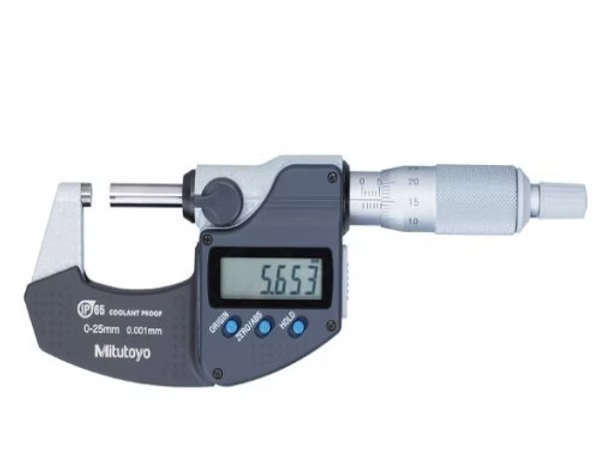
Digital micrometers make measurements easier. What makes digital micrometers superior is their faster resolution and scale conversion.
If you use a digital micrometer, the display shows measurements with a precision of up to 0.00005 and is easier to convert from imperial to metric. However, in practice, analog screw micrometers are more popular because they are easier to understand and more intuitive to use.
How to Use a Screw Micrometer
The working principle of a screw micrometer is to use a screw to magnify a distance that is too small to be measured directly, then converting it into a larger screw rotation. All of this can be seen from its scale.
The steps to use a screw micrometer are as follows:
-
The object being measured must be in contact with the fixed spindle.
-
The thimble is rotated until the object is clamped by the fixed spindle and the movable spindle.
-
Rotate the ratchet to get precise measurements by moving the vibrating spindle.
-
Once the object is completely clamped, read the measurement results on the main scale and vernier scale.
How to Use a Digital Screw Micrometer
You need to place the sample between the calipers when using a digital micrometer. The machine will then attach the calipers to the object.
Once the measurement is tested, the results will appear on the digital screen with high precision. Unfortunately, a digital screw micrometer must be free of dust or dirt before use.
How to Read Screw Micrometer Data
Reading a screw micrometer involves observing the main scale and the vernier scale. The main scale can be read on the sleeve, and the vernier scale can be read on the thimble.
For illustration, here's how to read screw micrometer data as reported by studiobelajar.com:
-
For the main scale, it can be seen that the thimble position has passed the number "5" at the top, and below the horizontal line, it has passed 1 strip of 0.5mm. This means that at this point, the measurement result is 5 + 0.5 mm = 5.5 mm. Measurements can also be made on the principle that each strip signifies a distance of 0.5mm. Since 5 strips are passed above the horizontal line and 6 strips below the horizontal line, the total distance is (5+6) x 0.5mm = 5.5mm.
-
Next, it is observed that the horizontal line on the main scale aligns with the number 28 on the vernier scale. This means that on the vernier scale, an additional length of 0.28mm is obtained.
-
Thus, the final measurement result of the screw micrometer in this example is 5.5 + 0.28 = 5.78mm with an accuracy level of 0.01 mm.
Accuracy/Precision of Measurement with a Screw Micrometer
A screw micrometer has scale division graduations with a measurement accuracy of 1/100 (0.01) mm. Each full rotation of the scale moves the spindle by 0.5 mm.