
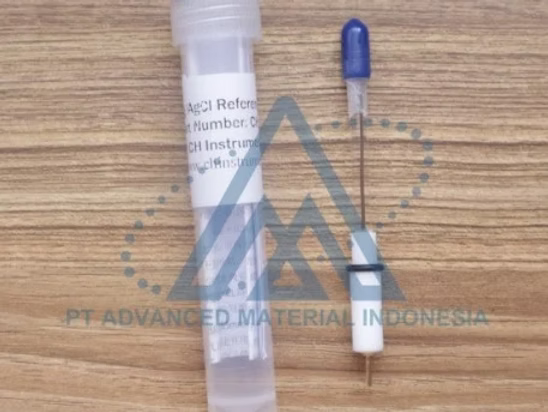
Silver Chloride (AgCl) - Non-Toxic Material Sparingly Soluble in Water
Bagikan
Silver chloride is a compound that quickly turns purplish when exposed to sunlight in a test tube. The chemical reaction of silver chloride consists of silver cations (Ag+) and chloride anions (Cl-).
Although an ionic compound, silver chloride is poorly soluble in water. In contrast, silver chloride is soluble in ammonia and concentrated acids.
What is Silver Chloride (AgCl)?
Silver chloride is a chemical compound in the form of white crystals. This compound will quickly turn purplish when in a test tube, especially in a laboratory exposed to sunlight. This is because silver chloride breaks down into silver and chlorine.
Silver chloride is made by adding sodium chloride to a silver nitrate solution, resulting in a white precipitate of silver chloride. Silver chloride is used to give glass a yellow color.
Structure of Silver Chloride (AgCl)
Silver chloride has a molar mass of 143.32 g/mol. It is an ionic compound consisting of silver cations (Ag+) and chloride anions (Cl-).
In the solid state, AgCl adopts a crystal structure similar to NaCl, with each cation surrounded by six chloride anions in an octahedral geometry.
Physical and Chemical Properties of Silver Chloride (AgCl)
Silver chloride has a white crystalline solid form with a density of 5.56 g/ml, a melting point of 455 °C, and a boiling point of 1,547 °C. Although an ionic compound, it is not easily soluble in water.
In contrast, silver chloride is soluble in ammonia and concentrated acids. It is a photosensitive material that reacts when exposed to light, decomposing into metallic silver and chlorine.
Silver chloride undergoes a decomposition reaction when exposed to sunlight to produce chlorine and silver. The chemical reaction for this can occur as follows:
AgCl → Ag + Cl
Silver chloride reacts with similar bases like ammonia, forming a complex compound called chloride ion and diamminesilver(I) ion. The chemical reaction can be given as follows:
AgCl + 2NH3 → [Ag(NH3)2]+ + Cl–
Applications of Silver Chloride (AgCl)
The application of silver chloride is of interest because it is non-toxic at low concentrations and is used in medical and disinfectant applications. In addition, silver chloride is also used in the following:
-
Antidote for mercury poisoning
-
Addition to pottery glazes for Inglaze luster formation
-
Making photographic paper because photons produce a latent image through photoreduction
-
Producing curing shades in stained glass manufacturing
-
Infrared transmissive optical components
-
Deodorant production
-
Drinking water preservation in water tanks