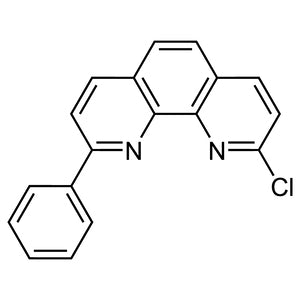
4-Bromo-1,10-phenanthroline is a halogenated derivative of 1,10-phenanthroline, one of the most classical and widely used nitrogen-donor ligands in coordination chemistry. Its flat tricyclic framework carries two nitrogen atoms facing one another, allowing the compound to bind metal ions strongly in a bidentate fashion and to form stable chelate complexes. The bromine atom introduced at the fourth position adds further value by providing a synthetic handle, so the ligand can be modified as required for catalysis or materials research programmes.
The property that makes this compound a preferred choice is the combination of strong chelating ability with ease of derivatisation. As a ligand, phenanthroline supplies a rigid coordination plane, so the geometry of the resulting metal complex is easier to predict and the complexes formed are generally resistant to dissociation. Its conjugated aromatic system also supports metal-to-ligand charge transfer, which underpins the photophysical behaviour of many photocatalysts. The carbon–bromine bond at position four can be transformed through palladium-catalysed cross-coupling, halogen–metal exchange, or nucleophilic substitution.
In Indonesian laboratories, this ligand is typically handled in university and institutional research groups working on coordination chemistry, homogeneous catalysis, and functional materials. It is normally used at small scale on the bench, weighed out for ligand synthesis or complex preparation and stored between experiments alongside other fine organic building blocks. Because it serves as an intermediate rather than a routine reagent, consumption per project is usually modest and orders are placed according to the needs of a specific synthetic route.
TCI brochures (PDF)
- Ligands 2025-12-01 · p. 14
- Building Blocks for Organic Semiconductor 2026-03-24 · p. 23
Related TCI products
- Preparation of metal chelate complexes, where the two opposing nitrogen donors bind a metal centre bidentately and give complexes that resist dissociation during subsequent handling and characterisation.
- Ligand design for homogeneous catalysis, since the rigid coordination plane makes the geometry around the metal predictable and therefore easier to relate to observed catalytic behaviour.
- Palladium-catalysed cross-coupling chemistry, in which the carbon–bromine bond at position four serves as the reactive site for building extended or functionalised phenanthroline architectures.
- Synthesis of photoactive complexes, because the conjugated aromatic system supports metal-to-ligand charge transfer that underpins the photophysical properties exploited in photocatalyst development.
- Functional materials research, where halogen–metal exchange or nucleophilic substitution at the bromine position allows the ligand to be tailored to the requirements of a particular material system.
| Brand | TCI |
|---|---|
| CAS number | 7089-67-0 |
| Molecular formula | — |
| Purity | — |
| Category | Chemistry > Catalysis and Inorganic Chemistry > Nitrogen-Donor Ligands [Catalysis] |
| Pack sizes | available in standard research-scale packaging; please confirm the currently listed pack options when ordering. |
| Physical form | — |
| Storage | keep in the tightly closed original container, in a cool, dry and well-ventilated place away from light. |
- Product code: B6939
Store the material in its original tightly closed container in a cool, dry and well-ventilated area, protected from direct sunlight and away from sources of heat or ignition. Amber glass or the manufacturer's supplied packaging is suitable for keeping the solid dry and shielded from light. Handle the compound in a fume hood using gloves, safety glasses and a laboratory coat, and avoid generating or inhaling dust when weighing. Keep the container closed when not in use, clean spatulas between transfers to prevent cross-contamination, and consult the manufacturer's safety data sheet before first use and for disposal guidance.
—
Product Categories
Produk Terkait
-
2-Bromo-1,10-phenanthroline TCI B4456
Regular price From Rp 3.365.250,00Regular priceRp 2.368.800,00Sale price From Rp 3.365.250,00 -
3-Bromo-1,10-phenanthroline TCI B2632
Regular price Rp 3.735.900,00Regular priceRp 2.628.150,00Sale price Rp 3.735.900,00 -
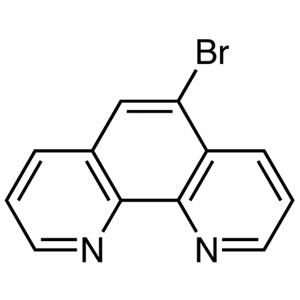
5-Bromo-1,10-phenanthroline TCI B5567
Regular price From Rp 1.643.250,00Regular priceRp 1.164.450,00Sale price From Rp 1.643.250,00 -
5-Amino-1,10-phenanthroline TCI A2977
Regular price Rp 3.790.500,00Regular priceRp 2.665.950,00Sale price Rp 3.790.500,00 -
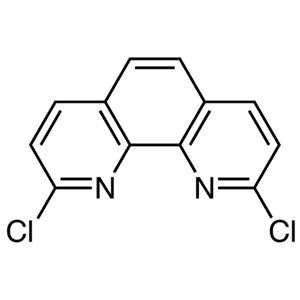
2,9-Dichloro-1,10-phenanthroline TCI D4186
Regular price From Rp 2.942.100,00Regular priceRp 2.072.700,00Sale price From Rp 2.942.100,00 -
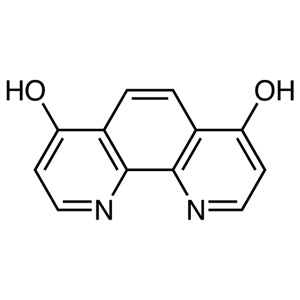
4,7-Dihydroxy-1,10-phenanthroline TCI D3869
Regular price Rp 3.763.200,00Regular priceRp 2.647.050,00Sale price Rp 3.763.200,00 -
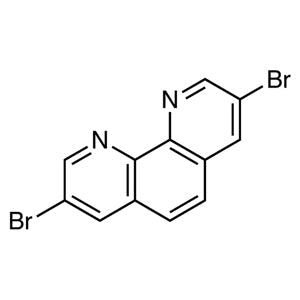
3,8-Dibromo-1,10-phenanthroline TCI D3209
Regular price From Rp 1.801.800,00Regular priceRp 1.275.750,00Sale price From Rp 1.801.800,00 -
2-Chloro-9-phenyl-1,10-phenanthroline TCI C4161
Regular price Rp 2.835.000,00Regular priceRp 1.998.150,00Sale price Rp 2.835.000,00