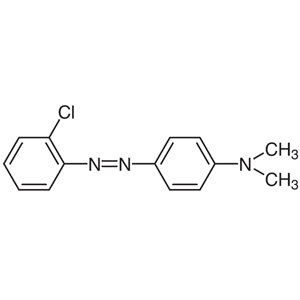
4'-Chloro-4-dimethylaminoazobenzene is an aromatic azo compound that places a dimethylamino group and a chlorine atom at the para positions on opposite ends of the azobenzene skeleton. This symmetrical arrangement produces a molecule with a straight, unobstructed electronic conjugation pathway, making it one of the most representative members of the 4-dimethylaminoazobenzene derivative family. In the laboratory, the compound serves as a comparison standard in dye research, a test substance in studies of azo compound metabolism, and a non-heterocyclic building block for the synthesis of coloured and photoresponsive molecules.
Its principal characteristics arise from a donor–acceptor architecture arranged neatly along the molecular axis. The dimethylamino group pushes electron density toward the azo bridge, while the chlorine atom at the para position of the opposite ring draws it back moderately, producing a strong charge-transfer transition and sharp absorption in the visible region. The sterically unhindered para positions allow the molecule to adopt a flatter geometry than its ortho isomers, so conjugation proceeds more efficiently and the resulting colour is more intense. The azo bond can also undergo photochemical isomerisation.
In Indonesian laboratories, this material is typically encountered in organic synthesis and dye chemistry groups at universities and research institutes, where it is used as a reference compound for spectroscopic comparison or as a starting material for preparing coloured and light-responsive structures. Analytical and toxicological laboratories studying the behaviour of azo compounds also use it as a model substance. It is supplied by TCI within the Chemistry > Building Blocks > Non-Heterocyclic Building Blocks portfolio.
Related TCI products
- Dye chemistry research: the compound acts as a reference material for comparison because its donor–acceptor arrangement produces a strong, well-defined charge-transfer absorption in the visible region.
- Azo compound metabolism studies: it functions as a representative test substance, allowing researchers to examine how the azo linkage behaves under laboratory investigation of azo compound transformation.
- Non-heterocyclic building block applications: the molecule provides a prepared aromatic azo framework for constructing larger coloured target molecules without requiring heterocyclic ring formation steps.
- Photoresponsive molecule synthesis: the azo bond undergoes photochemical isomerisation, making this material a suitable starting structure for building light-responsive molecular systems in the laboratory.
- Spectroscopic comparison work: the sharp visible-region absorption arising from efficient, sterically unhindered conjugation gives a dependable reference signal for instrument comparison and method development.
| Brand | TCI |
|---|---|
| CAS number | 2491-76-1 |
| Molecular formula | — |
| Purity | — |
| Category | Chemistry > Building Blocks > Non-Heterocyclic Building Blocks |
| Pack sizes | available in the pack sizes listed by TCI for this catalogue item |
| Physical form | — |
| Storage | store according to the conditions stated on the manufacturer's label and safety data sheet |
- Product code: C0159
Store the container tightly closed in a cool, dry, well-ventilated area, away from direct sunlight and strong light sources, since the azo bond is photochemically active and prolonged light exposure may cause isomerisation. Keep the material in its original tightly sealed container, or transfer it to an amber glass bottle with a chemically resistant closure if subdivision is required. Handle in a fume hood using gloves, safety glasses, and a laboratory coat, and avoid generating dust during weighing. Keep away from strong oxidising agents and incompatible materials. Always consult the manufacturer's safety data sheet before use, and dispose of residues and contaminated materials through the laboratory's chemical waste procedures.
—
Produk Terkait
-
2'-Chloro-4-dimethylaminoazobenzene TCI C0157
Regular price Rp 4.347.000,00Regular priceRp 3.039.750,00Sale price Rp 4.347.000,00 -
Azobenzene TCI A0565
Regular price Rp 2.411.850,00Regular priceRp 1.686.300,00Sale price Rp 2.411.850,00 -
4-Amino-4'-dimethylaminoazobenzene TCI A1672
Regular price Rp 1.829.100,00Regular priceRp 1.278.900,00Sale price Rp 1.829.100,00 -
4-AminoazobenzeneHydrochloride TCI A0771
Regular price Rp 1.405.950,00Regular priceRp 982.800,00Sale price Rp 1.405.950,00 -
Sodium4-Aminoazobenzene-4'-sulfonate TCI A0748
Regular price Rp 1.087.800,00Regular priceRp 760.200,00Sale price Rp 1.087.800,00 -
4-Aminoazobenzene TCI P0141
Regular price Rp 848.400,00Regular priceRp 593.250,00Sale price Rp 848.400,00 -
4'-Nitro-4-dimethylaminoazobenzene TCI N0192
Regular price Rp 2.306.850,00Regular priceRp 1.612.800,00Sale price Rp 2.306.850,00 -
3'-Nitro-4-dimethylaminoazobenzene TCI N0191
Regular price Rp 4.479.300,00Regular priceRp 3.132.150,00Sale price Rp 4.479.300,00