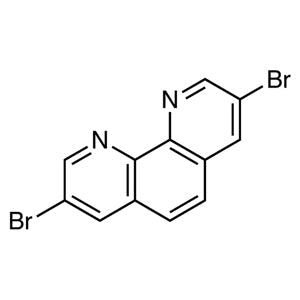
TCI C0786 5-Chloro-1,10-phenanthroline is a phenanthroline derivative in which one of the ring positions carries a chlorine substituent. The 1,10-phenanthroline framework itself is a classic bidentate ligand that binds metal ions through its two nitrogen atoms in a rigid arrangement almost perfectly suited to chelate formation. In the laboratory, ligands of this type are used to prepare transition metal complexes that play a role in catalysis, optical sensing, and analytical chemistry. The addition of a chlorine substituent introduces a new dimension: the ability to tune the electronic properties of the ligand while simultaneously providing a handle for further modification.
The principal characteristic that makes this compound a preferred choice is the influence of the electron-withdrawing chloro group on the electron density at the coordinating nitrogen atoms. This change affects the strength of the bond formed with the metal as well as the position of the absorption and emission bands of the resulting complexes, allowing researchers to direct the photophysical behaviour of their systems in a deliberate way. In addition, the chlorine atom on the aromatic ring can serve as a leaving group in substitution reactions or as a partner in metal-catalysed cross-coupling reactions, opening a route toward more elaborate ligand architectures built on the same phenanthroline core.
In Indonesian laboratories, a building block of this kind is typically used in university and institutional research groups working on coordination chemistry, homogeneous catalysis, and luminescent materials. It is normally purchased in small research quantities, weighed out on an analytical balance, and dissolved in an appropriate organic solvent before being combined with a metal salt. Because the material is handled at bench scale, it is generally stored centrally in a chemical store and drawn on by several projects over time.
TCI brochures (PDF)
- Ligands 2025-12-01 · p. 14
- Building Blocks for Organic Semiconductor 2026-03-24 · p. 23
Related TCI products
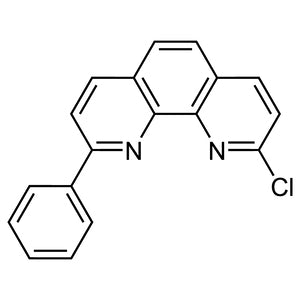
- TCI C4161 1937210-90-6 2-Chloro-9-phenyl-1,10-phenanthroline
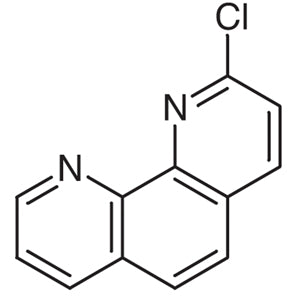
- TCI C1560 7089-68-1 2-Chloro-1,10-phenanthroline
- TCI A2977 54258-41-2 5-Amino-1,10-phenanthroline
- TCI B4456 22426-14-8 2-Bromo-1,10-phenanthroline
- TCI B2632 66127-01-3 3-Bromo-1,10-phenanthroline
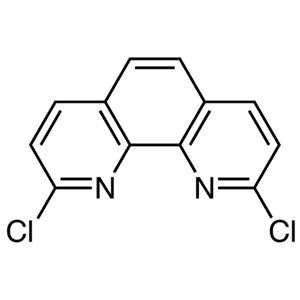
- TCI D4186 29176-55-4 2,9-Dichloro-1,10-phenanthroline
- Preparation of transition metal complexes, where the rigid bidentate nitrogen donor set forms stable chelates with a wide range of metal ions for structural and reactivity studies.
- Development of homogeneous catalysts, since the chloro substituent shifts electron density at the nitrogen donors and thereby modifies the electronic environment and activity of the coordinated metal centre.
- Synthesis of luminescent coordination compounds, because the electron-withdrawing group alters absorption and emission band positions, letting researchers tune the photophysical response of the system.
- Use as a synthetic intermediate in cross-coupling chemistry, where the aromatic chlorine acts as a coupling partner in metal-catalysed reactions to build more elaborate phenanthroline ligands.
- Ligand modification through nucleophilic substitution, in which the chlorine serves as a leaving group and provides a defined attachment point for introducing additional functional groups.
| Brand | TCI (Tokyo Chemical Industry) |
|---|---|
| CAS number | 4199-89-7 |
| Molecular formula | — |
| Purity | — |
| Category | Chemistry > Building Blocks > Heterocyclic Building Blocks |
| Pack sizes | available in standard research-scale pack sizes; please confirm the currently listed option when ordering |
| Physical form | — |
| Storage | keep in the tightly closed original container in a cool, dry, well-ventilated place |
- Chemical name: 5-Chloro-1,10-phenanthroline
- Catalogue number: C0786
Store the container tightly closed in a cool, dry, well-ventilated area away from direct sunlight, moisture, and incompatible materials such as strong oxidising agents. The original supplier container is the most suitable primary packaging; if the material must be transferred, use a clean, dry, chemically resistant vessel with a secure closure and label it clearly with the chemical name and CAS number. Weigh and transfer the solid in a fume hood or a well-ventilated weighing area to limit dust formation. Wear safety glasses, nitrile gloves, and a laboratory coat during handling, avoid inhalation of dust and contact with skin and eyes, and wash hands thoroughly after use. Clean up any spilled solid promptly and dispose of residues and contaminated materials in accordance with applicable chemical waste procedures. Always consult the manufacturer's safety data sheet before first use.
—
Product Categories
Produk Terkait
-
2-Chloro-9-phenyl-1,10-phenanthroline TCI C4161
Regular price Rp 2.835.000,00Regular priceRp 1.998.150,00Sale price Rp 2.835.000,00 -
2-Chloro-1,10-phenanthroline TCI C1560
Regular price From Rp 557.550,00Regular priceRp 405.300,00Sale price From Rp 557.550,00 -
5-Amino-1,10-phenanthroline TCI A2977
Regular price Rp 3.790.500,00Regular priceRp 2.665.950,00Sale price Rp 3.790.500,00 -
2-Bromo-1,10-phenanthroline TCI B4456
Regular price From Rp 3.365.250,00Regular priceRp 2.368.800,00Sale price From Rp 3.365.250,00 -
3-Bromo-1,10-phenanthroline TCI B2632
Regular price Rp 3.735.900,00Regular priceRp 2.628.150,00Sale price Rp 3.735.900,00 -
2,9-Dichloro-1,10-phenanthroline TCI D4186
Regular price From Rp 2.942.100,00Regular priceRp 2.072.700,00Sale price From Rp 2.942.100,00 -
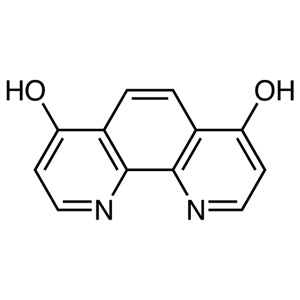
4,7-Dihydroxy-1,10-phenanthroline TCI D3869
Regular price Rp 3.763.200,00Regular priceRp 2.647.050,00Sale price Rp 3.763.200,00 -
3,8-Dibromo-1,10-phenanthroline TCI D3209
Regular price From Rp 1.801.800,00Regular priceRp 1.275.750,00Sale price From Rp 1.801.800,00