


5-(4-Carboxyphenyl)-10,15,20-triphenylporphyrin is a synthetic porphyrin compound that carries three phenyl groups and one 4-carboxyphenyl group at the meso positions of its macrocyclic ring. Porphyrins are a class of macrocyclic compounds that form the core of important natural molecules such as hemoglobin and chlorophyll, which is why their synthetic derivatives are widely used in the laboratory both as models of biological systems and as functional materials in their own right. In laboratory work, this compound serves as a photosensitizer, as a building-block ligand for metal-organic frameworks, and as a light-absorbing dye material in energy conversion research.
The characteristic that makes this compound a preferred choice is the extensive conjugated electron system of its macrocyclic ring, which produces very strong visible-light absorption in the Soret region together with several distinctive Q bands. This property makes it highly efficient at harvesting light and enables it to generate long-lived excited states capable of transferring energy to molecular oxygen. The presence of a single carboxylic acid group, rather than four, is a design advantage in itself: the molecule has one single attachment point for anchoring onto semiconductor surfaces, nanoparticles, or biomolecules, giving controlled and predictable orientation rather than multi-point binding.
In Indonesian laboratories, this porphyrin is typically used in university and institutional research groups working on solar energy conversion, photocatalysis, and coordination chemistry. It is commonly handled in small quantities for dye-sensitized solar cell fabrication, for the preparation of surface-anchored photoactive layers, and for the synthesis of metalloporphyrin complexes. Research teams in chemistry and materials science departments also apply it in photodynamic and singlet-oxygen studies, where its role as a nitrogen-donor ligand and light-harvesting unit is central to the experimental design.
TCI brochures (PDF)
- Ligands 2025-12-01 · p. 15
Related TCI products
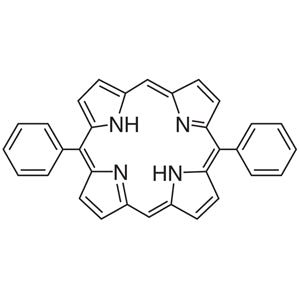
- TCI D2860 22112-89-6 5,15-Diphenylporphyrin
- TCI M1338 119730-06-2 5-(4-Methoxycarbonylphenyl)-10,15,20-triphenylporphyrin
- TCI A5015 14609-54-2 TCPP [=Tetrakis(4-carboxyphenyl)porphyrin] [Ultra-high sensitive spectrophotometric reagent for Cu, Cd] [For the simultaneous determination of metals by HPLC]
- TCI T1359 917-23-7 Tetraphenylporphyrin (Chlorin free)
- TCI O0234 2683-82-1 2,3,7,8,12,13,17,18-Octaethylporphyrin
- TCI P1364 210769-64-5 Pentamethylene Bis[4-(10,15,20-triphenylporphyrin-5-yl)benzoate]dizinc(II) [Reagent for application of the exciton chirality method]
- Dye-sensitized solar cell research: the single carboxylic acid group anchors the porphyrin firmly onto semiconductor oxide surfaces while its strong visible absorption drives efficient light harvesting and charge injection.
- Metal-organic framework construction: the compound functions as a nitrogen-donor ligand and carboxylate linker, allowing porphyrin units to be built into ordered photoactive frameworks with accessible metal coordination sites.
- Photosensitizer studies and singlet oxygen generation: its long-lived excited states transfer energy efficiently to molecular oxygen, making it a reliable reference sensitizer in photodynamic and photo-oxidation experiments.
- Metalloporphyrin synthesis for catalysis: the free macrocyclic core readily accepts metal insertion, giving researchers a convenient precursor for preparing catalytic complexes used in inorganic and coordination chemistry.
- Biomimetic model system research: as a synthetic analogue of the porphyrin cores found in hemoglobin and chlorophyll, it allows controlled laboratory study of natural light-harvesting and oxygen-binding behaviour.
| Brand | TCI (product code C1630) |
|---|---|
| CAS number | 95051-10-8 |
| Molecular formula | — |
| Purity | — |
| Category | Chemistry > Catalysis and Inorganic Chemistry > Nitrogen-Donor Ligands [Catalysis] |
| Pack sizes | available in standard research-scale TCI packaging; please confirm the required size when ordering |
| Physical form | — |
| Storage | keep in a cool, dark place in a tightly closed container |
- Chemical name: 5-(4-Carboxyphenyl)-10,15,20-triphenylporphyrin
Store the material in a cool, dark, and dry place, in a tightly closed container kept away from direct sunlight and strong light sources, since porphyrins are light-sensitive and prolonged exposure may degrade the chromophore. Amber glass vials or containers wrapped in foil are suitable for storage and for the preparation of stock solutions. Handle the compound inside a fume hood using gloves, safety glasses, and a laboratory coat, and avoid raising dust when weighing the solid. Keep the container tightly closed when not in use, label solutions clearly, and follow the supplier safety data sheet together with institutional waste disposal procedures for chemical residues.
—
Product Categories
Produk Terkait
-
5,15-Diphenylporphyrin TCI D2860
Regular price Rp 7.048.650,00Regular priceRp 4.944.450,00Sale price Rp 7.048.650,00 -
5-(4-Methoxycarbonylphenyl)-10,15,20-triphenylporphyrin TCI M1338
Regular price From Rp 3.260.250,00Regular priceRp 2.295.300,00Sale price From Rp 3.260.250,00 -
TCPP[=Tetrakis(4-carboxyphenyl)porphyrin][Ultra-highsensitivespectrophotometricreagentforCu,Cd][ForthesimultaneousdeterminationofmetalsbyHPLC] TCI A5015
Regular price From Rp 955.500,00Regular priceRp 683.550,00Sale price From Rp 955.500,00 -
Tetraphenylporphyrin(Chlorinfree) TCI T1359
Regular price Rp 5.114.550,00Regular priceRp 3.592.050,00Sale price Rp 5.114.550,00 -
2,3,7,8,12,13,17,18-Octaethylporphyrin TCI O0234
Regular price From Rp 4.108.650,00Regular priceRp 2.888.550,00Sale price From Rp 4.108.650,00 -
PentamethyleneBis[4-(10,15,20-triphenylporphyrin-5-yl)benzoate]dizinc(II)[Reagentforapplicationoftheexcitonchiralitymethod] TCI P1364
Regular price From Rp 2.702.700,00Regular priceRp 1.905.750,00Sale price From Rp 2.702.700,00 -
Tetrakis(4-carboxyphenyl)methane TCI T3896
Regular price Rp 6.863.850,00Regular priceRp 4.799.550,00Sale price Rp 6.863.850,00 -
1,2,4,5-Tetrakis(4-carboxyphenyl)benzene TCI T3894
Regular price From Rp 2.837.100,00Regular priceRp 1.983.450,00Sale price From Rp 2.837.100,00



![TCI A5015 14609-54-2 TCPP [=Tetrakis(4-carboxyphenyl)porphyrin] [Ultra-high sensitive spectrophotometric reagent for Cu, Cd] [For the simultaneous determination of metals by HPLC]](http://amiscientific.com/cdn/shop/files/TCI2510A5015_a6d96560-9a87-49e8-a74b-d696f3069055.jpg?v=1792658524&width=533)
![14609-54-2 TCPP [=Tetrakis(4-carboxyphenyl)porphyrin] [Ultra-high sensitive spectrophotometric reagent for Cu, Cd] [For the simultaneous determination of metals by HPLC] - AMI Scientific](http://amiscientific.com/cdn/shop/files/TCI2510A5015.jpg?v=1767084835&width=533)


![210769-64-5 Pentamethylene Bis[4-(10,15,20-triphenylporphyrin-5-yl)benzoate]dizinc(II) [Reagent for application of the exciton chirality method] - AMI Scientific](http://amiscientific.com/cdn/shop/files/TCI2510P1364.jpg?v=1769143302&width=533)


