

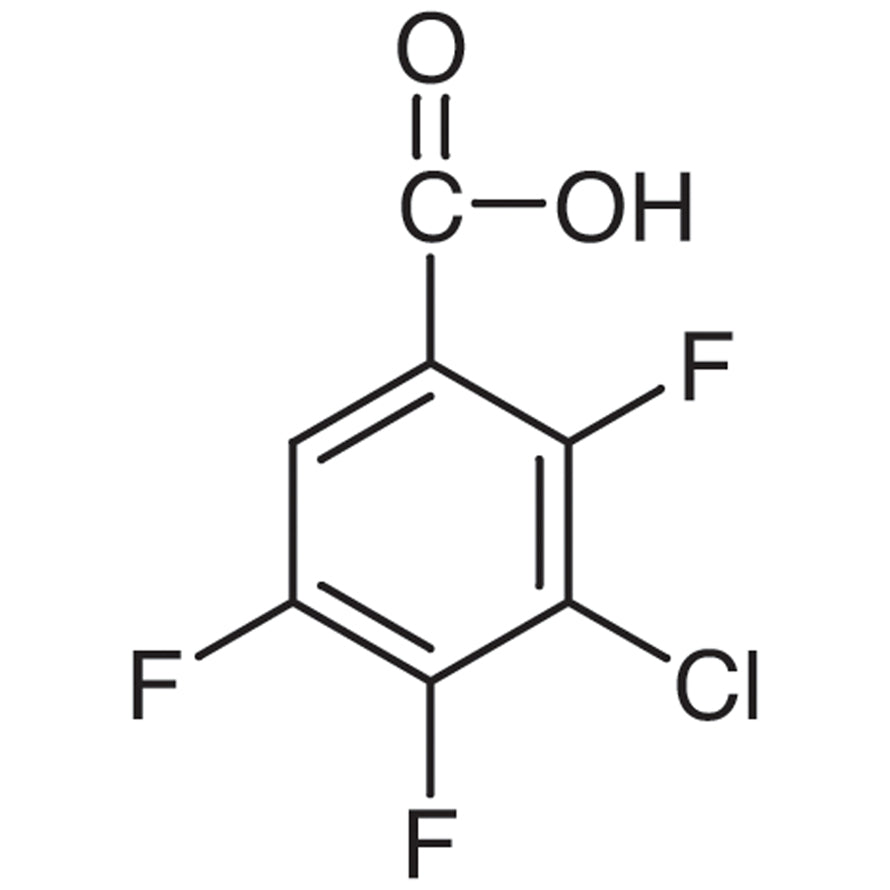
3-Chloro-2,4,5-trifluorobenzoic acid is a chemical compound derived from benzoic acid that carries three fluorine atoms and one chlorine atom on its aromatic ring. In the laboratory, this compound acts as a building block in organic synthesis — a starting material that is converted through various chemical reactions into more complex molecules. Because of the presence of its carboxyl group and its distinctive halogen substitution pattern, the compound is highly valued for designing intermediates in pharmaceutical, agrochemical, and materials chemistry research. Researchers use it to build the molecular frameworks of drug candidates, pesticide active ingredients, and other functional compounds that require a specific electronic character. Supplied by TCI in a practical 5-gram package, it is well suited to laboratory-scale experiments, whether for reaction trials, optimisation of synthesis conditions, or production of target compounds in small quantities.
The main advantage of this compound lies in the presence of fluorine and chlorine atoms, which are electron-withdrawing. This combination of halogens modifies the electron distribution across the aromatic ring, giving the molecule the reactivity profile that many synthetic transformations demand. The result is a versatile intermediate whose electronic behaviour can be exploited to direct further substitutions and couplings. Its well-defined structure and consistent quality make it dependable for reproducible work, which is essential when a reaction must be repeated or scaled from one batch to another. For chemists who need predictable behaviour under standard conditions, this compound offers a reliable platform for building carbon frameworks, attaching functional groups, or producing halogenated aromatic systems that are difficult to obtain through other routes.
In Indonesian laboratories, this compound is typically encountered in academic research groups, pharmaceutical R&D facilities, and agrochemical development teams that carry out small-scale organic synthesis. It is commonly used as an intermediate in route-scouting experiments, where researchers test several reaction pathways before selecting the most efficient one. It also appears in teaching laboratories and graduate research projects focused on fluorinated chemistry, where its availability in 5-gram quantities keeps procurement simple and cost-effective for bench-scale work. Local researchers integrate it into their standard workflows for preparing halogenated aromatic compounds and for studying how electron-withdrawing substituents influence reaction outcomes.
- Building block for pharmaceutical intermediates: the carboxyl group and halogen pattern let researchers assemble the core skeletons of drug candidates and explore structure–activity relationships during early lead optimisation.
- Synthesis of agrochemical active ingredients: its electron-withdrawing substituents are useful for constructing pesticide molecules whose biological activity depends on the electronic properties of the aromatic ring.
- Materials chemistry research: the compound serves as a precursor for functional molecules and monomers whose electronic characteristics are tuned for use in specialty materials and advanced formulations.
- Reaction screening and condition optimisation: its moderate scale and stable behaviour make it a convenient substrate for testing catalysts, solvents, temperatures, and coupling strategies before committing to larger batches.
- Graduate research and academic coursework: university laboratories use it as a model fluorinated building block in practical projects that train students in modern synthetic techniques and purification methods.
| Brand | TCI |
|---|---|
| CAS number | 101513-77-3 |
| Molecular formula | — |
| Purity | — |
| Category | Chemistry > Building Blocks > Fluorinated Building Blocks |
| Pack sizes | 5 grams |
| Physical form | not stated in the product data; confirm the appearance from the label upon receipt |
| Storage | keep in the original, tightly sealed container in a cool, dry place |
Store the compound in its original, tightly closed container in a cool, dry, and well-ventilated area, away from direct sunlight, moisture, and sources of heat. Keep the container sealed whenever it is not in use to avoid contamination or uptake of humidity. Use containers made of materials compatible with carboxylic acids, such as glass or suitable laboratory plastics, and avoid transferring the substance into unlabelled vessels. When handling, wear appropriate personal protective equipment including a laboratory coat, chemical-resistant gloves, and safety goggles, and work inside a fume hood to minimise exposure to dust or vapour. Avoid inhalation, skin contact, and eye contact, and wash hands thoroughly after handling. Keep the substance away from strong oxidising agents, bases, and incompatible reagents, and follow your institution's chemical safety procedures and local waste-disposal regulations.
—
Produk Terkait
-
2,4,6-TrifluorobenzoicAcid TCI T2409
Regular price Rp 1.590.750,00Regular price -
2,3,5-TrifluorobenzoicAcid TCI T2385
Regular price From Rp 2.704.800,00Regular price -
2,3,4-TrifluorobenzoicAcid TCI T1867
Regular price From Rp 557.550,00Regular price -
3,4,5-TrifluorobenzoicAcid TCI T1640
Regular price From Rp 928.200,00Regular price -
2,4,5-TrifluorobenzoicAcid TCI T1586
Regular price From Rp 1.644.300,00Regular price -
2,3,6-TrifluorobenzoicAcid TCI T1456
Regular price From Rp 1.431.150,00Regular price -
1-Chloro-4-(trifluoromethoxy)benzene TCI T2149
Regular price Rp 848.400,00Regular price -
5-Bromo-2-chloro-4-fluoroanisole TCI B5354
Regular price From Rp 664.650,00Regular price


