

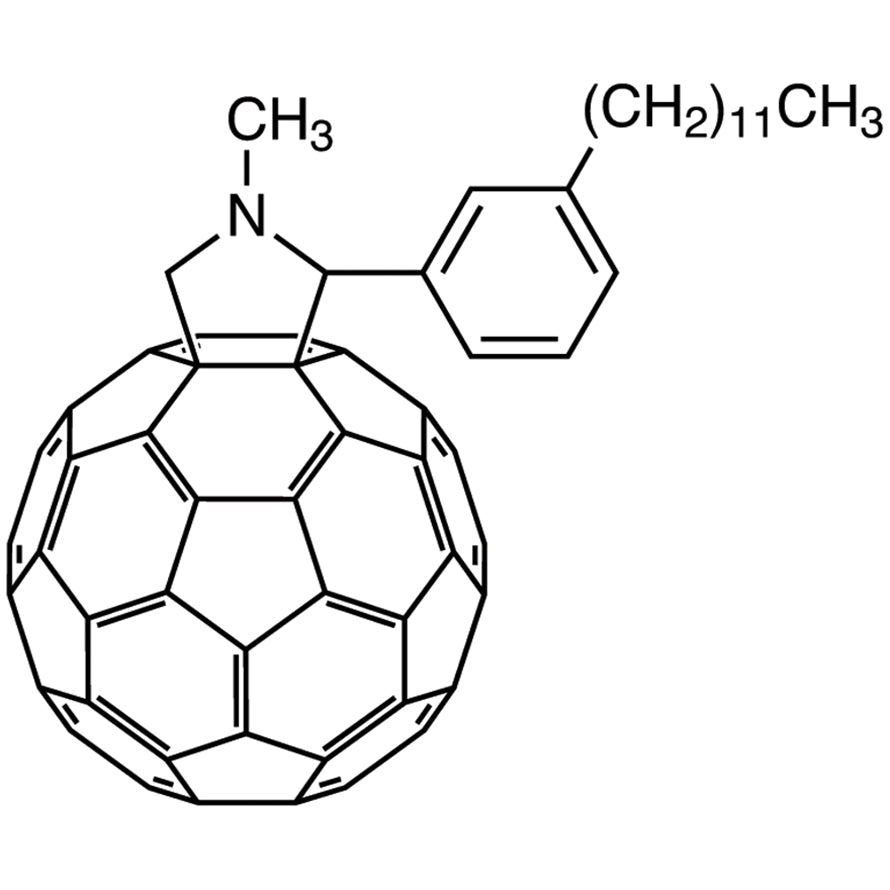
TCI C2415, catalogued under CAS number 403483-19-2 and designated C60MC12, is a functional material built on the C60 fullerene framework and intended for research into organic electronic materials, particularly organic solar cells. Fullerenes are spherical carbon molecules widely recognised for their excellent ability to accept and transport electrons. In derivative forms such as this product, the carbon cage is modified with organic groups so that the molecule dissolves in the common organic solvents used for solution coating processes. The material can therefore be processed into thin films without the expensive and complicated high-temperature vacuum evaporation step.
The reason materials of this type are selected for optoelectronic device research lies in their role as the n-type component, or electron acceptor. Within the active layer of an organic solar cell, the acceptor material is paired with an electron-donating polymer or small molecule to form a bulk heterojunction structure. This pairing separates the excitons generated after light absorption into free charges. The organic groups attached to the fullerene framework govern solubility, the tendency to form particular morphologies, and the stability of the blend, which is why comparative studies between different derivatives remain a central part of this research field.
In Indonesian laboratories, this material is typically used in university and institutional research groups working on organic photovoltaics and organic electronics. It supports thin-film deposition work carried out by spin coating or other solution-based methods, and it serves as a reference acceptor when new donor materials or blend formulations are being evaluated. Researchers also rely on it in device fabrication studies where the acceptor component must be varied systematically to understand its effect on film morphology and charge separation.
- Organic solar cell active layer fabrication: serves as the n-type acceptor component paired with a donor polymer or small molecule to form the bulk heterojunction where excitons separate into free charges.
- Solution-processed thin film deposition: its solubility in common organic solvents allows films to be coated from solution, removing the need for costly high-temperature vacuum evaporation equipment.
- Comparative studies of fullerene derivatives: the specific organic groups on the carbon cage let researchers examine how side-group structure influences solubility, blend stability and device behaviour against other derivatives.
- Blend morphology investigation: because the attached organic groups affect the tendency to form particular morphologies, the material supports systematic study of how active layer microstructure develops in donor-acceptor mixtures.
- Organic electronic material research more broadly: the strong electron accepting and transporting character of the fullerene framework makes it useful wherever an n-type organic semiconductor is required in a research device.
| Brand | TCI |
|---|---|
| CAS number | 403483-19-2 |
| Molecular formula | — |
| Purity | — |
| Category | Materials Science > Electronic Materials > Organic Solar Cell (OPV) Materials |
| Pack sizes | available in the pack sizes listed by the manufacturer for this catalogue item |
| Physical form | — |
| Storage | store according to the conditions stated on the manufacturer label and safety data sheet |
- Product designation: C2415, C60MC12
Store the material in its original tightly closed container, kept in a cool, dry and well ventilated place away from direct sunlight and sources of heat or ignition. Fullerene derivatives used for electronic materials research are generally handled as light-sensitive fine solids, so amber or otherwise light-protected containers are appropriate, and containers should be reclosed promptly after each use to limit exposure to air and moisture. Handle the powder inside a fume hood and avoid generating dust. Wear standard laboratory personal protective equipment, including a lab coat, safety glasses and chemically resistant gloves. Always consult the manufacturer's safety data sheet before use, and follow local institutional procedures for waste disposal.
—