

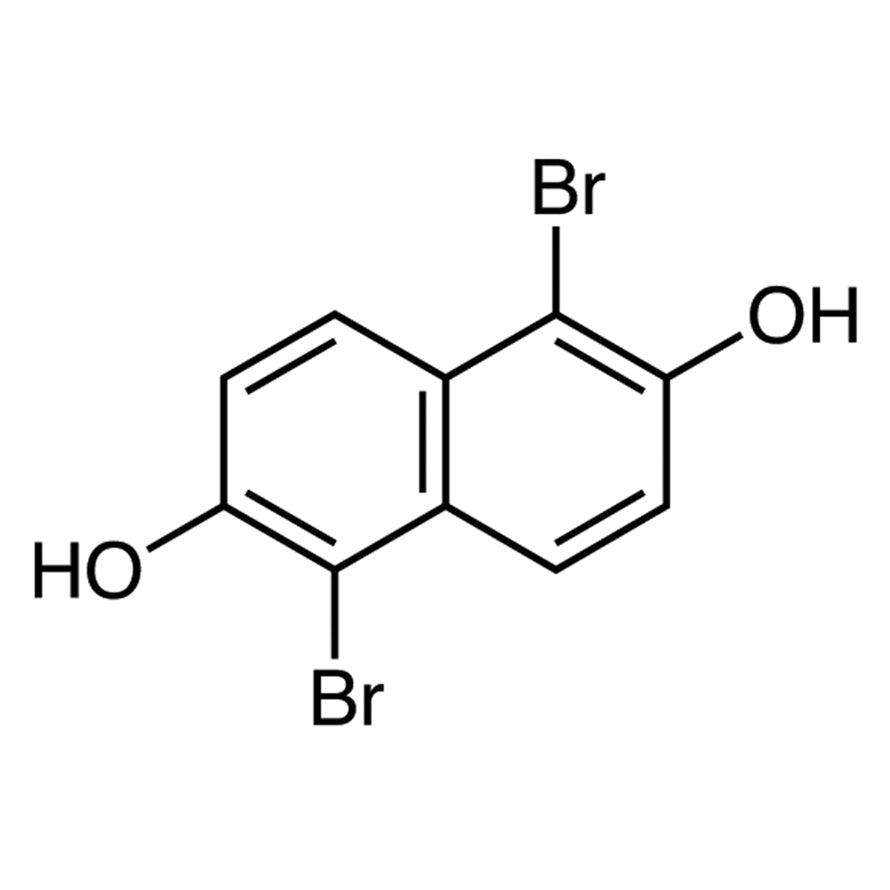
TCI D4668 1,5-Dibromo-2,6-dihydroxynaphthalene is an aromatic intermediate built on a naphthalene core that carries two hydroxy groups at positions 2 and 6 together with two bromine atoms at positions 1 and 5. The compound is classified as a small molecule semiconductor building block, meaning it serves as a construction unit for the preparation of organic semiconductor materials. In materials research laboratories, a reagent of this kind acts as the starting framework for assembling larger conjugated molecules, ranging from fused heterocycles through to liquid crystal cores and polymer monomers.
The added value of this material lies in its symmetrically ordered substitution pattern and in the presence of two complementary types of functional group. The aromatic hydroxy groups can be etherified, esterified, or converted to triflates, while the adjacent hydroxy–bromo pairing is particularly useful for forming fused furan rings through intramolecular cyclization. The bromine atoms, for their part, are dependable leaving groups for palladium-catalyzed cross-coupling reactions such as Suzuki, Stille, and Sonogashira couplings, as well as for metal-catalyzed polymerization. The naphthalene core itself contributes rigidity and a conjugated electron system that supports molecular packing.
In Indonesian laboratories, a building block of this type is typically used in university and institutional materials chemistry groups working on organic electronics and functional molecule synthesis. It is generally handled at bench scale in synthesis laboratories, where small quantities are consumed per reaction and the product is carried forward through further coupling or cyclization steps. Researchers ordinarily order this class of intermediate for defined project work, storing the remaining material for subsequent synthetic campaigns rather than for routine bulk use.
- Suzuki cross-coupling synthesis — the two bromine positions act as reliable leaving groups for palladium catalysis, allowing aryl fragments to be attached symmetrically onto the naphthalene core.
- Stille and Sonogashira coupling — the same dibromo substitution supports organostannane and alkyne coupling partners, giving researchers direct routes toward extended conjugated frameworks from a single intermediate.
- Fused furan ring construction — the neighbouring hydroxy and bromo groups are well positioned for intramolecular cyclization, making this material a convenient precursor to fused heterocyclic systems.
- Polymer monomer preparation — the symmetric dibromo pattern makes the compound suitable for metal-catalyzed polymerization, where two reactive sites allow controlled chain growth along a rigid aromatic backbone.
- Liquid crystal core synthesis — the rigid naphthalene core with its conjugated electron system supports the ordered molecular packing sought in liquid crystalline and organic semiconductor target structures.
| Brand | TCI (Tokyo Chemical Industry) |
|---|---|
| CAS number | 132178-78-0 |
| Molecular formula | — |
| Purity | — |
| Category | Materials Science > Material Building Blocks > Small Molecule Semiconductor Building Blocks |
| Pack sizes | available in research-scale packs according to the manufacturer's current catalogue listing |
| Physical form | — |
| Storage | keep in the tightly closed original container as indicated on the manufacturer's label |
- Catalogue number: D4668
- Chemical name: 1,5-Dibromo-2,6-dihydroxynaphthalene
Store the material in its tightly closed original container, kept in a cool, dry, and well-ventilated place away from direct sunlight, heat sources, and incompatible reagents. Because phenolic aromatic compounds can be sensitive to prolonged air and light exposure, containers should be resealed promptly after each use and, where possible, handled under an inert atmosphere for demanding syntheses. Weigh and transfer the solid inside a fume hood using clean, dry glassware or dedicated spatulas to avoid cross-contamination. Wear safety glasses, gloves, and a laboratory coat during handling, avoid generating dust, and refer to the manufacturer's safety data sheet for full hazard information and waste disposal requirements before beginning any work.
—
Produk Terkait
-
2-Bromoresorcinol TCI B5737
Regular price From Rp 928.200,00Regular price -
4-Bromo-3-chlorophenol TCI B5816
Regular price From Rp 1.565.550,00Regular price -
4,4'-[2-(4-Bromophenyl)-2-phenylethene-1,1-diyl]diphenol TCI B6579
Regular price Rp 7.712.250,00Regular price -
4-Chloro-m-cresol TCI C0150
Regular price From Rp 610.050,00Regular price -
4-Chloro-o-cresol TCI C0152
Regular price From Rp 1.035.300,00Regular price -
4-Chloro-3,5-dimethylphenol TCI C0161
Regular price From Rp 637.350,00Regular price -
Chlorohydroquinone TCI C0185
Regular price From Rp 1.167.600,00Regular price -
2-Chlorophenol TCI C0241
Regular price From Rp 477.750,00Regular price


![4,4'-[2-(4-Bromophenyl)-2-phenylethene-1,1-diyl]diphenol (CAS 936803-69-9) - TCI B6579 - AMI Scientific](http://amiscientific.com/cdn/shop/files/TCI2510B6579.jpg?v=1768204513&width=533)


