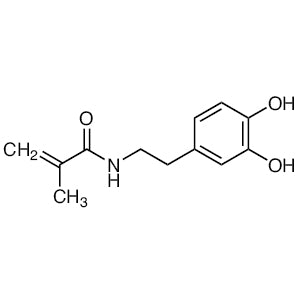
TCI D5907, CAS number 471915-89-6, is N-(3,4-Dihydroxyphenethyl)methacrylamide, an acrylic monomer that carries the dopamine-derived catechol group on its side chain. The material serves as a non-heterocyclic building block that bridges polymer chemistry and surface chemistry: the methacrylamide group provides a point for radical polymerization, while the catechol ring gives the molecule a strong ability to interact with metals, metal oxides, and biological tissue. In the laboratory, this monomer is a key raw material for researchers designing mussel-inspired adhesive polymers as well as functional hydrogels with high adhesion to wet substrates.
The characteristic that makes this material a frequent choice is the duality of function contained in a single small molecule. The catechol group is electron-rich and readily forms hydrogen bonds, coordination complexes with metal ions, and covalent bonds after oxidation to the corresponding quinone, making it highly effective as a surface anchor. The methacrylamide group, on the other hand, is compatible with both conventional and controlled radical polymerization techniques such as RAFT and ATRP, allowing researchers to tune copolymer composition and architecture rather than being limited to a single synthetic route.
In Indonesian laboratories, this building block is typically used in university and institutional research groups working on polymer synthesis, biomaterials, coatings, and surface modification. It usually appears in bench-scale synthetic work where a small quantity of a specialty monomer is copolymerized with more common comonomers to introduce adhesive or metal-binding functionality. Because it is supplied as a catalogue research chemical from TCI, it fits well into project-based work where reproducible identity and consistent supply matter more than large volumes.
Advantages (TCI brochure)
- Obtained polymers show excellent adhesion in water
- Obtained polymers show low toxicity
TCI brochures (PDF)
- Catechol-Containing Monomers for the Development of Biomimetic Materials 2026-09-08 · p. 1
- Biomaterials Research Reagents 2025-02-19 · p. 11
- Monomers 2025-05-28 · p. 11
Related TCI products
- TCI D6062 201610-44-8 N-(3,4-Dihydroxyphenethyl)acrylamide
- TCI H1164 19243-95-9 N-(4-Hydroxyphenyl)methacrylamide
- TCI A0139 79-06-1 Acrylamide Monomer
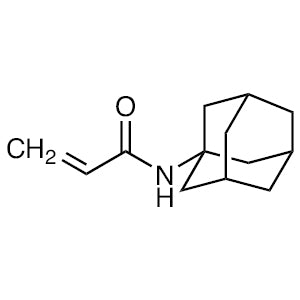
- TCI A3438 19026-83-6 N-(1-Adamantyl)acrylamide
- TCI A0145 96-33-3 Methyl Acrylate (stabilized with MEHQ)
- TCI A0144 103-11-7 2-Ethylhexyl Acrylate Monomer (stabilized with MEHQ)
- Mussel-inspired adhesive polymer synthesis — the catechol side chain mimics the DOPA residues of mussel foot proteins, giving copolymers genuine bonding strength on wet and mineral surfaces.
- Functional hydrogel formulation — incorporating this monomer lets researchers build networks that adhere to moist substrates and tissue instead of merely swelling in contact with them.
- Surface modification and primer chemistry — the catechol anchors strongly to metals and metal oxides, so polymers containing it can graft durably onto substrates that resist conventional coatings.
- Controlled radical copolymerization studies — the methacrylamide group works with RAFT and ATRP, letting researchers control chain length, composition, and block architecture in designed catechol polymers.
- Metal-ion coordination and crosslinking research — the electron-rich catechol forms coordination complexes with metal ions, enabling reversible, metal-mediated crosslinking and self-healing network studies.
From the TCI brochure
- Synthesis of repeatedly re-bondable adhesive for underwater use
| Brand | TCI |
|---|---|
| CAS number | 471915-89-6 |
| Molecular formula | — |
| Purity | — |
| Category | Chemistry > Building Blocks > Non-Heterocyclic Building Blocks |
| Pack sizes | available in TCI research-scale catalogue pack sizes; please confirm the current option when ordering |
| Physical form | — |
| Storage | store in a closed original container, protected from light and air, under the conditions stated on the manufacturer's label |
- Chemical name: N-(3,4-Dihydroxyphenethyl)methacrylamide
Keep the container tightly closed and store it in a cool, dark, well-ventilated place, following the storage conditions printed on the manufacturer's label. Catechol-bearing monomers are sensitive to air and light, and methacrylamide functionality can polymerize under heat or radical initiation, so avoid unnecessary exposure and prolonged warming. Use the original supplier container or a compatible, well-sealed amber glass vessel with a chemically resistant closure, and label all working aliquots clearly. Handle the material in a fume hood using safety glasses, gloves, and a laboratory coat. Consult the manufacturer's Safety Data Sheet before use, and dispose of residues and contaminated materials as chemical waste according to your institution's procedures.
—
Product Categories
Produk Terkait
-
N-(3,4-Dihydroxyphenethyl)acrylamide TCI D6062
Regular price From Rp 2.623.950,00Regular priceRp 1.850.100,00Sale price From Rp 2.623.950,00 -
N-(4-Hydroxyphenyl)methacrylamide TCI H1164
Regular price Rp 2.809.800,00Regular priceRp 1.980.300,00Sale price Rp 2.809.800,00 -
AcrylamideMonomer TCI A0139
Regular price From Rp 505.050,00Regular priceRp 352.800,00Sale price From Rp 505.050,00 -
N-(1-Adamantyl)acrylamide TCI A3438
Regular price Rp 3.683.400,00Regular priceRp 2.591.400,00Sale price Rp 3.683.400,00 -
MethylAcrylate(stabilizedwithMEHQ) TCI A0145
Regular price From Rp 477.750,00Regular priceRp 333.900,00Sale price From Rp 477.750,00 -
2-EthylhexylAcrylateMonomer(stabilizedwithMEHQ) TCI A0144
Regular price From Rp 505.050,00Regular priceRp 352.800,00Sale price From Rp 505.050,00 -
ButylAcrylate(stabilizedwithMEHQ) TCI A0142
Regular price From Rp 505.050,00Regular priceRp 352.800,00Sale price From Rp 505.050,00 -
3-SulfopropylAcrylatePotassiumSalt TCI U0117
Regular price Rp 1.565.550,00Regular priceRp 1.094.100,00Sale price Rp 1.565.550,00