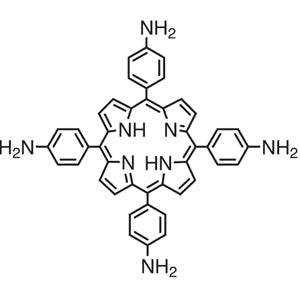
TCI D6148 Protoporphyrin IX Dimethyl Ester is a derivative of a naturally occurring porphyrin in which both propionic acid groups have been converted into methyl esters. Porphyrins are macrocycles built from four interconnected pyrrole rings that enclose a central cavity lined with four nitrogen atoms — the same framework found in the heme core of hemoglobin. In the laboratory, this compound serves as a nitrogen-donor ligand and as a model molecule for studying the behaviour of metal-containing biological systems, particularly reactions involving the binding and activation of small molecules at metal centres.
The key property behind its widespread selection is the ester form itself. Unlike free protoporphyrin IX, which dissolves poorly in organic solvents and tends to aggregate, the dimethyl ester form dissolves far more readily in common organic solvents, making it considerably more practical for synthetic reactions, chromatographic purification, and spectroscopic measurement. The macrocyclic cavity binds a wide range of transition metal ions strongly to form metalloporphyrin complexes. Its extensively conjugated system also produces strong, characteristic light absorption together with photophysical properties that can be exploited experimentally.
In Indonesian laboratories, this material is typically encountered in university research groups, institutional chemistry laboratories, and research and development units working on coordination chemistry, bioinorganic model systems, and photochemistry. It is normally handled in small quantities on the bench, dissolved in organic solvent for reaction work or for the preparation of spectroscopic samples, and is generally used as a starting material for metal complex synthesis rather than as a routine analytical reagent.
TCI brochures (PDF)
- Ligands 2025-12-01 · p. 15
Related TCI products
- TCI T2222 16834-13-2 5,10,15,20-Tetra(4-pyridyl)porphyrin
- TCI T1832 74684-34-7 5,10,15,20-Tetrakis(3,5-dimethoxyphenyl)porphyrin
- TCI T1497 51094-17-8 5,10,15,20-Tetrakis(4-hydroxyphenyl)porphyrin
- TCI T1495 127812-08-2 5,10,15,20-Tetrakis(4-carboxymethyloxyphenyl)porphyrin
- TCI T1494 22112-84-1 5,10,15,20-Tetrakis(4-aminophenyl)porphyrin
- TCI T1438 37083-37-7 5,10,15,20-Tetrakis(2,6-dichlorophenyl)porphyrin
- Nitrogen-donor ligand in coordination chemistry, where the four nitrogen atoms of the macrocyclic cavity bind transition metal ions strongly to form well-defined metalloporphyrin complexes.
- Model compound for bioinorganic studies, since the porphyrin framework matches the heme core of hemoglobin and allows metal-centred biological behaviour to be examined in a simplified system.
- Investigation of small-molecule binding and activation at metal centres, which is one of the principal reaction types this ligand framework was selected to reproduce in laboratory settings.
- Synthetic starting material for metalloporphyrin preparation, because the ester form dissolves readily in common organic solvents and is convenient to carry through reaction and chromatographic purification steps.
- Spectroscopic and photochemical work, as the extensively conjugated system gives strong, characteristic light absorption together with photophysical properties that can be measured and exploited experimentally.
| Brand | TCI |
|---|---|
| CAS number | 5522-66-7 |
| Molecular formula | — |
| Purity | — |
| Category | Chemistry > Catalysis and Inorganic Chemistry > Nitrogen-Donor Ligands [Catalysis] |
| Pack sizes | available in the pack sizes offered by TCI for this catalogue item |
| Physical form | — |
| Storage | keep in the closed original container under the conditions stated on the manufacturer's label |
- Product code: D6148
Store the material in its original tightly closed container, kept in a cool, dry, and well-ventilated place away from direct sunlight and strong light sources, since the extensively conjugated porphyrin system absorbs light strongly. Amber glass or otherwise light-protected containers are appropriate for solutions prepared in organic solvent, and these should be freshly prepared where possible. Handle the solid in a fume hood or a well-ventilated area to avoid generating or inhaling dust, and wear a laboratory coat, safety glasses, and chemically resistant gloves. Keep containers clearly labelled, avoid contact with skin and eyes, and follow the manufacturer's safety data sheet together with local institutional waste-disposal procedures.
—
Product Categories
Produk Terkait
-
5,10,15,20-Tetra(4-pyridyl)porphyrin TCI T2222
Regular price From Rp 4.266.150,00Regular priceRp 2.998.800,00Sale price From Rp 4.266.150,00 -
5,10,15,20-Tetrakis(3,5-dimethoxyphenyl)porphyrin TCI T1832
Regular price Rp 1.776.600,00Regular priceRp 1.257.900,00Sale price Rp 1.776.600,00 -
5,10,15,20-Tetrakis(4-hydroxyphenyl)porphyrin TCI T1497
Regular price Rp 1.881.600,00Regular priceRp 1.331.400,00Sale price Rp 1.881.600,00 -
5,10,15,20-Tetrakis(4-carboxymethyloxyphenyl)porphyrin TCI T1495
Regular price Rp 3.815.700,00Regular priceRp 2.683.800,00Sale price Rp 3.815.700,00 -
5,10,15,20-Tetrakis(4-aminophenyl)porphyrin TCI T1494
Regular price Rp 6.227.550,00Regular priceRp 4.370.100,00Sale price Rp 6.227.550,00 -
5,10,15,20-Tetrakis(2,6-dichlorophenyl)porphyrin TCI T1438
Regular price Rp 7.712.250,00Regular priceRp 5.408.550,00Sale price Rp 7.712.250,00 -
5,10,15,20-Tetrakis(4-methoxyphenyl)porphyrin TCI T1360
Regular price From Rp 1.033.200,00Regular priceRp 738.150,00Sale price From Rp 1.033.200,00 -
Tetraphenylporphyrin(Chlorinfree) TCI T1359
Regular price Rp 5.114.550,00Regular priceRp 3.592.050,00Sale price Rp 5.114.550,00