

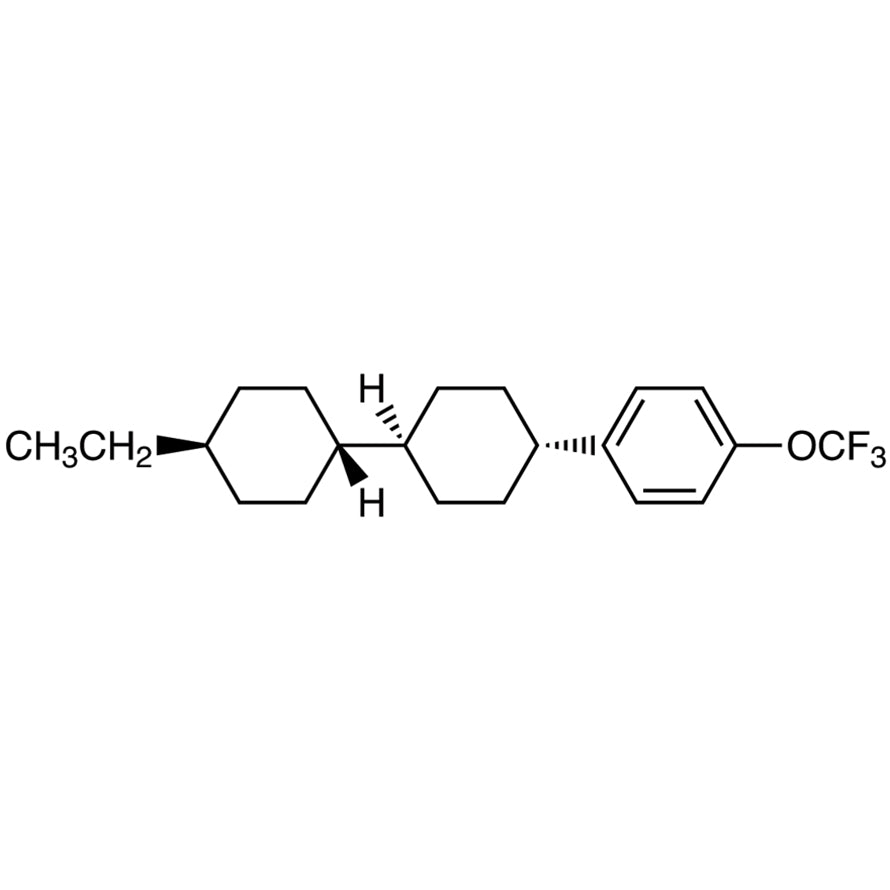
TCI E1165, with the CAS number 135734-59-7, is a specialized chemical compound classified under liquid crystal (LC) materials in the field of materials science. This compound is a trans,trans-4'-ethyl-4-(4-trifluoromethoxyphenyl)bicyclohexyl, featuring a complex molecular structure composed of two cyclohexyl rings connected by an ethyl chain and a trifluoromethoxy group on an aromatic ring. In laboratory settings, it plays a crucial role in the study of optical and electronic properties of liquid crystals, contributing to advancements in material science and technology.
The compound's chemical stability and strong molecular interactions make it a preferred choice for researchers working with liquid crystal materials. Its unique molecular architecture allows it to respond effectively to electric fields and temperature changes, which is essential for applications in electro-optic devices. Additionally, its optical properties, such as the ability to alter molecular orientation under stimuli, make it highly valuable in the development of advanced electronic components and display technologies.
In Indonesian laboratories, TCI E1165 is widely used in material science and information technology research. It is particularly relevant for studies involving liquid crystal displays, optical sensors, and other electronic devices. Its versatility and reliability make it an essential tool for researchers aiming to explore new applications in the field of electronic materials.
- Liquid Crystal Display (LCD) Research – TCI E1165 is ideal for studying the optical and electronic behavior of liquid crystals, which is critical for developing next-generation display technologies.
- Optical Sensor Development – The compound's response to electric fields and temperature makes it suitable for creating sensitive optical sensors used in various industrial and scientific applications.
- Electronic Material Characterization – Its stable chemical properties allow for accurate and consistent testing of electronic materials under different environmental conditions.
- Electro-Optic Device Fabrication – The compound's ability to change molecular orientation under stimuli is essential for the production of electro-optic devices such as modulators and switches.
- Material Science Research – TCI E1665 is frequently used in academic and industrial research to investigate the fundamental properties of liquid crystal materials for new technological innovations.
| Brand | TCI |
|---|---|
| CAS number | 135734-59-7 |
| Molecular formula | — |
| Purity | — |
| Category | Materials Science > Electronic Materials > Liquid Crystal (LC) Materials |
| Pack sizes | — |
| Physical form | — |
| Storage | Store in a cool, dry place away from direct sunlight |
TCI E1165 should be stored in a cool, dry environment to maintain its chemical stability and prevent degradation. It is recommended to keep the compound in airtight containers to minimize exposure to moisture and air. While the physical form and pack sizes are not specified, standard laboratory practice suggests using appropriate glass or plastic containers that are resistant to chemical reactions. Due to its complex molecular structure, it is important to handle the compound with care, ensuring proper ventilation in the laboratory to avoid any potential inhalation risks. General laboratory precautions should be followed, including the use of personal protective equipment when handling or transferring the material.
—
Produk Terkait
-
5-Bromo-1,2,3-tris(dodecyloxy)benzene TCI B5602
Regular price From Rp 2.215.500,00Regular price -
9,9-Bis(4-methoxyphenyl)-9H-fluorene TCI B5617
Regular price From Rp 2.539.950,00Regular price -
1,3-Bis(methoxymethoxy)benzene TCI B5643
Regular price From Rp 916.650,00Regular price -
3-Bromo-4-iodoanisole TCI B5697
Regular price From Rp 2.480.100,00Regular price -
1,4-Bis(4-phenoxyphenoxy)benzene TCI B6098
Regular price Rp 1.830.150,00Regular price -
1-Bromo-2-methoxynaphthalene TCI B6103
Regular price From Rp 1.388.100,00Regular price -
1-Bromo-4-methoxynaphthalene TCI B6147
Regular price From Rp 2.274.300,00Regular price -
[[(7-Bromoheptyl)oxy]methyl]benzene TCI B6162
Regular price Rp 4.044.600,00Regular price


![[[(7-Bromoheptyl)oxy]methyl]benzene (CAS 94427-22-2) - TCI B6162 - AMI Scientific](http://amiscientific.com/cdn/shop/files/TCI2510B6162.jpg?v=1768815997&width=533)