Pembayaran hanya melalui request quotation dan dilakukan setelah tim kami menghubungi Anda. Mohon cantumkan nomor WhatsApp aktif untuk konfirmasi pesanan & pembuatan invoice. Estimasi pengiriman 4-5 minggu setelah pembayaran.
Description
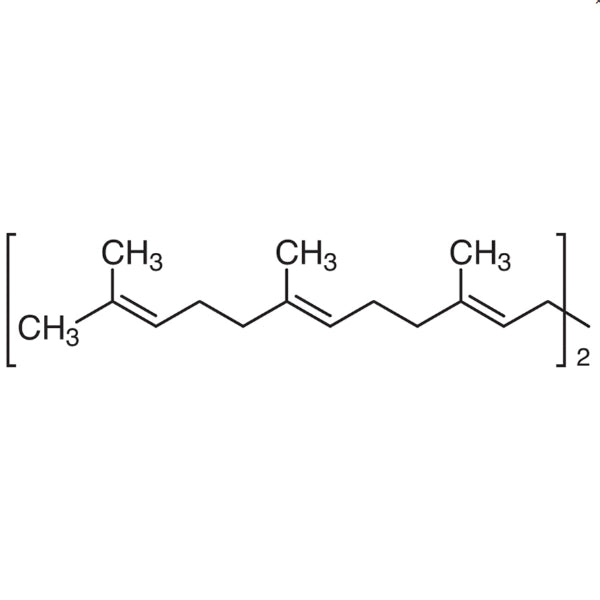
TCI H0097 Squalene is an unsaturated hydrocarbon triterpene built from thirty carbon atoms and six double bonds, supplied as a colourless oily liquid. The compound holds an important position in biochemistry because it is a natural precursor in the sterol biosynthesis pathway, occupying the intermediate stage before the molecule is converted into lanosterol and ultimately into cholesterol. On the basis of that biological role, squalene is classified among biochemicals and reagents in the terpene group, and it serves as a common reference material in laboratory work on lipids, metabolism, and food science.
The property that governs how squalene is used is the presence of six double bonds, which make it reactive and at the same time sensitive to oxidation by air, light, and heat. This degree of unsaturation makes it an attractive substrate for studies of lipid oxidation, cyclisation reactions, and antioxidant research, while simultaneously demanding more careful storage than its saturated counterpart would require. Squalene is strongly lipophilic, insoluble in water, and miscible with non-polar organic solvents, a combination that determines how it is dissolved, handled, and formulated at the bench.
Its interfacial behaviour and its capacity to form emulsions have made squalene a widely studied material in research on delivery systems. In Indonesian laboratories these characteristics place it within lipid chemistry, biochemistry, and food science programmes, where analysts working in university research groups, quality control units, and formulation laboratories use it as a reference substance for oxidation studies, metabolic pathway work, and emulsion-based experimental systems.
Laboratory Applications
- Sterol biosynthesis pathway research: squalene is the natural intermediate preceding lanosterol and cholesterol, making it the authentic substrate for tracing each enzymatic step in the sequence.
- Lipid oxidation studies: the six double bonds oxidise readily under air, light, and heat, giving researchers a realistic and responsive model substrate for degradation experiments.
- Antioxidant evaluation: because squalene is inherently susceptible to oxidation, it provides a sensitive test system for measuring how effectively candidate antioxidant compounds suppress lipid degradation.
- Cyclisation reaction work: the polyunsaturated triterpene skeleton is the classical starting structure for studies of ring-forming chemistry in terpene and sterol systems.
- Emulsion and delivery system research: its strong lipophilicity and interfacial behaviour make squalene a well-studied oil phase for formulating and characterising emulsion-based experimental systems.
Specifications
- Brand: TCI (Tokyo Chemical Industry)
- CAS number: 111-02-4
- Category: Life Science > Biochemicals and Reagents > Terpenes
- Physical form: colourless oily liquid; unsaturated hydrocarbon triterpene with thirty carbon atoms and six double bonds
- Solubility: insoluble in water, miscible with non-polar organic solvents
- Pack sizes: available in the standard laboratory pack sizes supplied by TCI; please confirm the required pack size when ordering
- Storage: protect from air, light, and heat because of its oxidation sensitivity
Handling and Storage
Squalene should be stored in a cool, dark place and kept protected from air, light, and heat, since all three accelerate oxidation of its six double bonds. Tightly closed containers are essential, and amber glass or otherwise light-protected vessels are preferred; headspace should be minimised and the container resealed promptly after each withdrawal. Handle the material in a well-ventilated area or fume hood using gloves, safety glasses, and a laboratory coat, and avoid contamination with metal residues or oxidising agents. Because the liquid is oily and lipophilic, wipe spills with absorbent material and clean glassware with a suitable non-polar organic solvent. Consult the manufacturer's safety data sheet before use.