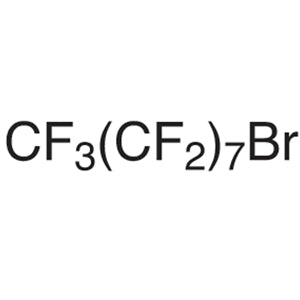
TCI H0946 Heptadecafluoro-n-octyl Bromide is an eight-carbon perfluorocarbon compound in which every hydrogen atom has been replaced by fluorine, with a single bromine atom occupying the terminal position of the chain. Widely known under the name perflubron, this compound holds a distinctive position in the laboratory because it combines the extreme inertness characteristic of perfluorocarbons with one carbon–bromine bond that remains available for reaction. On the researcher's bench it serves both as a fluorinated building block for introducing perfluoroalkyl chains into target molecules and as a perfluorocarbon medium in emulsion studies, gas transport research, and fluorous chemistry.
The characteristics that make this material a preferred choice are highly distinctive. The perfluoroalkyl chain confers high chemical and thermal stability, together with properties that are simultaneously hydrophobic and lipophobic, low surface tension, and a density far greater than that of ordinary organic solvents, so that the material forms a separate phase that is easily isolated. Perfluorocarbons are also well known for their capacity to dissolve gases such as oxygen in high quantities, a property that underpins a great deal of biomedical research. On the reactivity side, the carbon–bromine bond at the end of the chain is far weaker than the surrounding carbon–fluorine bonds, which makes it the natural point of attack for synthetic transformations while the remainder of the molecule stays untouched.
In Indonesian laboratories this compound is typically encountered in university research groups and institutional laboratories working on fluorine chemistry, materials science, and biomedical formulation. It is generally ordered in research quantities for synthetic work where a perfluoroalkyl segment must be installed into a larger molecular framework, and for experimental work in which a dense, chemically inert, gas-dissolving liquid phase is required. Its role in fluorous separation techniques also makes it relevant to method development work in academic and applied analytical settings.
Advantages (TCI brochure)
- Forms a homogeneous solution with benzene or toluene when heated
- Fluorous phase containing the palladium catalyst can be reused after separation
TCI brochures (PDF)
- Fluorous Chemistry 2025-01-21 · p. 2
- Building Blocks for Organic Semiconductor 2026-03-24 · p. 45
- Fluorination Reagents, Fluorinated Building Blocks 2026-03-18 · p. 53
Related TCI products
- Fluorinated building block synthesis — the reactive terminal carbon–bromine bond allows the perfluorooctyl chain to be attached to target molecules without disturbing the stable carbon–fluorine framework.
- Fluorous chemistry and phase separation — the high density and combined hydrophobic and lipophobic character create a distinct fluorous phase that separates cleanly from aqueous and organic layers.
- Emulsion research — as a perfluorocarbon medium it is used in the preparation and study of emulsion systems where an inert, immiscible dense liquid phase is required.
- Gas transport studies — the well documented capacity of perfluorocarbons to dissolve gases such as oxygen at high levels makes this compound a standard medium for such investigations.
- Biomedical research formulation — under its common name perflubron it supports experimental work that draws on both its chemical inertness and its gas-dissolving behaviour in biological systems.
From the TCI brochure
- Oxidation of sulfides with O2 and isobutyraldehyde
- Epoxidation of olefins with O2 and isobutyraldehyde
- Wacker oxidation with palladium catalyst complexed with fluorous β-diketone
| Brand | TCI |
|---|---|
| CAS number | 423-55-2 |
| Molecular formula | — |
| Purity | — |
| Category | Chemistry > Building Blocks > Fluorinated Building Blocks |
| Pack sizes | available in standard research pack sizes; please confirm the currently listed options when ordering |
| Physical form | liquid perfluorocarbon of high density |
| Storage | store in a tightly closed container in a cool, well-ventilated area |
Data from the TCI brochure
| Yield | 91% (1 (3 mol%), O2 (1 atm), iPrCHO (1.6 equiv.), H0946/toluene, 60°C, 10-16 h (sulfida)) |
|---|---|
| Yield | 85% (2 (5 mol%), O2 (1 atm), iPrCHO (1.5-2 equiv.), H0946/toluene, 50°C, 12 h (olefin)) |
| Yield (run 1-4) | 78%, 77%, 75%, 77% (4 (5 mol%), tBuOOH (1.5-3.5 equiv.), H0946/benzene, 56°C) |
| Yield (run 5-8) | 70%, 73%, 72%, 72% (4 (5 mol%), tBuOOH (1.5-3.5 equiv.), H0946/benzene, 56°C) |
Source: TCI brochure R5064 (2025-01-21)
Store the container tightly closed in a cool, dry, and well-ventilated place, away from direct sunlight and sources of heat or ignition. Containers should be chemically compatible and kept sealed, since the low surface tension of perfluorocarbons allows them to creep and evaporate readily from poorly closed vessels. Handle the material in a fume hood using standard personal protective equipment, including safety glasses, chemical-resistant gloves, and a laboratory coat. Avoid inhalation of vapours and contact with skin and eyes, and always consult the manufacturer's safety data sheet before use.
—
Product Categories
Produk Terkait
-
Octadecafluorooctane TCI O0268
Regular price Rp 1.326.150,00Regular priceRp 927.150,00Sale price Rp 1.326.150,00 -
Tetradecafluoro-2-methylpentane TCI T1012
Regular price Rp 2.704.800,00Regular priceRp 1.891.050,00Sale price Rp 2.704.800,00 -
Hexadecafluoroheptane(mixtureofisomers) TCI P0851
Regular price Rp 955.500,00Regular priceRp 667.800,00Sale price Rp 955.500,00 -
Tetradecafluorohexane TCI P0839
Regular price From Rp 3.367.350,00Regular priceRp 2.354.100,00Sale price From Rp 3.367.350,00 -
1H,1H-Undecafluoro-1-hexanol TCI U0074
Regular price Rp 3.207.750,00Regular priceRp 2.242.800,00Sale price Rp 3.207.750,00 -
TridecafluorohexylBromide TCI T2479
Regular price From Rp 1.458.450,00Regular priceRp 1.019.550,00Sale price From Rp 1.458.450,00 -
TridecafluorohexylIodide TCI T1098
Regular price From Rp 795.900,00Regular priceRp 556.500,00Sale price From Rp 795.900,00 -
EthylHeptadecafluorononanoate TCI H1038
Regular price Rp 1.618.050,00Regular priceRp 1.146.600,00Sale price Rp 1.618.050,00