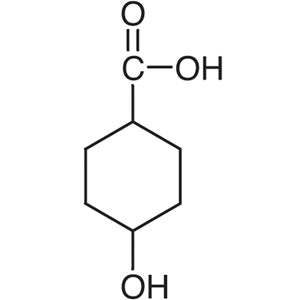
4-Hydroxycyclohexanecarboxylic Acid is a bifunctional alicyclic compound built around a cyclohexane ring that carries a carboxylic acid group on one side and a hydroxyl group at the opposite position, namely position 4. This product is supplied as a mixture of cis and trans isomers. In the laboratory it occupies an important place as a non-heterocyclic building block, particularly when chemists need a rigid saturated chair-shaped framework that still carries two chemically distinct handles for further elaboration into complex target molecules.
The main appeal of this compound lies in the character of its saturated cyclohexane skeleton. Unlike a flat aromatic ring, the cyclohexane ring is three-dimensional and provides a better defined spatial distance and orientation between the carboxyl and hydroxyl groups. In drug molecule design, this three-dimensional character is frequently associated with improved solubility and a better metabolic profile compared with the corresponding aromatic analogues. The presence of two different types of functional group also enables orthogonal reactions: the carboxyl group can be amidated or esterified, while the hydroxyl group can be oxidised, protected, or otherwise transformed independently.
In Indonesian laboratories, this building block is typically used in synthetic organic chemistry groups at universities and research institutes, as well as in pharmaceutical and fine chemical research and development work. It is usually taken up at the bench scale, where a small quantity supports a sequence of exploratory reactions, route scouting, and the preparation of intermediates for further study. Supplied as a cis and trans mixture, it suits work where the isomer composition is addressed at a later stage of the synthetic route.
- Non-heterocyclic building block synthesis: the saturated cyclohexane core supplies a rigid carbon framework that chemists elaborate stepwise into more complex target molecules.
- Medicinal chemistry scaffold work: its three-dimensional ring character is associated with improved solubility and metabolic profiles compared with the flat aromatic analogues often used in early programmes.
- Amide and ester library preparation: the carboxylic acid group can be amidated or esterified, allowing researchers to generate a series of related analogues from one common starting material.
- Selective hydroxyl transformations: the hydroxyl group at position 4 can be oxidised, protected, or otherwise converted independently of the carboxyl group, supporting orthogonal reaction sequences.
- Spatially defined linker construction: the fixed distance and orientation between the two functional groups on the chair-shaped ring helps researchers control the geometry of the molecules they assemble.
| Brand | TCI |
|---|---|
| CAS number | 17419-81-7 |
| Molecular formula | — |
| Purity | — |
| Category | Chemistry > Building Blocks > Non-Heterocyclic Building Blocks |
| Pack sizes | available in the standard research-scale pack sizes offered for this catalogue item |
| Physical form | — |
| Storage | store according to the conditions stated on the manufacturer's label and Safety Data Sheet |
- Product code: H0960
- Isomer composition: supplied as a mixture of cis and trans isomers
Store the container tightly closed in a cool, dry, well-ventilated area, away from direct sunlight, moisture, and incompatible materials, following the conditions stated on the manufacturer's label and Safety Data Sheet. Keep the material in its original supplier container, or in a clean, clearly labelled glass container with a secure closure if it must be transferred. Handle the compound in a fume hood using standard personal protective equipment, including safety goggles, a laboratory coat, and chemical-resistant gloves. Avoid generating dust, and avoid contact with skin and eyes. Use clean, dry spatulas when weighing to prevent moisture ingress and cross-contamination, close the container immediately after use, and consult the Safety Data Sheet before first handling and before disposal of any residue.
—
Produk Terkait
-
TCI B5774 5,10-Bis(4,4,5,5-tetramethyl-1,3,2-dioxaborolan-2-yl)naphtho[1,2-c:5,6-c']bis([1,2,5]oxadiazole)
Regular price Rp 10.255.350,00Regular price -
Dihydroiodide TCI B6569
Regular price From Rp 1.936.200,00Regular price -
Trifluoromethanesulfonate TCI B7003
Regular price From Rp 1.936.200,00Regular price
![5,10-Bis(4,4,5,5-tetramethyl-1,3,2-dioxaborolan-2-yl)naphtho[1,2-c:5,6-c']bis([1,2,5]oxadiazole) - TCI B5774 - AMI Scientific](http://amiscientific.com/cdn/shop/files/TCI2510B5774.jpg?v=1769180228&width=533)