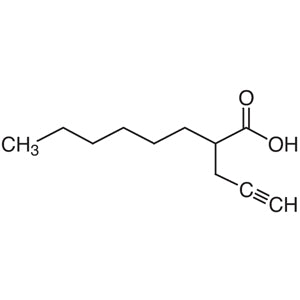
2-Hexyl-4-pentynoic Acid is a branched aliphatic carboxylic acid that carries a hexyl chain at the alpha position and a terminal alkyne group at position 4. Structurally, the compound is a long-chain analogue of valproic acid that has been equipped with an alkyne handle. In the laboratory it plays a dual role: as a non-heterocyclic building block for organic synthesis, and as a probe molecule that can be tethered to biological systems, because its terminal alkyne group opens the door to highly selective bioorthogonal ligation reactions.
The property that makes this compound attractive is the presence of two functional groups with genuinely different behaviour within one simple molecule. The carboxylic acid group is polar, readily activated to an amide or an ester, and serves as the attachment point to a carrier molecule. The terminal alkyne, meanwhile, is almost unreactive towards biological functional groups in general, yet reacts rapidly and specifically with azides through the copper-catalysed cycloaddition commonly known as click chemistry. The long hexyl chain contributes lipophilic character, allowing the molecule to insert into membrane environments or hydrophobic protein pockets.
In Indonesian laboratories, a reagent of this kind is typically used in university and institutional research settings where synthetic organic chemistry and chemical biology work is carried out. It is generally handled in small quantities on the bench scale, weighed out for multi-step preparations or for the assembly of probe conjugates, and stored alongside other fine chemicals in a controlled reagent store. As a TCI catalogue item, it is ordered as a research-grade building block rather than as a bulk production input.
- Non-heterocyclic building block synthesis — the carboxylic acid is readily activated to amides or esters, giving synthetic chemists a straightforward attachment point for elaborating larger target molecules.
- Bioorthogonal probe preparation — the terminal alkyne reacts rapidly and specifically with azides under copper-catalysed click chemistry, allowing selective labelling without interference from common biological functional groups.
- Valproic acid analogue studies — as a long-chain structural analogue of valproic acid bearing an added alkyne handle, it supports comparative work on this family of branched aliphatic acids.
- Membrane and hydrophobic pocket investigations — the long hexyl chain contributes lipophilic character, so the molecule can insert into membrane environments or hydrophobic protein binding pockets during study.
- Conjugate assembly for chemical biology — the two functional groups behave differently within one simple molecule, letting researchers tether the acid end to a carrier while reserving the alkyne for later ligation.
| Brand | TCI |
|---|---|
| CAS number | 96017-59-3 |
| Molecular formula | — |
| Purity | — |
| Category | Chemistry > Building Blocks > Non-Heterocyclic Building Blocks |
| Pack sizes | available in the standard TCI research pack sizes; please confirm the packaging options at the time of ordering |
| Physical form | — |
| Storage | keep in the original tightly closed container, protected from light and moisture, in accordance with the manufacturer's stated conditions |
- Catalogue code: H0964
Store the compound in its original tightly closed container in a cool, dry, well-ventilated reagent store, protected from light, moisture, and sources of ignition, and follow the storage conditions stated by the manufacturer on the product label. Glass containers with chemically resistant closures are suitable for transfer and short-term working portions. As a carboxylic acid, the material should be kept away from strong bases and strong oxidising agents. Handle it inside a fume hood, wearing safety glasses, a laboratory coat, and chemically resistant gloves; avoid inhalation of vapours and contact with skin and eyes. Keep containers clearly labelled, and consult the manufacturer's safety data sheet before use and before disposal of any residues.
—
Produk Terkait
-
TCI B5774 5,10-Bis(4,4,5,5-tetramethyl-1,3,2-dioxaborolan-2-yl)naphtho[1,2-c:5,6-c']bis([1,2,5]oxadiazole)
Regular price Rp 10.255.350,00Regular price -
Dihydroiodide TCI B6569
Regular price From Rp 1.936.200,00Regular price -
Trifluoromethanesulfonate TCI B7003
Regular price From Rp 1.936.200,00Regular price
![5,10-Bis(4,4,5,5-tetramethyl-1,3,2-dioxaborolan-2-yl)naphtho[1,2-c:5,6-c']bis([1,2,5]oxadiazole) - TCI B5774 - AMI Scientific](http://amiscientific.com/cdn/shop/files/TCI2510B5774.jpg?v=1769180228&width=533)