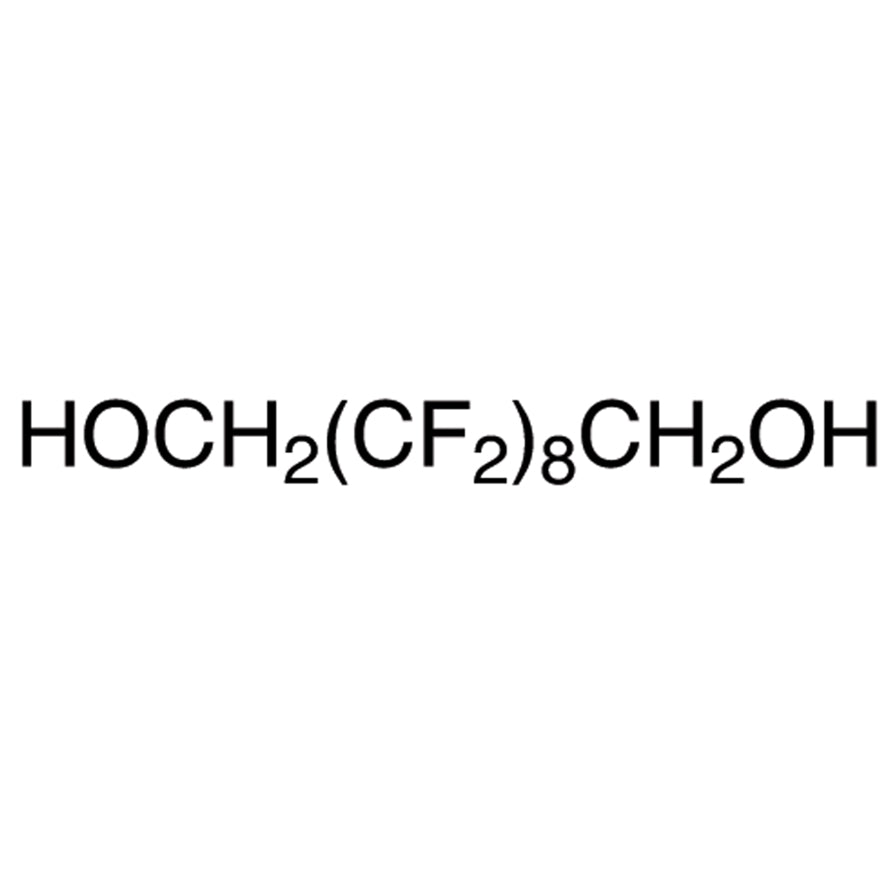
1H,1H,10H,10H-Hexadecafluoro-1,10-decanediol is a ten-carbon diol whose central segment is fully fluorinated, while both ends carry reactive methylene hydroxyl groups. This architecture makes it a high-value building block in fluorine chemistry: the perfluoroalkyl chain contributes the characteristic properties of low surface energy, high thermal and chemical stability, and fluorophilic character, while the two terminal hydroxyl groups provide attachment points for esterification, etherification, urethane formation, and step-growth polymerization. In the laboratory it serves as the starting material from which fluorinated segments are introduced into larger target structures.
The property that makes it a preferred choice is its ability to insert a long fluorinated segment into a target structure through the well-established chemistry of alcohols. Because the hydroxyl groups sit on non-fluorinated carbons, their reactivity is far more manageable than that of alcohols directly adjacent to fluorine. Its bifunctional nature makes it suitable as a diol monomer in the formation of fluorinated polyesters and polyurethanes, where the perfluoroalkyl segment lowers the surface tension of the material and improves its water- and oil-repellent behaviour. Its distinctive solubility in fluorinated solvents is a further point of interest.
In Indonesian laboratories this compound is typically handled in synthetic and materials chemistry groups working on fluorine chemistry, at universities, research institutes, and industrial R&D units developing coatings and specialty polymers. It is normally used on a research scale, weighed out in a fume hood and carried forward into esterification, etherification, or polymerization steps. Because it functions as a building block rather than a finished product, it is generally purchased in small research quantities and stored alongside other moisture-sensitive organic intermediates.
TCI brochures (PDF)
- Fluorinated Monomers 2025-10-03 · p. 2
- Fluorous Chemistry 2025-01-21 · p. 5
- Monomers 2025-05-28 · p. 25
- Fluorination Reagents, Fluorinated Building Blocks 2026-03-18 · p. 53
Related TCI products
- TCI H0892 307-78-8 Hexadecafluorosebacic Acid
- TCI T2296 425-61-6 2,2,3,3-Tetrafluoro-1,4-butanediol
- TCI H1279 918-21-8 Hexafluoro-2,3-bis(trifluoromethyl)-2,3-butanediol
- TCI H0746 376-90-9 2,2,3,3,4,4-Hexafluoro-1,5-pentanediol
- TCI D5223 120903-40-4 2,2,3,3,4,4,5,5,6,6-Decafluoro-6-[(1,2,2-trifluorovinyl)oxy]hexanenitrile
- TCI D2891 90177-96-1 2,2,3,3,4,4,5,5,6,6,7,7-Dodecafluoro-1,8-octanediol
- Fluorinated polyester synthesis: as a diol monomer it condenses with diacids or diesters through conventional step-growth chemistry, placing a perfluoroalkyl segment directly into the polymer backbone.
- Fluorinated polyurethane preparation: the two terminal hydroxyl groups react with isocyanates in urethane formation, giving materials whose fluorinated segments lower surface tension and improve repellency.
- Low surface energy coating research: the perfluoroalkyl chain imparts water- and oil-repellent character, so the diol is used to build coating resins where surface behaviour is the target property.
- Esterification and etherification building block: the hydroxyl groups sit on non-fluorinated carbons, so familiar alcohol chemistry can be applied with far more manageable reactivity than fluorine-adjacent alcohols.
- Fluorous chemistry and fluorinated solvent systems: its distinctive solubility in fluorinated solvents and fluorophilic character make it useful where fluorous phase behaviour is being studied or exploited.
| Brand | TCI |
|---|---|
| CAS number | 754-96-1 |
| Molecular formula | — |
| Purity | — |
| Category | Chemistry > Building Blocks > Fluorinated Building Blocks |
| Pack sizes | available in research-scale packaging; please confirm the currently offered pack sizes when ordering |
| Physical form | — |
| Storage | store in a tightly closed container, protected from moisture, in a cool and well-ventilated place |
- Catalogue code: H1233
Store the container tightly closed in a cool, dry, and well-ventilated area, away from direct sunlight and from sources of heat or ignition. Keep it in its original container or in a clean, chemically compatible, tightly sealed vessel, and protect the contents from moisture and humid air, which is particularly relevant in Indonesian laboratory conditions. Handle the solid in a fume hood using gloves, safety glasses, and a laboratory coat, avoiding the formation and inhalation of dust. Keep it separate from strong oxidizing agents and from isocyanates or other reagents that react readily with hydroxyl groups. Always consult the manufacturer's safety data sheet before use, and dispose of residues and contaminated materials in accordance with the applicable chemical waste procedures.
—
Produk Terkait
-
HexadecafluorosebacicAcid TCI H0892
Regular price From Rp 1.908.900,00Regular priceRp 1.350.300,00Sale price From Rp 1.908.900,00 -
2,2,3,3-Tetrafluoro-1,4-butanediol TCI T2296
Regular price From Rp 795.900,00Regular priceRp 556.500,00Sale price From Rp 795.900,00 -
Hexafluoro-2,3-bis(trifluoromethyl)-2,3-butanediol TCI H1279
Regular price From Rp 2.625.000,00Regular priceRp 1.835.400,00Sale price From Rp 2.625.000,00 -
2,2,3,3,4,4-Hexafluoro-1,5-pentanediol TCI H0746
Regular price Rp 903.000,00Regular priceRp 631.050,00Sale price Rp 903.000,00 -
2,2,3,3,4,4,5,5,6,6-Decafluoro-6-[(1,2,2-trifluorovinyl)oxy]hexanenitrile TCI D5223
Regular price From Rp 3.975.300,00Regular priceRp 2.795.100,00Sale price From Rp 3.975.300,00 -
2,2,3,3,4,4,5,5,6,6,7,7-Dodecafluoro-1,8-octanediol TCI D2891
Regular price Rp 3.100.650,00Regular priceRp 2.168.250,00Sale price Rp 3.100.650,00 -
Hexadecafluoroheptane(mixtureofisomers) TCI P0851
Regular price Rp 955.500,00Regular priceRp 667.800,00Sale price Rp 955.500,00 -
1,8-Dibromohexadecafluorooctane TCI D3587
Regular price From Rp 1.008.000,00Regular priceRp 704.550,00Sale price From Rp 1.008.000,00


![2,2,3,3,4,4,5,5,6,6-Decafluoro-6-[(1,2,2-trifluorovinyl)oxy]hexanenitrile (CAS 120903-40-4) - TCI D5223 - AMI Scientific](http://amiscientific.com/cdn/shop/files/TCI2510D5223.jpg?v=1768818332&width=533)