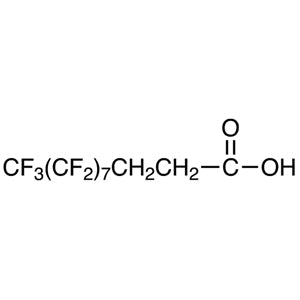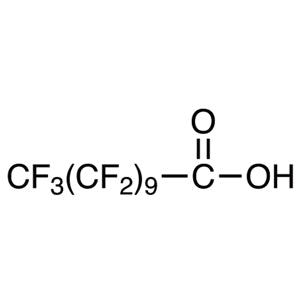
Heneicosafluoroundecanoic Acid is an eleven-carbon carboxylic acid in which every hydrogen position along the alkyl chain has been replaced by fluorine. This long perfluoroalkyl architecture gives the molecule a combination of properties not found in ordinary fatty acids: markedly stronger acidity arising from the electron-withdrawing effect of fluorine, very high thermal and chemical stability, and a distinctive affinity for fluorinated phases. In the laboratory it is used primarily in fluorous chemistry, serving both as a fluorous tag and as a starting material for the preparation of other fluorinated derivatives.
The characteristic that underlies its selection is the fluorine version of the "like dissolves like" principle. The long perfluoroalkyl chain causes the molecule to prefer fluorinated solvents over both conventional organic phases and water, and it is precisely this difference in affinity that is exploited for triphasic separations or fluorous solid-phase extraction. The terminal carboxyl group provides a convenient point of attachment that is readily activated into an ester, an amide, or an acid chloride, allowing the fluorous tag to be appended to other substrates. Its high acidity also makes the compound useful as a component of fluorinated surfactants.
In Indonesian laboratories this material is typically found in academic and institutional research groups working on synthetic methodology, separation science, and fluorine chemistry, as well as in industrial R&D units developing fluorinated specialty materials. It is generally purchased in small research quantities rather than bulk volumes, since fluorous tagging and extraction work consumes limited amounts per experiment. Supplied by TCI, it sits within the specialty synthesis segment of the reagent inventory rather than among routine bench chemicals.
TCI brochures (PDF)
- Fluorous Chemistry 2025-01-21 · p. 7
- Polymer Additives 2026-04-16 · p. 12
- Fluorination Reagents, Fluorinated Building Blocks 2026-03-18 · p. 53
Related TCI products
- Fluorous tagging of synthetic intermediates, where the carboxyl group is activated to an ester or amide so the perfluoroalkyl chain can be attached covalently to a substrate for later phase-based recovery.
- Fluorous solid-phase extraction, where the strong affinity of the long perfluoroalkyl chain for fluorinated stationary phases allows tagged species to be retained and separated from untagged reaction components.
- Triphasic liquid-liquid separation work, in which the compound's preference for fluorinated solvents over both organic and aqueous phases provides the partitioning behaviour that drives the separation.
- Preparation of other fluorinated derivatives, using the terminal carboxyl group as a readily activated synthetic handle for conversion into acid chlorides, esters, or amides bearing the same perfluoroalkyl chain.
- Formulation and study of fluorinated surfactants, where the combination of high acidity from the electron-withdrawing fluorines and a long fluorous tail supplies the required surface-active character.
| Brand | TCI |
|---|---|
| CAS number | 2058-94-8 |
| Molecular formula | — |
| Purity | — |
| Category | Chemistry > Specialty Synthesis > Fluorous Synthesis |
| Pack sizes | research-scale packaging as listed by the manufacturer; please confirm the available size when ordering |
| Physical form | — |
| Storage | keep in a tightly closed container in a cool, dry, well-ventilated place |
- Product code: H1234
Store the container tightly closed in a cool, dry, and well-ventilated area, away from heat sources and from incompatible materials such as strong bases and strong oxidising agents. Keep the compound in its original manufacturer packaging, or in chemically compatible tightly sealed glass or fluoropolymer containers, clearly labelled with the product name and CAS number. Because this is a strongly acidic material, handle it inside a fume hood using safety glasses, gloves, and a laboratory coat, and avoid generating or inhaling dust. Return the container promptly after weighing and consult the manufacturer's safety data sheet before first use.
—
Produk Terkait
-
2H,2H,3H,3H-HeptadecafluoroundecanoicAcid TCI H1502
Regular price Rp 4.081.350,00Regular priceRp 2.869.650,00Sale price Rp 4.081.350,00 -
TridecafluoroheptanoicAcid TCI T1545
Regular price From Rp 1.829.100,00Regular priceRp 1.294.650,00Sale price From Rp 1.829.100,00 -
HeptadecafluorononanoicAcid TCI H0843
Regular price From Rp 1.167.600,00Regular priceRp 831.600,00Sale price From Rp 1.167.600,00 -
UndecanoicAcid TCI U0004
Regular price From Rp 1.008.000,00Regular priceRp 720.300,00Sale price From Rp 1.008.000,00 -
Icosafluoro-15-crown5-Ether TCI I1043
Regular price From Rp 2.013.900,00Regular priceRp 1.423.800,00Sale price From Rp 2.013.900,00 -
1H,1H,11H-Eicosafluoro-1-undecanol TCI E0239
Regular price Rp 2.518.950,00Regular priceRp 1.760.850,00Sale price Rp 2.518.950,00 -
BenzyldimethyltetradecylammoniumChloride TCI A0208
Regular price From Rp 662.550,00Regular priceRp 478.800,00Sale price From Rp 662.550,00 -
UndecafluorohexanoylFluoride TCI U0075
Regular price Rp 3.658.200,00Regular priceRp 2.557.800,00Sale price Rp 3.658.200,00