

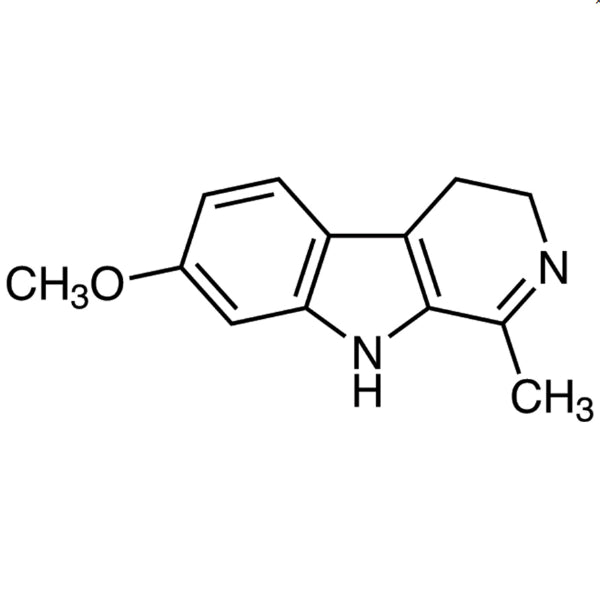
Harmaline is a β-carboline alkaloid that occurs naturally in the seeds of *Peganum harmala* (Syrian rue) and in several other plants. The compound is the dihydro derivative of harmine and has long been a subject of study in pharmacology and neuroscience because of its ability to interact with the monoamine oxidase enzyme system. In the laboratory, harmaline serves as a test compound and research reagent for tracing neurotransmitter metabolic pathways, for studying the chemistry of indole alkaloids, and as a reference standard in the phytochemical analysis of extracts from β-carboline-producing plants.
The property that makes this compound a preferred choice is its clearly defined β-carboline framework bearing the characteristic methoxy and methyl groups, which gives it a readily recognisable spectroscopic fingerprint in ultraviolet, infrared, and mass spectrometric analysis. Harmaline is also fluorescent, a feature exploited both in fluorescence-based analytical detection and in studies of its interaction with biological macromolecules. As an alkaloid base, its solubility is pH-dependent, so it can be extracted selectively, and this behaviour makes it convenient to isolate, purify, and transfer between aqueous and organic phases during sample preparation.
In Indonesian laboratories, harmaline is typically encountered in university research groups, natural product chemistry units, and analytical service laboratories working on plant-derived compounds. It is used where a well-characterised alkaloid reference is needed to confirm the identity of a β-carboline detected in a plant extract, or where a consistent test compound is required for enzyme and neuropharmacology work. Because it is supplied in small research quantities, it suits method development, teaching at the postgraduate level, and comparative studies rather than large-scale preparative work.
TCI brochures (PDF)
- MALDI Matrix 2025-01-17 · p. 1
- Alkaloids 2025-10-10 · p. 6
- Phytochemical reference standard: used to confirm the identity and retention behaviour of β-carboline alkaloids detected in plant extracts, since its defined structure gives a reproducible comparison point for chromatographic and spectroscopic identification.
- Monoamine oxidase enzyme studies: applied as a test compound in pharmacological work on the monoamine oxidase system, because its interaction with these enzymes is the property for which it has been most extensively studied.
- Neurotransmitter metabolism research: employed to trace metabolic pathways of neurotransmitters in neuroscience investigations, where a defined alkaloid with known enzyme interaction is required rather than a crude botanical extract.
- Indole alkaloid chemistry: serves as a model substrate for studying the reactivity and derivatisation of the indole and β-carboline framework, its methoxy and methyl substituents offering clear reference points for structural work.
- Fluorescence-based detection and binding studies: its intrinsic fluorescence allows it to be used in fluorescence analytical methods and in investigations of alkaloid interaction with biological macromolecules without an added label.
| Brand | TCI |
|---|---|
| CAS number | 304-21-2 |
| Molecular formula | — |
| Purity | — |
| Category | Life Science > Biochemicals and Reagents > Alkaloids |
| Pack sizes | available in research-scale pack sizes; please refer to the current catalogue listing for the options offered |
| Physical form | solid alkaloid base, supplied as a research-grade chemical |
| Storage | light-sensitive and susceptible to oxidation; store protected from light |
- Product code: H1237
Harmaline is sensitive to light and to oxidation, so it should be stored in a tightly closed, light-resistant container such as an amber glass vial or a container kept inside an opaque secondary box, in a cool and dry place away from direct sunlight and heat sources. Keep the container sealed when not in use to limit exposure to air and moisture, and allow cold-stored material to reach room temperature before opening to avoid condensation on the solid. Handle the compound as a biologically active alkaloid: weigh and transfer it in a fume hood or well-ventilated area, wear gloves, safety glasses, and a laboratory coat, and avoid generating or inhaling dust. Prepare solutions fresh where possible, label all containers clearly, and dispose of residues and contaminated consumables according to the chemical waste procedures in force at your institution. Always consult the manufacturer's safety data sheet before first use.
—
Produk Terkait
-
Reserpine TCI R0007
Regular price Rp 1.988.700,00Regular priceRp 1.405.950,00Sale price Rp 1.988.700,00 -
L-NoradrenalineBitartrateMonohydrate TCI A0906
Regular price Rp 4.266.150,00Regular priceRp 2.998.800,00Sale price Rp 4.266.150,00 -
YohimbineHydrochloride TCI Y0002
Regular price From Rp 3.392.550,00Regular priceRp 2.387.700,00Sale price From Rp 3.392.550,00 -
ArecolineHydrobromide TCI A0523
Regular price From Rp 2.147.250,00Regular priceRp 1.517.250,00Sale price From Rp 2.147.250,00 -
AtropineSulfateMonohydrate TCI A0550
Regular price From Rp 1.908.900,00Regular priceRp 1.350.300,00Sale price From Rp 1.908.900,00 -
L-AdrenalineBitartrate TCI A0175
Regular price From Rp 1.563.450,00Regular priceRp 1.108.800,00Sale price From Rp 1.563.450,00 -
L-Adrenaline TCI A0173
Regular price Rp 1.351.350,00Regular priceRp 960.750,00Sale price Rp 1.351.350,00 -
BerberineSulfate TCI B0451
Regular price From Rp 1.378.650,00Regular priceRp 979.650,00Sale price From Rp 1.378.650,00


