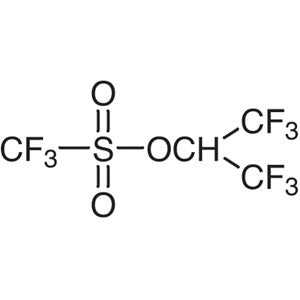
1,1,1,3,3,3-Hexafluoroisopropyl trifluoromethanesulfonate, CAS 156241-41-7, is a fluorinated reagent that combines a hexafluoroisopropyl group with a triflate group, making it an ester of trifluoromethanesulfonic acid. The compound belongs to the fluorinated building blocks category and is used in organic synthesis laboratories as a reagent for introducing the hexafluoroisopropyl group into target molecules. Because the triflate group is recognised as one of the best leaving groups in organic chemistry, this reagent is designed for substitution reactions that demand high reactivity from the electrophilic partner.
The property that makes this material valuable is the strength of the triflate group as an excellent leaving group, combined with the electronic influence of the six fluorine atoms on the isopropyl skeleton. Fluorine is strongly electronegative and pulls electron density powerfully towards itself, producing a highly electrophilic carbon centre while at the same time conferring the characteristic metabolic stability and lipophilicity associated with fluorinated products. This combination of characteristics is precisely why fluorinated groups are so widely sought after in modern drug molecule design and functional materials development, where a fluorinated fragment can change how a candidate compound behaves without changing its overall architecture.
In Indonesian laboratories, this reagent is typically found in university and institutional organic synthesis groups, in medicinal chemistry research programmes, and in materials chemistry work where fluorinated fragments are required. As a fluorinated sulfonate reagent it is handled in the same way as other highly reactive synthetic reagents, on a research scale rather than in bulk, and is usually ordered alongside the anhydrous solvents, bases and inert-atmosphere glassware that reactions of this type require.
- Introduction of hexafluoroisopropyl groups into target molecules, where the reagent serves as the direct source of the fluorinated fragment in organic synthesis work.
- Nucleophilic substitution reactions demanding high reactivity, since the triflate group is among the best leaving groups available and readily departs when attacked by a nucleophile.
- Medicinal chemistry and drug molecule design, where fluorinated groups are sought for the metabolic stability and lipophilicity they confer on candidate compounds under development.
- Functional materials research, in which fluorinated fragments are incorporated into molecular frameworks to exploit the distinctive electronic character contributed by the six fluorine atoms.
- Building block chemistry in academic synthesis laboratories, where the highly electrophilic carbon centre allows coupling to a variety of nucleophilic partners in multi-step routes.
| Brand | TCI |
|---|---|
| CAS number | 156241-41-7 |
| Molecular formula | — |
| Purity | — |
| Category | Chemistry > Building Blocks > Fluorinated Building Blocks |
| Pack sizes | available in the research-scale catalogue pack sizes offered by TCI for this item |
| Physical form | — |
| Storage | store according to the conditions stated on the manufacturer's label and safety data sheet |
- Product code: H1276
Store this reagent in its original tightly closed container in a cool, dry and well ventilated area, away from moisture, heat and direct sunlight, and follow the storage conditions given on the manufacturer's label and safety data sheet. Because it is a highly reactive fluorinated sulfonate ester, keep the container sealed against atmospheric moisture and handle it separately from incompatible materials such as bases and nucleophiles. All transfers and reaction set-ups should be carried out in a functioning fume hood, using dry glassware and, where the procedure requires it, an inert atmosphere. Personnel should wear safety goggles, a laboratory coat and chemically resistant gloves, and consult the safety data sheet before first use. Dispose of residues and contaminated materials as chemical waste in accordance with institutional laboratory waste procedures.
—
Produk Terkait
-
TCI B5774 5,10-Bis(4,4,5,5-tetramethyl-1,3,2-dioxaborolan-2-yl)naphtho[1,2-c:5,6-c']bis([1,2,5]oxadiazole)
Regular price Rp 10.255.350,00Regular price -
Dihydroiodide TCI B6569
Regular price From Rp 1.936.200,00Regular price -
Trifluoromethanesulfonate TCI B7003
Regular price From Rp 1.936.200,00Regular price
![5,10-Bis(4,4,5,5-tetramethyl-1,3,2-dioxaborolan-2-yl)naphtho[1,2-c:5,6-c']bis([1,2,5]oxadiazole) - TCI B5774 - AMI Scientific](http://amiscientific.com/cdn/shop/files/TCI2510B5774.jpg?v=1769180228&width=533)