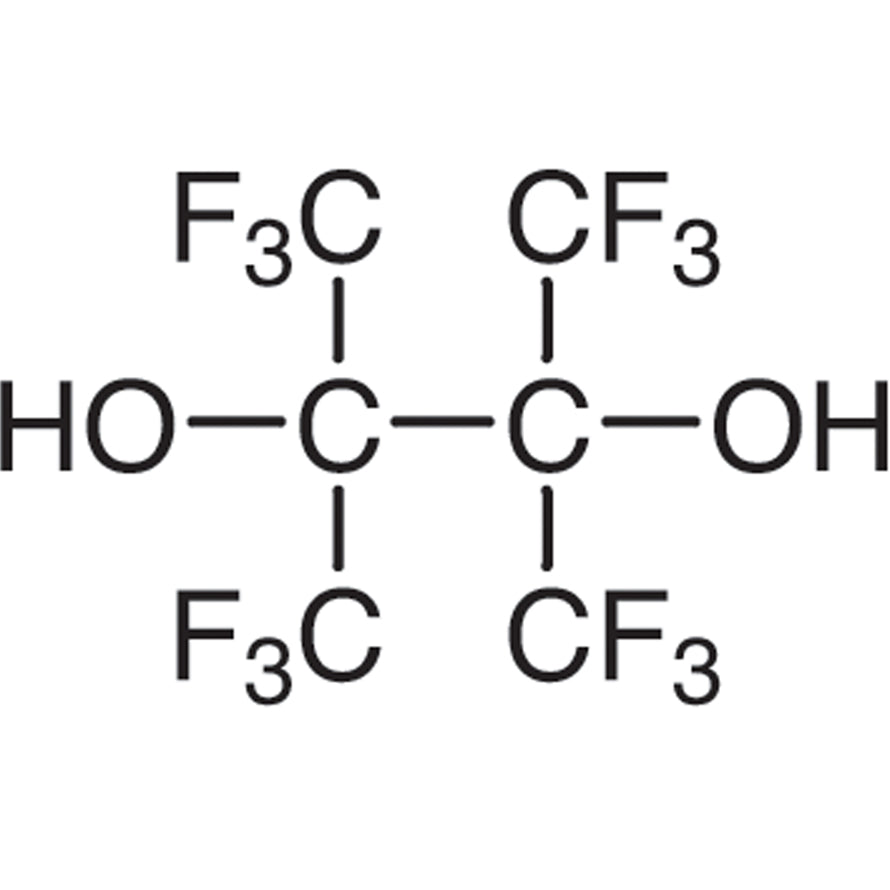
Hexafluoro-2,3-bis(trifluoromethyl)-2,3-butanediol, better known among researchers as perfluoropinacol, is a vicinal diol in which every hydrocarbon position has been replaced by trifluoromethyl groups. The material belongs to the fluorinated building blocks family, a class of starting materials used to install fluorine character into target molecules. In synthetic laboratories its role is that of a precursor to fluorinated alkoxide ligands, a chelating partner for transition metals and main group elements, and a protecting and directing group in the construction of new structures.
The principal attraction of this compound lies in its six strongly electron-withdrawing CF3 groups. That inductive effect raises the acidity of both hydroxyl groups significantly compared with ordinary pinacol, so the alkoxides formed from it are weakly coordinating and instead generate metal centres that are more electrophilic and more reactive. The strong carbon–fluorine bonds also confer resistance to oxidation and thermal degradation, while its combination of strong hydrogen-bond donor character with low nucleophilicity makes it useful in systems that demand a chemically undemanding environment around the reactive site.
In Indonesian laboratories this compound is typically found in university and institutional research groups working on organometallic chemistry, catalysis, and fluorine chemistry, where fluorinated building blocks are ordered in small quantities for exploratory synthesis rather than routine analysis. It is normally handled as a specialist reagent within a documented synthetic route, stored alongside other moisture-sensitive organic starting materials, and used on scales appropriate to method development and postgraduate research work.
TCI brochures (PDF)
- Fluorinated Monomers 2025-10-03 · p. 2
- Fluorous Chemistry 2025-01-21 · p. 5
- Monomers 2025-05-28 · p. 25
- Fluorination Reagents, Fluorinated Building Blocks 2026-03-18 · p. 53
Related TCI products
- TCI T2296 425-61-6 2,2,3,3-Tetrafluoro-1,4-butanediol
- TCI H0746 376-90-9 2,2,3,3,4,4-Hexafluoro-1,5-pentanediol
- TCI T3493 69804-19-9 2,2,3,3-Tetrafluoro-3-[[1,1,1,2,3,3-hexafluoro-3-[(1,2,2-trifluorovinyl)oxy]propan-2-yl]oxy]propionitrile
- TCI B1403 802-93-7 1,3-Bis(hexafluoro-alpha-hydroxyisopropyl)benzene
- TCI H1233 754-96-1 1H,1H,10H,10H-Hexadecafluoro-1,10-decanediol
- TCI B0681 513-85-9 2,3-Butanediol (mixture of stereoisomers)
- Fluorinated alkoxide ligand synthesis: the two acidic hydroxyl groups are readily deprotonated to give bulky, weakly coordinating alkoxides that leave the bound metal centre unusually electrophilic and reactive.
- Chelate formation with transition metals: the vicinal diol arrangement allows both oxygen donors to bind a single metal centre, producing defined chelate complexes for organometallic and coordination chemistry studies.
- Main group element coordination chemistry: the same chelating motif is applied to main group centres, where the electron-withdrawing CF3 environment tunes the Lewis acidity of the resulting species.
- Protecting and directing group chemistry: the diol can be installed to mask or steer reactivity during the construction of new molecular structures, then carried through subsequent synthetic steps.
- Introduction of fluorine character into target molecules: as a fluorinated building block it transfers a heavily fluorinated fragment into larger structures, imparting oxidative and thermal robustness through its carbon–fluorine bonds.
| Brand | TCI |
|---|---|
| CAS number | 918-21-8 |
| Molecular formula | — |
| Purity | — |
| Category | Chemistry > Building Blocks > Fluorinated Building Blocks |
| Pack sizes | available in TCI catalogue research pack sizes; please confirm the size required when ordering |
| Physical form | — |
| Storage | keep in a tightly closed original container, protected from moisture |
- Product code: H1279
Store the product in its original tightly closed container in a cool, dry, well ventilated area away from sources of heat, ignition, and direct sunlight. Because the compound is a strong hydrogen-bond donor and is intended for moisture-sensitive synthetic work, containers should be resealed promptly after use and, where the application requires it, kept under an inert atmosphere. Handle the material in a fume hood using safety glasses, chemically resistant gloves, and a laboratory coat. Avoid contact with skin and eyes and avoid breathing vapours. Keep the reagent segregated from strong bases and other incompatible materials, and consult the manufacturer's safety data sheet before first use and before disposal of residues.
—
Produk Terkait
-
2,2,3,3-Tetrafluoro-1,4-butanediol TCI T2296
Regular price From Rp 795.900,00Regular priceRp 556.500,00Sale price From Rp 795.900,00 -
2,2,3,3,4,4-Hexafluoro-1,5-pentanediol TCI H0746
Regular price Rp 903.000,00Regular priceRp 631.050,00Sale price Rp 903.000,00 -
2,2,3,3-Tetrafluoro-3-[[1,1,1,2,3,3-hexafluoro-3-[(1,2,2-trifluorovinyl)oxy]propan-2-yl]oxy]propionitrile TCI T3493
Regular price From Rp 4.399.500,00Regular priceRp 3.092.250,00Sale price From Rp 4.399.500,00 -
1,3-Bis(hexafluoro-alpha-hydroxyisopropyl)benzene TCI B1403
Regular price From Rp 1.670.550,00Regular priceRp 1.167.600,00Sale price From Rp 1.670.550,00 -
1H,1H,10H,10H-Hexadecafluoro-1,10-decanediol TCI H1233
Regular price From Rp 610.050,00Regular priceRp 426.300,00Sale price From Rp 610.050,00 -
2,3-Butanediol(mixtureofstereoisomers) TCI B0681
Regular price From Rp 769.650,00Regular priceRp 553.350,00Sale price From Rp 769.650,00 -
2,2,4,4-Tetramethyl-1,3-cyclobutanediol(mixtureofisomers) TCI T0145
Regular price From Rp 2.279.550,00Regular priceRp 1.609.650,00Sale price From Rp 2.279.550,00 -
1,1,1,3,3,3-Hexafluoro-2-methyl-2-propanol TCI H1349
Regular price From Rp 2.359.350,00Regular priceRp 1.649.550,00Sale price From Rp 2.359.350,00


![69804-19-9 2,2,3,3-Tetrafluoro-3-[[1,1,1,2,3,3-hexafluoro-3-[(1,2,2-trifluorovinyl)oxy]propan-2-yl]oxy]propionitrile - AMI Scientific](http://amiscientific.com/cdn/shop/files/TCI2510T3493.jpg?v=1768819782&width=533)
![69804-19-9 2,2,3,3-Tetrafluoro-3-[[1,1,1,2,3,3-hexafluoro-3-[(1,2,2-trifluorovinyl)oxy]propan-2-yl]oxy]propionitrile - AMI Scientific](http://amiscientific.com/cdn/shop/files/TCI2510T3493_2f6bddec-1b38-407e-8eff-cb77397f9f37.jpg?v=1769058235&width=533)