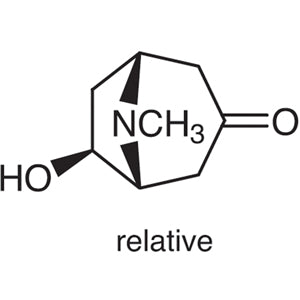
(+/-)-exo-6-Hydroxytropinone is a tropinone derivative carrying a hydroxyl group at the six position in the exo orientation, supplied as a racemic mixture. The compound is built on a tropane skeleton, an eight-membered bicyclic system bridged by nitrogen, which forms the structural core of many important natural alkaloids. In organic synthesis laboratories, this material serves as a high-value building block because it supplies a pre-formed tropane framework together with two distinct functional groups — a ketone and a secondary alcohol — available for further elaboration.
The practical value of this compound lies in the rigidity and regularity of that bicyclic framework. The rigid tropane geometry means every functional group occupies a clearly defined position in space, so subsequent reactions tend to proceed with good and predictable stereoselectivity. The exo hydroxyl group is readily protected, oxidised, acylated, or converted into a leaving group, while the ketone is poised to undergo reductive amination, nucleophilic addition, or olefination. The tertiary nitrogen within the bridge also confers basic character that is useful for purification by acid–base extraction.
In Indonesian laboratories, this material is typically used in university and institutional research groups working on organic synthesis, medicinal chemistry, and natural product chemistry, as well as in development laboratories preparing alkaloid analogues. It is normally handled at bench scale in fume-hooded synthesis work, where the compound is weighed out for multi-step routes and the resulting intermediates are characterised by routine spectroscopic and chromatographic methods.
- Tropane alkaloid synthesis — provides a pre-assembled bicyclic nitrogen-bridged core, removing the need to construct the demanding tropane skeleton from simpler acyclic or monocyclic precursors.
- Medicinal chemistry analogue preparation — the two orthogonal handles, ketone and secondary alcohol, allow systematic structural variation around a rigid scaffold when exploring structure–activity relationships.
- Stereoselective transformation studies — the rigid and well-defined tropane geometry fixes each functional group in space, making it a useful substrate for investigating facial selectivity in additions and reductions.
- Reductive amination and nucleophilic addition chemistry — the available ketone group readily accepts amine or carbon nucleophiles, giving direct access to substituted tropane derivatives in a single step.
- Protecting group and functional group interconversion work — the exo hydroxyl can be protected, oxidised, acylated, or converted into a leaving group, supporting multi-step route development and methodology teaching.
| Brand | TCI |
|---|---|
| CAS number | 5932-53-6 |
| Molecular formula | — |
| Purity | — |
| Category | Chemistry > Building Blocks > Non-Heterocyclic Building Blocks |
| Pack sizes | available in standard TCI research pack sizes; please refer to the current listing for the sizes offered |
| Physical form | — |
| Storage | store according to the manufacturer's stated conditions on the product label and safety data sheet |
- Catalogue code: H1289
Store the container tightly closed in a cool, dry, well-ventilated area away from direct sunlight, moisture, and incompatible materials, following the storage conditions stated by the manufacturer on the label and safety data sheet. Keep the material in its original supplier container, or transfer it to a clean, well-sealed, chemically compatible vessel that is clearly labelled with the compound name and CAS number. Handle the compound in a fume hood using appropriate personal protective equipment, including safety goggles, chemical-resistant gloves, and a laboratory coat. Avoid inhalation of dust and contact with skin and eyes, and allow cold containers to warm to room temperature before opening to prevent moisture condensation. Dispose of residues and contaminated materials in accordance with applicable laboratory waste regulations.
—
Produk Terkait
-
TCI B5774 5,10-Bis(4,4,5,5-tetramethyl-1,3,2-dioxaborolan-2-yl)naphtho[1,2-c:5,6-c']bis([1,2,5]oxadiazole)
Regular price Rp 10.255.350,00Regular price -
Dihydroiodide TCI B6569
Regular price From Rp 1.936.200,00Regular price -
Trifluoromethanesulfonate TCI B7003
Regular price From Rp 1.936.200,00Regular price
![5,10-Bis(4,4,5,5-tetramethyl-1,3,2-dioxaborolan-2-yl)naphtho[1,2-c:5,6-c']bis([1,2,5]oxadiazole) - TCI B5774 - AMI Scientific](http://amiscientific.com/cdn/shop/files/TCI2510B5774.jpg?v=1769180228&width=533)