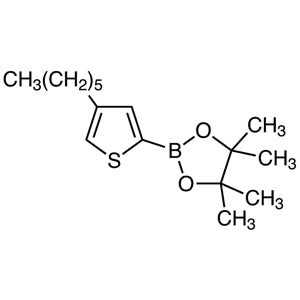
TCI H1294 4-Hexyl-2-(4,4,5,5-tetramethyl-1,3,2-dioxaborolan-2-yl)thiophene is an organoboron reagent that combines a hexyl-substituted thiophene core with a pinacol boronate ester group at the 2-position. In the organic synthesis laboratory, this compound serves as the nucleophilic partner in palladium-catalysed cross-coupling reactions, most notably the Suzuki–Miyaura coupling, allowing researchers to attach thiophene units to other aromatic or heteroaromatic frameworks in a directed, regiocontrolled manner. Because the boron centre is already protected as a pinacol ester, the reagent is considerably more practical to handle than the corresponding free boronic acid, which readily undergoes protodeboronation and boroxine formation.
The characteristics that make this material a preferred choice are the combination of storage stability and controlled reactivity. Pinacol esters are relatively tolerant of atmospheric moisture and can be purified by ordinary silica column chromatography — something that is difficult to achieve with heteroaromatic boronic acids, which frequently decompose on silica or during workup. The hexyl chain at the 4-position provides good solubility in non-polar organic solvents such as toluene, tetrahydrofuran, and chloroform, while simultaneously acting as a solubilising side chain in the extended structures built from it. This solubility profile simplifies reaction setup, extraction, and chromatographic purification alike.
In Indonesian laboratories, this reagent is typically found in university and institutional organic synthesis groups working on conjugated materials, heterocyclic building blocks, and methodology development. It is normally ordered in small research quantities for exploratory coupling work rather than bulk preparation, and is handled within the standard synthetic workflow of a fume hood, inert-atmosphere line, and rotary evaporator. Its shelf stability makes it well suited to laboratories where reagents may be stored between project phases rather than consumed immediately.
- Suzuki–Miyaura cross-coupling: the pinacol boronate transfers the hexylthiophene unit to aryl or heteroaryl halides under palladium catalysis, giving reliable carbon–carbon bond formation with predictable regiochemistry at the thiophene 2-position.
- Conjugated polymer and oligomer synthesis: the hexyl side chain confers solubility on the growing conjugated backbone, which is essential for keeping extended thiophene-containing chains processable in solution during and after polymerisation.
- Heteroaromatic building block assembly: researchers use this reagent to introduce a substituted thiophene fragment into larger heterocyclic scaffolds without needing to generate an unstable boronic acid in situ beforehand.
- Methodology and catalyst screening studies: its stability and clean chromatographic behaviour make it a dependable benchmark substrate when comparing palladium catalyst systems, ligands, bases, or solvent conditions across coupling experiments.
- Small-scale exploratory synthesis: because the material can be purified on standard silica columns and handled on the open bench briefly, it suits discovery-stage work where many short reactions are run in parallel.
| Brand | TCI (Tokyo Chemical Industry) |
|---|---|
| CAS number | 883742-29-8 |
| Molecular formula | — |
| Purity | — |
| Category | Chemistry > Organometallic Reagents > Organoboron [Organometallic Reagents] |
| Pack sizes | supplied in standard TCI research-scale packaging; please confirm the available size when ordering |
| Physical form | — |
| Storage | keep in a cool, dry place in the tightly closed original container |
- Chemical name: 4-Hexyl-2-(4,4,5,5-tetramethyl-1,3,2-dioxaborolan-2-yl)thiophene
Store the reagent in its original tightly closed container in a cool, dry, well-ventilated place, away from direct sunlight, heat sources, and strong oxidising agents. Although the pinacol ester is more moisture-tolerant than a free boronic acid, prolonged exposure to humid air should still be avoided; keeping the container in a desiccator or under an inert atmosphere after opening helps preserve quality. Handle the material in a fume hood using appropriate personal protective equipment, including safety glasses, chemical-resistant gloves, and a laboratory coat. Use clean, dry glassware and spatulas to prevent contamination, close the container promptly after weighing, and dispose of residues and contaminated materials in accordance with the institution's chemical waste procedures. Consult the manufacturer's safety data sheet before first use.
—
Produk Terkait
-
TCI B5774 5,10-Bis(4,4,5,5-tetramethyl-1,3,2-dioxaborolan-2-yl)naphtho[1,2-c:5,6-c']bis([1,2,5]oxadiazole)
Regular price Rp 10.255.350,00Regular price -
Dihydroiodide TCI B6569
Regular price From Rp 1.936.200,00Regular price -
Trifluoromethanesulfonate TCI B7003
Regular price From Rp 1.936.200,00Regular price
![5,10-Bis(4,4,5,5-tetramethyl-1,3,2-dioxaborolan-2-yl)naphtho[1,2-c:5,6-c']bis([1,2,5]oxadiazole) - TCI B5774 - AMI Scientific](http://amiscientific.com/cdn/shop/files/TCI2510B5774.jpg?v=1769180228&width=533)