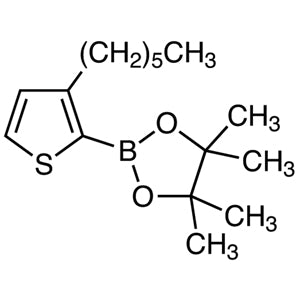
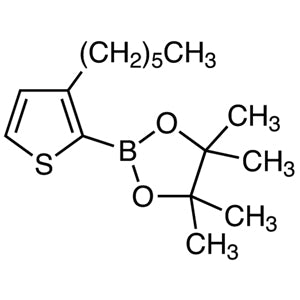
TCI H1298 3-Hexyl-2-(4,4,5,5-tetramethyl-1,3,2-dioxaborolan-2-yl)thiophene is an organoboron reagent built around a thiophene ring carrying a hexyl chain at the 3-position and a pinacol boronate ester group at the 2-position. This arrangement makes it a key monomer for the preparation of poly(3-hexylthiophene) and its derivatives, one of the most extensively studied families of semiconducting polymers in organic electronics. In the laboratory, the compound serves as the boron partner in palladium-catalysed cross-coupling reactions, allowing researchers to join alkylated thiophene units to other aromatic groups in a directed and repeatable manner.
The property that makes this reagent sought after is the adjacent placement of its substituents: the hexyl chain and the boronate group sit next to one another, and this directly governs the regiochemistry of head-to-tail linkages along the polymer chain. That regioregularity determines chain packing, the degree of crystallinity, and ultimately the charge-carrier mobility of the resulting material. Because the boron is carried as a pinacol ester, it is far more robust than thiophene boronic acids, which readily undergo protodeboronation, so the reagent can be purified, stored, and weighed using ordinary laboratory procedures. The hexyl chain, for its part, contributes the solubility that makes solution processing practical.
In Indonesian laboratories, this reagent is typically found in university and institute research groups working on organic electronics, conjugated polymers, and synthetic organometallic chemistry. It is normally handled on a small synthetic scale under inert atmosphere, in Schlenk lines or gloveboxes, alongside palladium catalysts and degassed solvents. Groups developing organic solar cells, thin-film transistors, or new thiophene-based monomers use it as a defined, reproducible building block rather than preparing the boronate in house.
- Suzuki-Miyaura cross-coupling: the pinacol boronate transfers the alkylthiophene unit to aryl halides under palladium catalysis, giving controlled and repeatable carbon-carbon bond formation.
- Synthesis of poly(3-hexylthiophene): serves as the monomeric building block for one of the most widely studied semiconducting polymer families in organic electronics research.
- Regioregular polymer construction: the neighbouring hexyl and boronate substituents fix head-to-tail connectivity, which directly controls chain packing and crystallinity in the finished material.
- Organic electronic device materials: supplies thiophene segments for polymers whose charge-carrier mobility underpins organic solar cells, transistors, and related thin-film device studies.
- Preparation of conjugated oligomers and copolymers: couples alkylated thiophene units to other aromatic partners, letting researchers build defined donor-acceptor sequences step by step.
| Brand | TCI (Tokyo Chemical Industry) |
|---|---|
| CAS number | 850881-09-3 |
| Molecular formula | — |
| Purity | — |
| Category | Chemistry > Organometallic Reagents > Organoboron [Organometallic Reagents] |
| Pack sizes | supplied in standard TCI research-scale packaging; please confirm the available size when ordering |
| Physical form | — |
| Storage | keep in a cool, dry place in the tightly closed original container, protected from moisture and air |
- Chemical name: 3-Hexyl-2-(4,4,5,5-tetramethyl-1,3,2-dioxaborolan-2-yl)thiophene
Store the reagent in its tightly closed original container in a cool, dry place, away from moisture, direct sunlight, and sources of ignition. Boronate esters are best kept under an inert atmosphere where the laboratory is equipped for it, and containers should be allowed to reach room temperature before opening so that condensation does not form on the contents. Handle in a fume hood using gloves, safety glasses, and a laboratory coat, and weigh the material with clean, dry spatulas and glassware. Because the compound is intended for use with palladium catalysts and organic solvents, keep it separate from strong oxidising agents and dispose of residues through the institution's chemical waste route. Always consult the manufacturer's safety data sheet before first use.
—
Produk Terkait
-
TCI B5774 5,10-Bis(4,4,5,5-tetramethyl-1,3,2-dioxaborolan-2-yl)naphtho[1,2-c:5,6-c']bis([1,2,5]oxadiazole)
Regular price Rp 10.255.350,00Regular price -
Dihydroiodide TCI B6569
Regular price From Rp 1.936.200,00Regular price -
Trifluoromethanesulfonate TCI B7003
Regular price From Rp 1.936.200,00Regular price
![5,10-Bis(4,4,5,5-tetramethyl-1,3,2-dioxaborolan-2-yl)naphtho[1,2-c:5,6-c']bis([1,2,5]oxadiazole) - TCI B5774 - AMI Scientific](http://amiscientific.com/cdn/shop/files/TCI2510B5774.jpg?v=1769180228&width=533)