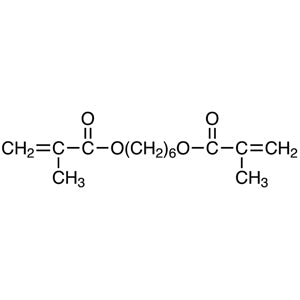
1,6-Hexanediol Dimethacrylate is a difunctional monomer built around a hexanediol chain whose two terminal hydroxyl groups have each been esterified with methacrylic acid. Because the molecule carries two reactive vinyl groups, it functions as a crosslinking agent across a wide range of free-radical polymerization systems. When it is added to a formulation alongside monofunctional monomers, it forms bridges between growing polymer chains and knits them into a three-dimensional network rather than a collection of independent linear molecules. The resulting material is no longer soluble in solvents, carries higher mechanical strength, and displays markedly better heat resistance and chemical resistance than an ordinary linear polymer.
The property that makes this particular crosslinker a preferred choice is the six-carbon length of its connecting chain, which strikes an attractive balance between crosslink density and network flexibility. Shorter spacer chains tend to lock the network tightly and produce brittle materials, whereas the hexanediol bridge leaves enough conformational freedom that the finished product does not crack easily under stress. The product is also stabilized with MEHQ, an inhibitor that prevents premature polymerization during storage and shipping, so the material reaches the bench as a pourable liquid that is straightforward to measure and dispense.
In Indonesian laboratories, this monomer is typically drawn on by polymer chemistry and materials research groups working on resin formulation, coatings, and network polymer studies at university and institutional scale. It is normally handled in a fume hood as part of formulation work where a measured quantity of crosslinker is blended into a base monomer mixture before curing. Because it is supplied as a stabilized liquid, it suits laboratories that prepare formulations in small batches and need the remaining material to stay usable between experiments.
- Crosslinked network polymer synthesis — the two reactive vinyl groups bridge separate polymer chains during free-radical polymerization, converting linear products into insoluble three-dimensional networks with superior mechanical strength.
- Resin and coating formulation development — adding measured amounts of this difunctional monomer to a monofunctional base lets researchers tune crosslink density and study how network structure affects the cured film.
- Thermal and chemical resistance studies — because crosslinking raises heat resistance and chemical resistance well above that of linear polymers, this monomer serves as the variable in comparative durability experiments.
- Flexible network materials research — the six-carbon spacer preserves network flexibility that shorter crosslinkers cannot provide, making it the reagent of choice when brittleness and cracking must be avoided.
- Structure-property relationship investigations — varying the loading of this crosslinker in otherwise identical formulations allows systematic study of how crosslink density governs solubility, strength, and thermal behavior.
| Brand | TCI, catalog number H1369 |
|---|---|
| CAS number | 6606-59-3 |
| Molecular formula | — |
| Purity | — |
| Category | Chemistry > Building Blocks > Non-Heterocyclic Building Blocks |
| Pack sizes | available in standard TCI research-scale packaging; please confirm the size required when ordering |
| Physical form | liquid, stabilized with MEHQ (hydroquinone monomethyl ether) as a polymerization inhibitor |
| Storage | keep the container tightly closed and protected from conditions that would promote premature polymerization |
Store the container tightly closed in a cool, well-ventilated area away from heat, direct sunlight, and any source of ignition or free radicals, since these conditions can overcome the MEHQ inhibitor and trigger premature polymerization in the bottle. Keep the material in its original tightly sealed container, or in a comparable chemically compatible vessel, and do not decant it into containers that cannot be closed securely. Handle the liquid inside a fume hood while wearing safety goggles, chemically resistant gloves, and a laboratory coat, because methacrylate esters can irritate the skin, eyes, and respiratory tract. Avoid direct skin contact and prolonged inhalation of vapors, return the container promptly to storage after dispensing, and consult the manufacturer's safety data sheet before first use.
—
Produk Terkait
-
TCI B5774 5,10-Bis(4,4,5,5-tetramethyl-1,3,2-dioxaborolan-2-yl)naphtho[1,2-c:5,6-c']bis([1,2,5]oxadiazole)
Regular price Rp 10.255.350,00Regular price -
Dihydroiodide TCI B6569
Regular price From Rp 1.936.200,00Regular price -
Trifluoromethanesulfonate TCI B7003
Regular price From Rp 1.936.200,00Regular price
![5,10-Bis(4,4,5,5-tetramethyl-1,3,2-dioxaborolan-2-yl)naphtho[1,2-c:5,6-c']bis([1,2,5]oxadiazole) - TCI B5774 - AMI Scientific](http://amiscientific.com/cdn/shop/files/TCI2510B5774.jpg?v=1769180228&width=533)