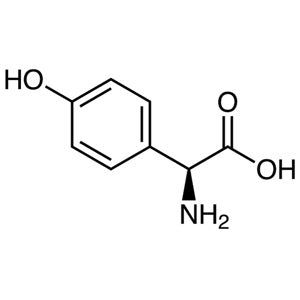
TCI H1389 4-Hydroxy-L-(+)-2-phenylglycine is a non-proteinogenic aromatic amino acid carrying a hydroxyl group on the phenyl ring together with a single chiral centre of defined configuration. In the laboratory it plays an important role in peptide chemistry and in the synthesis of pharmaceutical intermediates, because its structure corresponds to a side chain found in certain beta-lactam class antibiotics. The presence of an amino group, a carboxyl group, and a phenolic group within one molecule provides three points of reactivity that can be addressed sequentially through protecting-group strategies.
The property that makes this compound the preferred choice is its maintained optical purity, since the configuration of the chiral centre determines the biological activity of the final product and cannot be substituted by a racemic mixture. The phenylglycine framework is also more rigid than aliphatic amino acids, so its insertion into a peptide chain restricts conformational flexibility and helps researchers direct the secondary structure of designed molecules. The phenolic hydroxyl group adds hydrogen-bonding capability while simultaneously providing a site for further modification. As an amino acid, the compound exists as a zwitterion, which influences its solubility behaviour across different solvent systems.
In Indonesian laboratories, this material is typically used in university and institutional research groups working on peptide synthesis, medicinal chemistry, and the preparation of antibiotic-related intermediates. It is normally handled in small quantities on the bench scale, weighed out for coupling and protection steps, and stored alongside other chiral building blocks in the synthetic chemistry inventory. Because the stereochemical integrity of the material governs downstream results, laboratories generally keep it under controlled conditions and record its handling carefully.
- Peptide synthesis building block: the defined chiral centre and free amino and carboxyl groups allow direct incorporation into growing peptide chains through standard coupling chemistry.
- Pharmaceutical intermediate preparation: the structure matches the side chain present in certain beta-lactam antibiotics, making it a direct starting point for synthetic route development in medicinal chemistry.
- Conformationally constrained peptide design: the rigid phenylglycine framework limits backbone flexibility, allowing researchers to bias and study the secondary structure of designed peptide sequences.
- Protecting-group strategy development: three distinct reactive sites, namely amino, carboxyl, and phenolic groups, allow chemists to practise and optimise sequential, orthogonal protection and deprotection schemes.
- Chiral building block applications: the preserved optical purity supports asymmetric synthesis work where racemic material would be unsuitable because stereochemistry governs the biological activity of the product.
| Brand | TCI |
|---|---|
| CAS number | 32462-30-9 |
| Molecular formula | — |
| Purity | — |
| Category | Chemistry > Chemical Biology > Peptide Chemistry |
| Pack sizes | available in standard laboratory research pack sizes; please refer to the catalogue listing for the options offered |
| Physical form | — |
| Storage | store under the conditions indicated on the manufacturer label |
- Product code: H1389
Store the container tightly closed in a cool, dry place away from direct sunlight, moisture, and sources of heat, following the storage conditions stated on the manufacturer label. Keep the material in its original container or in a clean, chemically compatible, well-sealed vessel that is clearly labelled with the compound name and CAS number. Handle the solid in a well-ventilated area or fume hood to avoid generating and inhaling dust, and wear appropriate personal protective equipment including a laboratory coat, safety glasses, and chemical-resistant gloves. Use clean, dry spatulas when weighing to prevent cross-contamination and to protect the stereochemical and chemical integrity of the material. Consult the manufacturer safety data sheet before use and dispose of residues in accordance with institutional chemical waste procedures.
—
Produk Terkait
-
TCI B5774 5,10-Bis(4,4,5,5-tetramethyl-1,3,2-dioxaborolan-2-yl)naphtho[1,2-c:5,6-c']bis([1,2,5]oxadiazole)
Regular price Rp 10.255.350,00Regular price -
Dihydroiodide TCI B6569
Regular price From Rp 1.936.200,00Regular price -
Trifluoromethanesulfonate TCI B7003
Regular price From Rp 1.936.200,00Regular price
![5,10-Bis(4,4,5,5-tetramethyl-1,3,2-dioxaborolan-2-yl)naphtho[1,2-c:5,6-c']bis([1,2,5]oxadiazole) - TCI B5774 - AMI Scientific](http://amiscientific.com/cdn/shop/files/TCI2510B5774.jpg?v=1769180228&width=533)