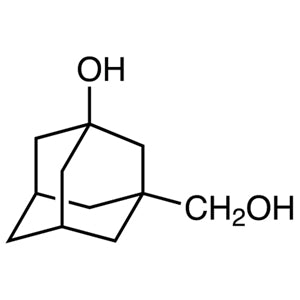
3-(Hydroxymethyl)-1-adamantanol is an adamantane derivative that carries two hydroxyl groups on its saturated hydrocarbon cage skeleton: one tertiary hydroxyl group bonded directly to the cage framework, and one primary hydroxymethyl group. In the organic synthesis laboratory, this compound serves as a building block, meaning a starting material that already carries a specific core skeleton so that chemists only need to construct other functional groups around it. Its role is important because the adamantane cage is difficult to build from scratch, so the availability of a ready-made material such as this one eliminates many reaction steps that would otherwise be required.
The characteristics that make this compound a frequent choice are the rigidity and symmetry of its adamantane framework. The cage structure is lipophilic, chemically resistant, and provides a distinctive three-dimensional spatial volume, which is why it is often used to control the conformation of target molecules. The two hydroxyl groups have different levels of reactivity, primary and tertiary, which creates opportunities for selective derivatisation: the primary group is more readily esterified, etherified, or oxidised first, while the tertiary group can be preserved or activated at a later stage of the synthetic sequence.
In Indonesian laboratories, this material is typically handled in university research groups, institutional chemistry laboratories, and industrial development units that carry out multi-step organic synthesis. It is generally ordered in small research quantities for exploratory route development rather than in bulk, weighed out on an analytical balance, and used as the starting point of a reaction sequence in which the adamantane core is retained while the surrounding functionality is elaborated according to the target structure.
- Building block for multi-step organic synthesis: the pre-formed adamantane cage removes the need to construct that skeleton from simpler precursors, shortening the overall route considerably.
- Selective derivatisation studies: the coexistence of a primary and a tertiary hydroxyl group allows chemists to functionalise one position while deliberately leaving the other untouched.
- Conformational control of target molecules: the rigid, symmetrical cage restricts rotational freedom and imposes a defined three-dimensional shape on the structures built around it.
- Introduction of lipophilic character: the saturated hydrocarbon cage is strongly lipophilic, making it useful when a molecular design requires a bulky non-polar fragment.
- Preparation of adamantane-based esters and ethers: the primary hydroxymethyl group is readily esterified or etherified, giving convenient access to a family of related derivatives.
| Brand | TCI |
|---|---|
| CAS number | 38584-37-1 |
| Molecular formula | — |
| Purity | — |
| Category | Chemistry > Building Blocks > Non-Heterocyclic Building Blocks |
| Pack sizes | — |
| Physical form | — |
| Storage | store according to the conditions stated on the manufacturer's label and safety data sheet; pack sizes as listed on the product page |
- Catalogue number: H1415
- Chemical name: 3-(Hydroxymethyl)-1-adamantanol
Store the container tightly closed in a cool, dry place away from direct sunlight, moisture, and incompatible materials, following the storage conditions stated on the manufacturer's label and safety data sheet. Keep the material in its original supplier container, or in a clean, well-sealed glass or chemically compatible bottle that is clearly labelled with the chemical name and CAS number. Handle the solid in a well-ventilated area or fume hood, wearing a laboratory coat, safety glasses, and suitable chemical-resistant gloves. Avoid generating dust, avoid inhalation and direct skin or eye contact, and close the container promptly after weighing to limit exposure to atmospheric moisture. Dispose of residues and contaminated materials in accordance with applicable laboratory waste regulations.
—
Produk Terkait
-
TCI B5774 5,10-Bis(4,4,5,5-tetramethyl-1,3,2-dioxaborolan-2-yl)naphtho[1,2-c:5,6-c']bis([1,2,5]oxadiazole)
Regular price Rp 10.255.350,00Regular price -
Dihydroiodide TCI B6569
Regular price From Rp 1.936.200,00Regular price -
Trifluoromethanesulfonate TCI B7003
Regular price From Rp 1.936.200,00Regular price
![5,10-Bis(4,4,5,5-tetramethyl-1,3,2-dioxaborolan-2-yl)naphtho[1,2-c:5,6-c']bis([1,2,5]oxadiazole) - TCI B5774 - AMI Scientific](http://amiscientific.com/cdn/shop/files/TCI2510B5774.jpg?v=1769180228&width=533)