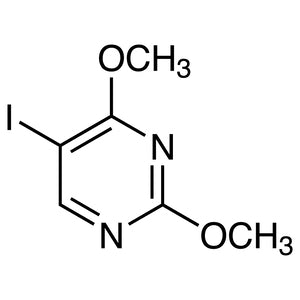
TCI I0531 5-Iodo-2,4-dimethoxypyrimidine is a heterocyclic building block based on a pyrimidine ring that carries two methoxy groups at the two and four positions together with an iodine atom at the five position. Pyrimidine is the nucleobase core that forms the underlying skeleton of cytosine, thymine, and uracil, which is why its derivatives are in such high demand in nucleoside research, antiviral work, and anticancer compound development. This material supplies that core in an already functionalised, ready-to-couple state, saving a considerable number of synthetic steps that would otherwise demand harsh reaction conditions and repeated, time-consuming purification if prepared in house.
The advantage that makes this compound a frequent first choice lies in the combination of two complementary types of reactive site. The iodine atom at the five position is an ideal entry point for palladium-catalysed cross-coupling reactions, because the C–I bond undergoes oxidative addition readily. The two methoxy groups, meanwhile, play a dual role: they act as protected latent carbonyl functions and as electron-donating substituents that stabilise the ring. Those methoxy groups can be hydrolysed at a late stage to reveal a pyrimidinedione structure closely resembling the natural nucleobase, and the clear difference in reactivity between the sites allows transformations to be carried out in a controlled, sequential manner.
In Indonesian laboratories, this building block is typically used by university and institutional research groups pursuing medicinal chemistry and nucleoside analogue programmes, as well as by process development teams preparing heterocyclic intermediates. Because locally synthesising a functionalised pyrimidine of this kind requires equipment and reaction control that are not always available, obtaining the core ready-made allows a research group to focus its effort on the coupling and derivatisation steps that actually generate novel structures.
- Palladium-catalysed cross-coupling chemistry: the carbon–iodine bond at position five undergoes oxidative addition readily, making it a dependable handle for Suzuki, Sonogashira, Stille, and Heck type bond formation.
- Nucleoside and nucleobase analogue synthesis: the pyrimidine ring is the same core found in cytosine, thymine, and uracil, so derivatives built from it map directly onto biologically relevant scaffolds.
- Antiviral compound research: modified pyrimidine cores are a long-standing structural motif in antiviral discovery, and this pre-functionalised building block shortens the route to new candidate structures.
- Anticancer agent discovery programmes: the ability to introduce diverse substituents at the five position lets medicinal chemists rapidly explore structure–activity relationships around a pharmaceutically proven heterocyclic core.
- Late-stage pyrimidinedione preparation: the two methoxy groups serve as protected latent carbonyls that can be hydrolysed at the end of a sequence to unmask a natural nucleobase-like structure.
| Brand | TCI (Tokyo Chemical Industry) |
|---|---|
| CAS number | 52522-99-3 |
| Molecular formula | — |
| Purity | — |
| Category | Chemistry > Building Blocks > Heterocyclic Building Blocks |
| Pack sizes | available in the standard research-scale pack sizes offered by TCI for this catalogue item |
| Physical form | — |
| Storage | refer to the storage condition stated on the manufacturer's label and safety data sheet |
- Product code: I0531
Store the container tightly closed in a cool, dry, well-ventilated place away from direct sunlight, heat sources, and strong oxidising agents, following the storage condition printed on the manufacturer's label. Iodinated organic compounds are generally best protected from prolonged light exposure, so keep the material in its original amber or opaque container whenever possible and avoid unnecessary transfer between vessels. Handle the solid inside a fume hood while wearing safety goggles, chemical-resistant gloves, and a laboratory coat, and avoid generating or inhaling dust. Allow a chilled container to warm to room temperature before opening to prevent moisture condensation, and consult the safety data sheet before use and disposal.
—
Produk Terkait
-
TCI B5774 5,10-Bis(4,4,5,5-tetramethyl-1,3,2-dioxaborolan-2-yl)naphtho[1,2-c:5,6-c']bis([1,2,5]oxadiazole)
Regular price Rp 10.255.350,00Regular price -
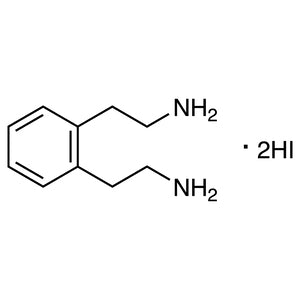
Dihydroiodide TCI B6569
Regular price From Rp 1.936.200,00Regular price -
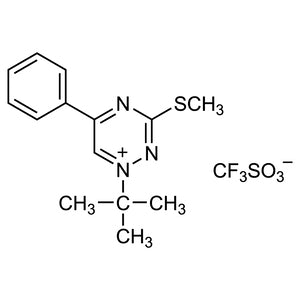
Trifluoromethanesulfonate TCI B7003
Regular price From Rp 1.936.200,00Regular price
![5,10-Bis(4,4,5,5-tetramethyl-1,3,2-dioxaborolan-2-yl)naphtho[1,2-c:5,6-c']bis([1,2,5]oxadiazole) - TCI B5774 - AMI Scientific](http://amiscientific.com/cdn/shop/files/TCI2510B5774.jpg?v=1769180228&width=533)