


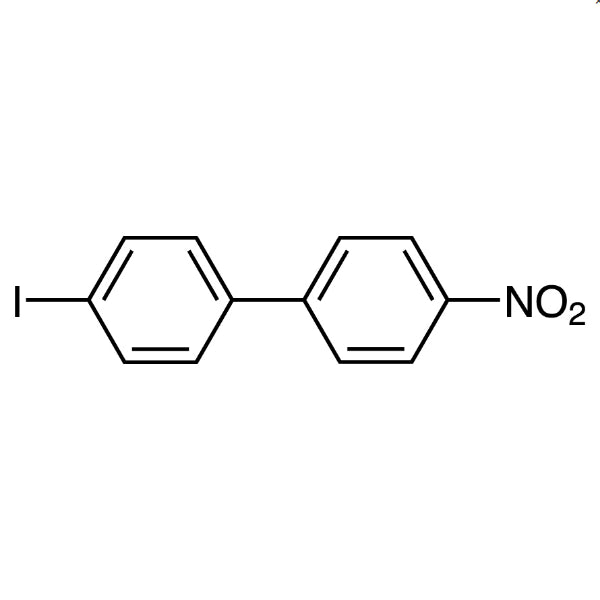

TCI I0537 4-Iodo-4'-nitrobiphenyl is a biphenyl compound carrying an iodine atom at the end of one ring and a nitro group at the end of the other ring, both in the para position. As a non-heterocyclic building block, this material provides a linear biphenyl framework that has already been functionalised at both ends, so it can be used directly as a long connecting unit in the construction of larger molecules. This directly linked two-ring aromatic structure is an important motif in materials chemistry, medicinal chemistry, and supramolecular chemistry because it confers rigidity together with a well-defined spatial reach.
The characteristic that makes this compound a preferred choice is the sharp difference in electronic character and reactivity between its two ends. The nitro group is a strong electron-withdrawing substituent that polarises the entire conjugated system, producing a large dipole moment that is useful in nonlinear optical materials research and in molecules with charge-transfer properties. That same nitro group can also be reduced to an aromatic amine, opening a route towards amides, diazonium salts, and a wide range of other derivatives. At the opposite end, the iodine atom provides a coupling site that is ready for coupling reactions.
In Indonesian laboratories, this type of difunctionalised building block is typically held as a synthesis starting material in university research groups, materials chemistry laboratories, and medicinal chemistry programmes that construct extended aromatic systems. Because the two ends react under different conditions, it suits stepwise synthetic planning in which one terminus is elaborated first and the other is reserved for a later stage, making it a practical stock item for laboratories that prepare biphenyl-based target molecules.
TCI brochures (PDF)
- Building Blocks for Organic Semiconductor 2026-03-24 · p. 5
Related TCI products
- Cross-coupling reaction substrate: the para iodine atom serves as a ready coupling point, allowing the biphenyl unit to be joined to other fragments while the nitro end remains untouched.
- Preparation of aromatic amine intermediates: the nitro group can be reduced to an aromatic amine, giving direct access to amides, diazonium salts, and numerous further derivatives.
- Nonlinear optical materials research: the strong electron-withdrawing nitro group polarises the conjugated system and produces a large dipole moment relevant to nonlinear optical investigations.
- Charge-transfer molecule design: the pronounced electronic contrast between the nitro and iodo termini makes this compound useful for building molecules with charge-transfer character.
- Supramolecular and materials chemistry scaffolds: the rigid, linear two-ring framework supplies a defined spatial reach, serving as a long connecting unit within larger assembled structures.
| Brand | TCI |
|---|---|
| CAS number | 29170-08-9 |
| Molecular formula | — |
| Purity | — |
| Category | Chemistry > Building Blocks > Non-Heterocyclic Building Blocks |
| Pack sizes | available in the standard catalogue pack sizes offered by TCI for this product |
| Physical form | — |
| Storage | keep according to the storage conditions stated on the manufacturer's label and safety data sheet |
- Chemical name: 4-Iodo-4'-nitrobiphenyl
- Product code: I0537
Store the container tightly closed in a cool, dry, and well-ventilated place, away from direct sunlight, heat, and ignition sources, and follow the specific storage conditions stated on the manufacturer's label and safety data sheet. Keep the material in its original supplier container, or in a tightly sealed, clearly labelled chemically compatible container if it is transferred. Handle only in a fume hood while wearing a laboratory coat, chemical-resistant gloves, and eye protection, and avoid inhalation of dust and contact with skin or eyes. Keep separated from strong reducing agents and other incompatible materials, weigh and transfer carefully to limit dust generation, and dispose of residues and contaminated materials in accordance with the applicable laboratory chemical waste procedures.
—
Produk Terkait
-
4'-Nitrobiphenyl-4-carboxaldehyde TCI N0967
Regular price From Rp 3.710.700,00Regular priceRp 2.594.550,00Sale price From Rp 3.710.700,00 -
4-Hydroxy-3-nitrobiphenyl TCI N0560
Regular price From Rp 2.757.300,00Regular priceRp 1.927.800,00Sale price From Rp 2.757.300,00 -
4-Hydroxy-2'-nitrobiphenyl TCI H0753
Regular price From Rp 3.155.250,00Regular priceRp 2.206.050,00Sale price From Rp 3.155.250,00 -
4,4'-Dibromo-2-nitrobiphenyl TCI D5189
Regular price From Rp 1.326.150,00Regular priceRp 927.150,00Sale price From Rp 1.326.150,00 -
2,4-Dichloro-4'-nitrobiphenylEther TCI D3912
Regular price Rp 6.943.650,00Regular priceRp 4.855.200,00Sale price Rp 6.943.650,00 -
2,2'-Diaminobiphenyl TCI D5255
Regular price Rp 2.782.500,00Regular priceRp 1.961.400,00Sale price Rp 2.782.500,00 -
2'-Bromo-[1,1'-biphenyl]-3-carbonitrile TCI B6956
Regular price From Rp 2.809.800,00Regular priceRp 1.980.300,00Sale price From Rp 2.809.800,00 -
3'-Bromo[1,1'-biphenyl]-4-carbonitrile TCI B5965
Regular price From Rp 2.411.850,00Regular priceRp 1.702.050,00Sale price From Rp 2.411.850,00


![2'-Bromo-[1,1'-biphenyl]-3-carbonitrile (CAS 690260-67-4) - TCI B6956 - AMI Scientific](http://amiscientific.com/cdn/shop/files/TCI2510B6956.jpg?v=1771058291&width=533)
![3'-Bromo[1,1'-biphenyl]-4-carbonitrile (CAS 160521-46-0) - TCI B5965 - AMI Scientific](http://amiscientific.com/cdn/shop/files/TCI2510B5965.jpg?v=1769180247&width=533)