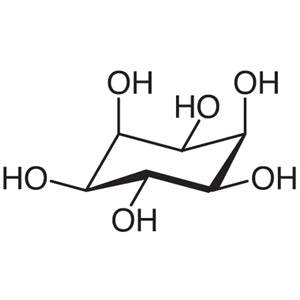
epi-Inositol is one of the rare stereoisomers of inositol, a cyclohexane ring bearing six hydroxyl groups arranged in a particular spatial configuration. Of the nine possible inositol stereoisomers, only a small number occur commonly in nature, and epi-inositol belongs to the group of rare isomers, which makes its availability especially valuable for research. In glycoscience and chemical biology laboratories, this compound is generally used as a comparison standard, as a reference material for analytical method development, and as a starting material in structure–activity relationship studies.
The property that leads researchers to select this material is the distinctive spatial arrangement of its hydroxyl groups. A difference in the orientation of even a single hydroxyl group can measurably alter hydrogen bonding patterns, solubility, and recognition by enzymes or binding proteins. For this reason, investigators use rare isomers of this kind to test how strictly an enzyme discriminates the stereochemistry of its substrate. The presence of six hydroxyl groups also makes it an attractive polyol scaffold for selective modification, although work of that nature demands careful protecting-group strategy.
In Indonesian laboratories, availability in small quantities is already sufficient for the roles this compound typically fills. University research groups, chemical biology laboratories, and analytical method development units generally require only limited amounts for use as reference and comparison material. Supplied under the TCI brand within the Chemistry > Chemical Biology > Glycoscience category, it fits routine research workflows where a well-defined rare inositol isomer is needed alongside more common isomers.
- Analytical reference material: serves as a defined comparison standard when developing and validating chromatographic or spectroscopic methods that must resolve closely related inositol stereoisomers.
- Enzyme stereoselectivity testing: used to probe how strictly an enzyme discriminates substrate stereochemistry, since a single differing hydroxyl orientation changes recognition by enzymes and binding proteins.
- Structure–activity relationship studies: functions as a starting material for investigating how the spatial arrangement of hydroxyl groups influences biological activity across the inositol isomer series.
- Glycoscience research: provides a rare, well-defined inositol stereoisomer for carbohydrate and polyol studies where common isomers alone cannot answer the stereochemical question posed.
- Selective polyol chemistry: its six hydroxyl groups offer an attractive scaffold for selective modification work, which requires carefully planned protecting-group strategies during synthesis.
| Brand | TCI |
|---|---|
| CAS number | 488-58-4 |
| Molecular formula | — |
| Purity | — |
| Category | Chemistry > Chemical Biology > Glycoscience |
| Pack sizes | available in small research quantities; please confirm the current pack options when ordering |
| Physical form | — |
| Storage | store according to the manufacturer's instructions stated on the product label |
- Product code: I0628
Store the container tightly closed in a cool, dry place, away from moisture, direct sunlight, and sources of heat, following the storage conditions printed on the manufacturer's label. Keep the material in its original supplier container, or in a clean, well-sealed glass or chemically compatible plastic vessel that is clearly labelled with the product name and CAS number. As a polyhydroxylated compound, it should be protected from humidity to avoid moisture uptake that may affect weighing accuracy. Handle in a well-ventilated area or fume hood, wear a laboratory coat, safety glasses, and suitable gloves, avoid generating dust, and consult the manufacturer's safety data sheet before use. Allow sealed containers to reach room temperature before opening to reduce condensation.
—
Produk Terkait
-
TCI B5774 5,10-Bis(4,4,5,5-tetramethyl-1,3,2-dioxaborolan-2-yl)naphtho[1,2-c:5,6-c']bis([1,2,5]oxadiazole)
Regular price Rp 10.255.350,00Regular price -
Dihydroiodide TCI B6569
Regular price From Rp 1.936.200,00Regular price -
Trifluoromethanesulfonate TCI B7003
Regular price From Rp 1.936.200,00Regular price
![5,10-Bis(4,4,5,5-tetramethyl-1,3,2-dioxaborolan-2-yl)naphtho[1,2-c:5,6-c']bis([1,2,5]oxadiazole) - TCI B5774 - AMI Scientific](http://amiscientific.com/cdn/shop/files/TCI2510B5774.jpg?v=1769180228&width=533)