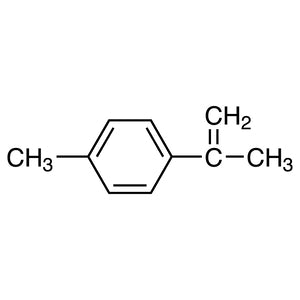
4-Isopropenyltoluene, catalogued under CAS number 1195-32-0, is an aromatic vinyl monomer whose structure closely resembles styrene, with the addition of a methyl group on the ring and an isopropenyl group serving as the polymerisation centre. The product is supplied in a stabilized state using TBC, an inhibitor added to prevent spontaneous polymerisation during storage and shipping. In materials science and polymer laboratories, this compound functions as a monomer for constructing homopolymers and copolymers, and as a reagent in research on addition reaction mechanisms at double bonds conjugated with an aromatic ring.
The property that makes this monomer attractive is its 1,1-disubstituted double bond, which gives polymerisation behaviour different from ordinary styrene, particularly in cationic and anionic polymerisation. The methyl group at the para position raises the electron density of the ring while also influencing chain stiffness and the thermal properties of the resulting polymer, so researchers can tune material character by selecting this monomer as a replacement for, or a companion to, styrene. The presence of the TBC stabilizer ensures the monomer remains liquid and pourable on arrival, even though the inhibitor must be taken into account when planning a reaction.
In Indonesian laboratories, this monomer is typically used within polymer chemistry and materials science research groups at universities and research institutes, as well as in industrial development units working on resins and specialty polymers. It is normally handled in small quantities for the synthesis of model polymers, copolymerisation studies, and the preparation of reference samples, where reproducible monomer quality matters more than volume.
- Homopolymer synthesis: the isopropenyl group acts as a defined polymerisation centre, allowing researchers to prepare poly(4-isopropenyltoluene) as a structurally well-characterised model polymer for comparison against polystyrene.
- Copolymerisation studies: pairing this monomer with styrene or other vinyl monomers lets researchers adjust chain stiffness and thermal behaviour systematically, because the para methyl group alters the electronic and steric environment of the growing chain.
- Cationic polymerisation research: the 1,1-disubstituted double bond stabilises the propagating cation differently from monosubstituted styrene, making this monomer a useful probe for reaction mechanism and kinetics investigations.
- Anionic polymerisation work: the distinct substitution pattern gives polymerisation behaviour that departs from ordinary styrene, providing a valuable comparison point in controlled polymerisation and living polymerisation experiments.
- Addition reaction mechanism studies: as a reagent, it supports research into addition across a double bond that is conjugated with an aromatic ring, where the electron-rich ring measurably influences reactivity and product distribution.
| Brand | TCI |
|---|---|
| CAS number | 1195-32-0 |
| Molecular formula | — |
| Purity | — |
| Category | Materials Science > Polymer/Macromolecule Reagents > Monomers |
| Pack sizes | available in the pack sizes listed on this product page |
| Physical form | liquid, supplied stabilized with TBC |
| Storage | keep the stabilizer intact; store as indicated on the manufacturer's label |
Store this monomer in a cool, well-ventilated area away from heat, direct sunlight, and sources of ignition, keeping it in the original tightly closed manufacturer container or an equivalent chemically compatible, well-sealed vessel. Because the material is stabilized with TBC to prevent spontaneous polymerisation, avoid conditions that would deplete or remove the inhibitor before use, and take the inhibitor into account when planning a reaction. Handle in a fume hood using appropriate gloves, safety goggles, and a laboratory coat, dispense only the quantity needed, and consult the manufacturer's safety data sheet before use.
—
Produk Terkait
-
TCI B5774 5,10-Bis(4,4,5,5-tetramethyl-1,3,2-dioxaborolan-2-yl)naphtho[1,2-c:5,6-c']bis([1,2,5]oxadiazole)
Regular price Rp 10.255.350,00Regular price -
Dihydroiodide TCI B6569
Regular price From Rp 1.936.200,00Regular price -
Trifluoromethanesulfonate TCI B7003
Regular price From Rp 1.936.200,00Regular price
![5,10-Bis(4,4,5,5-tetramethyl-1,3,2-dioxaborolan-2-yl)naphtho[1,2-c:5,6-c']bis([1,2,5]oxadiazole) - TCI B5774 - AMI Scientific](http://amiscientific.com/cdn/shop/files/TCI2510B5774.jpg?v=1769180228&width=533)