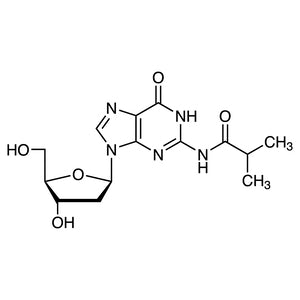
N2-Isobutyryl-2'-deoxyguanosine, CAS number 68892-42-2, is a guanosine deoxyribonucleoside in which the exocyclic amino group of the guanine base has been protected with an isobutyryl group. In nucleic acid chemistry laboratories, this compound serves as an important starting material on the route to DNA synthesis monomers. From this compound, the 5' hydroxyl group is subsequently protected with dimethoxytrityl and the 3' position is phosphitylated to form the deoxyguanosine phosphoramidite used by oligonucleotide synthesisers to assemble DNA strands according to the base sequence a researcher has designed.
The property that makes this compound so widely chosen is the appropriate base protection it places on guanine, the most reactive nucleobase and the one most prone to giving rise to side reactions if left unprotected during synthesis. The isobutyryl amide is robust enough to survive the full sequence of coupling and oxidation cycles, yet it can be removed completely at the final deprotection stage with ammonia. Both hydroxyl groups on the deoxyribose sugar remain available for stepwise functionalisation, giving researchers the freedom to devise their own synthetic strategies, including the preparation of modified nucleosides that are not commercially available.
In Indonesian laboratories, this material is typically handled in university and institutional research groups working on nucleic acid chemistry, in synthetic organic chemistry laboratories preparing oligonucleotide building blocks, and in molecular biology support facilities that produce or modify DNA sequences in house. It is also used in teaching and method development work where the stepwise protection chemistry of nucleosides is studied directly rather than purchased as a finished phosphoramidite.
- DNA phosphoramidite monomer preparation — the protected exocyclic amine on guanine is already in place, so the laboratory can proceed directly to 5' dimethoxytritylation and 3' phosphitylation without a separate base protection step.
- Automated oligonucleotide synthesis support — the isobutyryl amide withstands repeated coupling and oxidation cycles on the synthesiser, then comes off cleanly with ammonia during final deprotection of the assembled strand.
- Modified nucleoside synthesis — both deoxyribose hydroxyl groups remain free for stepwise functionalisation, allowing researchers to build modified deoxyguanosine derivatives that are not offered commercially.
- Protecting group strategy development — the compound gives synthetic chemists a well defined guanine protected starting point from which alternative protection and deprotection routes can be tested and compared.
- Nucleic acid chemistry teaching and method work — the material illustrates why the most reactive nucleobase requires protection, making it useful for practical training in nucleoside chemistry and side reaction control.
| Brand | TCI |
|---|---|
| CAS number | 68892-42-2 |
| Molecular formula | — |
| Purity | — |
| Category | Chemistry > Chemical Biology > Nucleic Acid Chemistry |
| Pack sizes | available in the catalogue pack sizes offered by TCI for this product code |
| Physical form | — |
| Storage | store according to the conditions stated on the manufacturer's label and safety data sheet |
- Product code: I0700
Store this material in its original tightly closed container in a cool, dry place, away from moisture, direct sunlight and sources of heat, and follow the specific storage temperature stated on the manufacturer's label and safety data sheet. Keep the container sealed between uses, as protected nucleosides are best handled under dry conditions to preserve their quality for downstream synthesis. Weigh and transfer the solid in a well ventilated area or fume hood using clean, dry spatulas and glassware. Wear a laboratory coat, safety glasses and suitable gloves, avoid the generation of dust, and wash hands after handling. Consult the manufacturer's safety data sheet before use and dispose of residues and contaminated materials in accordance with applicable laboratory waste procedures.
—
Produk Terkait
-
TCI B5774 5,10-Bis(4,4,5,5-tetramethyl-1,3,2-dioxaborolan-2-yl)naphtho[1,2-c:5,6-c']bis([1,2,5]oxadiazole)
Regular price Rp 10.255.350,00Regular price -
Dihydroiodide TCI B6569
Regular price From Rp 1.936.200,00Regular price -
Trifluoromethanesulfonate TCI B7003
Regular price From Rp 1.936.200,00Regular price
![5,10-Bis(4,4,5,5-tetramethyl-1,3,2-dioxaborolan-2-yl)naphtho[1,2-c:5,6-c']bis([1,2,5]oxadiazole) - TCI B5774 - AMI Scientific](http://amiscientific.com/cdn/shop/files/TCI2510B5774.jpg?v=1769180228&width=533)