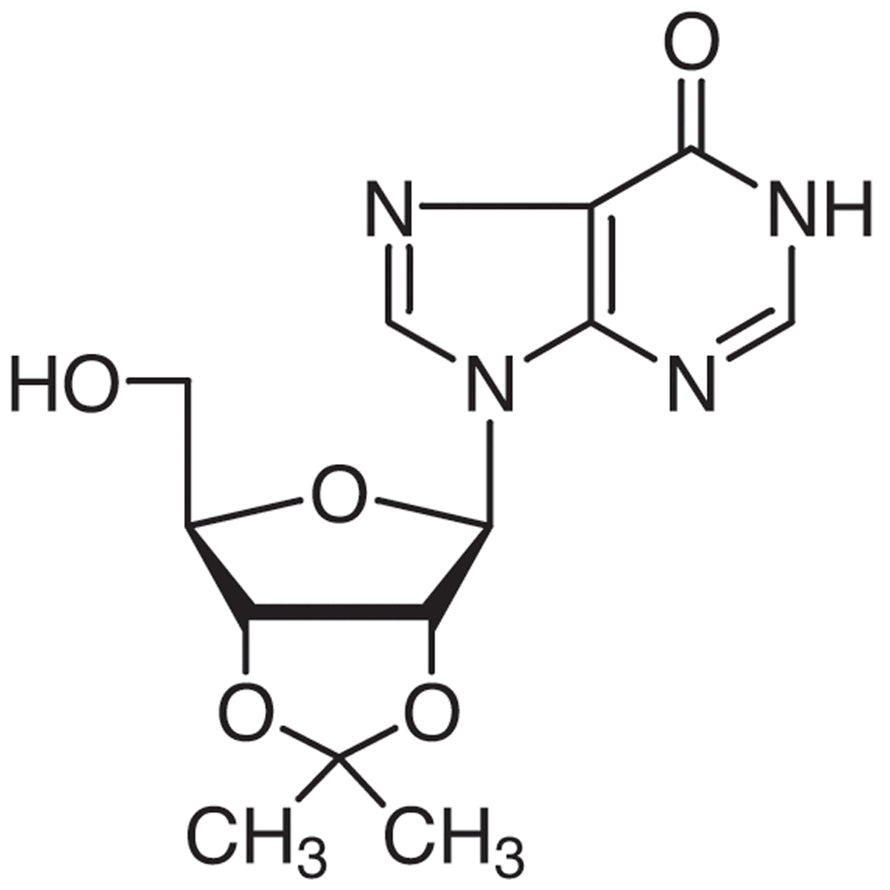
TCI I0704 2',3'-O-Isopropylideneinosine is inosine in which the 2',3'-diol of the ribose ring is protected as an acetonide. Inosine itself is a nucleoside built from a hypoxanthine base and ribose, widely recognised as an important junction in the purine metabolic pathway and as the "wobble" base found in transfer RNA. In this protected form, the compound serves as an intermediate that allows researchers to construct hypoxanthine nucleoside analogues, as a precursor for transformation into other purine derivatives, and as a reagent for studies of enzymes that process inosine in the biochemistry laboratory.
The principal appeal of this material lies in its chemical flexibility. The hypoxanthine base can be converted further into 6-chloro or other 6-substituted derivatives, so that a single intermediate can lead to a diverse range of purine analogues without the need to begin from a different nucleoside each time. The acetonide group withstands basic and neutral conditions yet opens under mild aqueous acidic treatment, giving neat control over the deprotection step. Protection of the diol also raises solubility in organic solvents and simplifies purification, making step-by-step yields easier to maintain at research scale.
In Indonesian laboratories, this compound is typically encountered in university and institutional research groups working on nucleoside chemistry, medicinal chemistry, and purine metabolism. It is generally handled in multi-step synthetic sequences where a protected nucleoside building block is required, and in biochemical studies where inosine-processing enzymes are examined. Its role is that of a specialty intermediate ordered in research quantities rather than a routine bulk consumable.
- Nucleoside analogue synthesis — the protected 2',3'-diol leaves the 5'-position and the hypoxanthine base free for selective modification, allowing controlled construction of hypoxanthine nucleoside analogues in multi-step sequences.
- Purine derivative preparation — the hypoxanthine base can be converted into 6-chloro or other 6-substituted purines, so a single intermediate opens access to a wide family of purine analogues.
- Medicinal chemistry building block — its defined protection pattern and organic-solvent solubility make it a practical starting material for exploratory routes toward nucleoside-based compounds of pharmacological interest.
- Enzyme study reagent — as a protected form of inosine it supports laboratory investigations of enzymes that process inosine within purine metabolism, including substrate and selectivity comparisons.
- Protecting-group methodology work — the acetonide is stable to basic and neutral conditions but cleaved by mild aqueous acid, making the compound a useful model for teaching and testing deprotection strategies.
| Brand | TCI (Tokyo Chemical Industry) |
|---|---|
| CAS number | 2140-11-6 |
| Molecular formula | — |
| Purity | — |
| Category | Life Science > Biochemicals and Reagents > Nucleosides, Nucleotides, Oligonucleotides |
| Pack sizes | supplied in research-scale pack sizes according to the TCI catalogue listing |
| Physical form | — |
| Storage | store as indicated on the manufacturer label for this nucleoside intermediate |
- Catalogue number: I0704
Store the container tightly closed in a cool, dry place away from direct sunlight, moisture, and sources of heat, following the conditions stated on the manufacturer label. Keep the material in its original supplier packaging or in a clean, well-sealed glass or chemically compatible container, clearly labelled with the compound name, catalogue number, and CAS number. Because the acetonide group is sensitive to acidic conditions, avoid contact with acids and humid air during weighing and transfer. Handle in a well-ventilated area or fume hood, wear a laboratory coat, safety glasses, and suitable gloves, and avoid inhalation of dust or contact with skin and eyes. Consult the manufacturer's safety data sheet before use and dispose of residues in accordance with institutional chemical waste procedures.
—
Produk Terkait
-
TCI B5774 5,10-Bis(4,4,5,5-tetramethyl-1,3,2-dioxaborolan-2-yl)naphtho[1,2-c:5,6-c']bis([1,2,5]oxadiazole)
Regular price Rp 10.255.350,00Regular price -
Dihydroiodide TCI B6569
Regular price From Rp 1.936.200,00Regular price -
Trifluoromethanesulfonate TCI B7003
Regular price From Rp 1.936.200,00Regular price
![5,10-Bis(4,4,5,5-tetramethyl-1,3,2-dioxaborolan-2-yl)naphtho[1,2-c:5,6-c']bis([1,2,5]oxadiazole) - TCI B5774 - AMI Scientific](http://amiscientific.com/cdn/shop/files/TCI2510B5774.jpg?v=1769180228&width=533)