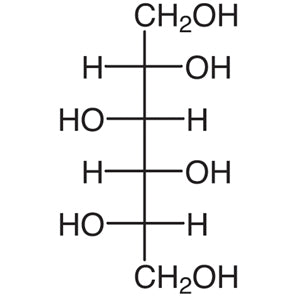
TCI I0725 L-Iditol is the enantiomer of D-iditol, a six-carbon sugar alcohol whose spatial arrangement is the mirror image of its counterpart. The compound is known in carbohydrate biochemistry as a polyol connected to the metabolic pathways of sorbitol and L-sorbose, and for that reason it is frequently cited in discussions of sorbitol dehydrogenase activity. In the laboratory, L-iditol serves as an analytical reference standard, a comparative substrate in enzymology studies, and a chiral starting material in the synthesis of polyhydroxy compounds.
The principal property that leads researchers to select this compound is the distinctiveness of its stereochemistry. Although its molecular formula is identical to that of other hexitols such as sorbitol, mannitol, and galactitol, the spatial arrangement of its hydroxyl groups determines whether a given enzyme recognizes and processes it. L-Iditol therefore becomes an important tool for testing enzyme selectivity and for confirming peak identity in instrumental analysis. Its availability in high purity allows researchers to draw a clear distinction between two enantiomeric forms that behave differently in biological systems.
Its strongly polar character and good solubility in water make it straightforward to combine with enzymatic assay systems. In Indonesian laboratories, L-iditol is typically encountered in university biochemistry and carbohydrate research groups, in food and pharmaceutical analysis laboratories that work with polyol profiles, and in synthetic chemistry groups requiring a defined chiral building block. It is most often used in small quantities as a reference material rather than as a bulk process input.
- Analytical reference standard: provides a defined identity marker for confirming polyol peaks in chromatographic and spectroscopic work where hexitols of identical mass must be told apart.
- Enzyme selectivity studies: acts as a comparative substrate against D-iditol and related hexitols, revealing whether an enzyme's active site discriminates on stereochemistry alone.
- Sorbitol dehydrogenase research: relates directly to the sorbitol and L-sorbose metabolic pathways, making it relevant to investigations of polyol-processing enzyme behaviour and specificity.
- Chiral synthesis starting material: supplies a stereochemically defined polyhydroxy scaffold for building more complex chiral compounds without needing to establish configuration afresh.
- Carbohydrate biochemistry teaching and method development: illustrates enantiomeric behaviour clearly, allowing students and analysts to see how spatial arrangement governs biological recognition in practice.
| Brand | TCI |
|---|---|
| CAS number | 488-45-9 |
| Molecular formula | — |
| Purity | — |
| Category | Chemistry > Chemical Biology > Glycoscience |
| Pack sizes | available in standard research-scale pack sizes; please confirm the currently listed options when ordering. |
| Physical form | sugar alcohol (hexitol); highly polar and readily soluble in water. |
| Storage | keep in a closed container under the conditions stated on the manufacturer's label. |
Store the container tightly closed in a cool, dry place away from direct sunlight and sources of heat, following the conditions printed on the manufacturer's label. Because the material is highly polar and water-soluble, it readily takes up atmospheric moisture, so containers should be sealed promptly after each use and opened only in a dry environment. Use clean, dry spatulas and glass or chemically compatible plastic containers to avoid cross-contamination that would compromise its value as a reference standard. Handle in a well-ventilated area, wear gloves, safety glasses, and a laboratory coat, and avoid generating dust. Consult the manufacturer's safety data sheet before first use and dispose of residues in accordance with institutional chemical waste procedures.
—
Produk Terkait
-
TCI B5774 5,10-Bis(4,4,5,5-tetramethyl-1,3,2-dioxaborolan-2-yl)naphtho[1,2-c:5,6-c']bis([1,2,5]oxadiazole)
Regular price Rp 10.255.350,00Regular price -
Dihydroiodide TCI B6569
Regular price From Rp 1.936.200,00Regular price -
Trifluoromethanesulfonate TCI B7003
Regular price From Rp 1.936.200,00Regular price
![5,10-Bis(4,4,5,5-tetramethyl-1,3,2-dioxaborolan-2-yl)naphtho[1,2-c:5,6-c']bis([1,2,5]oxadiazole) - TCI B5774 - AMI Scientific](http://amiscientific.com/cdn/shop/files/TCI2510B5774.jpg?v=1769180228&width=533)