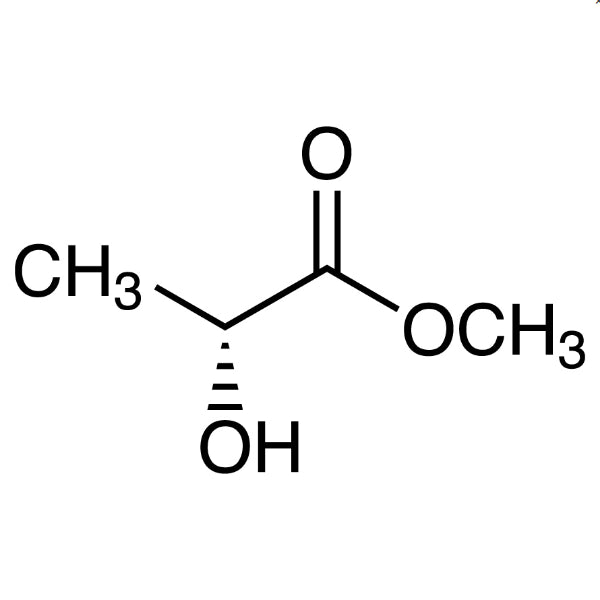
Methyl D-(+)-Lactate is the methyl ester of D-lactic acid, a small chiral molecule that carries a secondary hydroxyl group and an ester group on a three-carbon backbone. In synthesis laboratories, this compound serves as a chiral building block, meaning a starting material that already contains stereochemical information, so researchers do not need to construct the asymmetric center from scratch. This role is particularly valuable in the preparation of bioactive compounds, ligands, and pharmaceutical intermediates whose activity depends on the spatial configuration of the molecule.
The property that makes this compound a preferred choice is the presence of two different functional groups that can be modified sequentially. The hydroxyl group can be converted into an ether, an ester, or a leaving group, while the ester group can be reduced, amidated, or hydrolysed. The D configuration, indicated by a positive optical rotation, is available as the complement to the more common L enantiomer, allowing researchers to prepare both series of mirror-image compounds for activity testing. The material is a liquid of moderate polarity that dissolves readily in common organic solvents and can be purified by distillation.
In Indonesian laboratories, this compound is widely used in organic chemistry research, particularly in university and institutional groups working on asymmetric synthesis and the preparation of stereochemically defined intermediates. It is typically handled in small-scale synthetic work where a defined stereocenter must be carried through a multi-step sequence, and where access to both enantiomeric series supports comparative studies of biological activity.
- Asymmetric synthesis of bioactive compounds, where the existing stereocenter is carried through the route so the target is obtained with defined configuration without a separate resolution step.
- Preparation of chiral ligands, since the hydroxyl and ester groups can be elaborated independently into coordinating motifs while the three-carbon backbone retains its stereochemical information.
- Synthesis of pharmaceutical intermediates whose activity depends on spatial configuration, providing a stereochemically defined entry point that shortens routes toward enantiomerically pure targets.
- Preparation of mirror-image compound series for activity testing, because the D configuration complements the more common L enantiomer and allows both enantiomeric series to be built in parallel.
- Sequential functional group transformation studies, where the hydroxyl is converted into an ether, ester, or leaving group and the ester is reduced, amidated, or hydrolysed in a controlled order.
| Brand | TCI |
|---|---|
| CAS number | 17392-83-5 |
| Molecular formula | — |
| Purity | — |
| Category | Chemistry > Asymmetric Synthesis > Chiral Building Blocks |
| Pack sizes | available in the standard research pack sizes offered by the manufacturer for this catalogue item |
| Physical form | liquid of moderate polarity, soluble in common organic solvents and purifiable by distillation |
| Storage | keep in a tightly closed original container, protected from moisture |
- Catalogue number: L0136
Store the container tightly closed in a cool, dry, well-ventilated area away from heat sources, direct sunlight, and incompatible chemicals. Keep the material in its original supplier container or in glassware compatible with organic esters, ensuring the closure is secure to limit moisture uptake and evaporation, since the compound is a liquid. Handle in a fume hood using safety goggles, gloves, and a laboratory coat, and avoid contact with skin and eyes as well as inhalation of vapour. Transfer with clean, dry equipment to preserve stereochemical and chemical integrity, return the container promptly to storage after use, and consult the manufacturer's safety data sheet before first handling and for disposal guidance.
—
Produk Terkait
-
TCI B5774 5,10-Bis(4,4,5,5-tetramethyl-1,3,2-dioxaborolan-2-yl)naphtho[1,2-c:5,6-c']bis([1,2,5]oxadiazole)
Regular price Rp 10.255.350,00Regular price -
Dihydroiodide TCI B6569
Regular price From Rp 1.936.200,00Regular price -
Trifluoromethanesulfonate TCI B7003
Regular price From Rp 1.936.200,00Regular price
![5,10-Bis(4,4,5,5-tetramethyl-1,3,2-dioxaborolan-2-yl)naphtho[1,2-c:5,6-c']bis([1,2,5]oxadiazole) - TCI B5774 - AMI Scientific](http://amiscientific.com/cdn/shop/files/TCI2510B5774.jpg?v=1769180228&width=533)