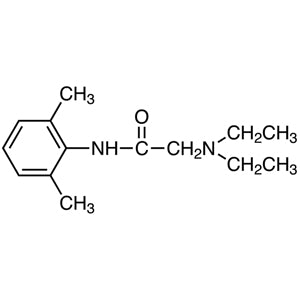
Lidocaine is a local anaesthetic compound of the amide class, structurally an acetamide derivative bearing a diethylaminoacetyl group attached to a 2,6-dimethylaniline ring. In the laboratory context, this material is supplied as a pharmaceutical research reagent intended for experimental purposes only, not for use in humans. Its role is that of a reference compound and test substance in studies of the mechanism of action of sodium channel blockers, in analytical method development, and in formulation research. Its availability as reagent-grade material makes it a consistent benchmark across a wide range of experimental designs.
The property that makes lidocaine a preferred research material is its relatively high chemical stability compared with ester-class local anaesthetics, because the amide bond is far more resistant to both enzymatic and chemical hydrolysis. As the free base, the compound is a solid that dissolves readily in organic solvents and can be converted into a water-soluble salt form as experimental requirements dictate. Its amphiphilic character, combining an ionisable tertiary amine group with a lipophilic aromatic ring, makes it an attractive model for studying partitioning behaviour between aqueous and lipid environments.
In Indonesian laboratories, this reagent is typically used in pharmaceutical research settings: university pharmacy and pharmacology departments, analytical chemistry laboratories developing and validating assay methods, and formulation development units working on dosage form research. It serves as a reference standard material in chromatographic work and as a model compound in mechanistic and physicochemical studies. Throughout, the material is handled strictly as an experimental reagent within controlled laboratory conditions.
- Sodium channel blocker mechanism studies — its well-defined amide structure and reagent-grade consistency make it a dependable test substance for probing how this class of compounds exerts its blocking action.
- Analytical method development and validation — the compound's chemical stability and defined identity allow it to serve as a reliable reference peak when establishing chromatographic or spectroscopic procedures.
- Pharmaceutical formulation research — its ability to exist as either a free base or a water-soluble salt gives formulators flexibility when investigating dosage form behaviour under different vehicle systems.
- Partitioning and physicochemical modelling — the amphiphilic combination of an ionisable tertiary amine and a lipophilic aromatic ring makes it a useful model for lipid–water distribution work.
- Comparative stability investigations — because the amide bond resists hydrolysis more strongly than ester linkages, it functions well as the stable comparator in degradation and stability study designs.
| Brand | TCI |
|---|---|
| CAS number | 137-58-6 |
| Molecular formula | — |
| Purity | — |
| Category | Life Science > Biochemicals and Reagents > Pharmaceutical Research Reagents (for Experimental Use) |
| Pack sizes | available in the standard TCI catalogue pack sizes; please confirm the required quantity when ordering |
| Physical form | solid (free base) |
| Storage | store under the conditions stated on the manufacturer's label and safety data sheet |
Store the material in its original tightly closed container, kept in a cool, dry and well-ventilated area away from direct sunlight, moisture and incompatible substances, following the conditions stated on the manufacturer's label and safety data sheet. Glass containers with chemically resistant closures are generally suitable, and containers should be resealed promptly after each use to limit moisture uptake. Handle the solid in a fume hood or a well-ventilated workspace, wearing a laboratory coat, gloves and eye protection, and avoid the generation of dust. Weigh and transfer the material using clean, dry utensils to prevent cross-contamination. As a pharmaceutical research reagent supplied for experimental use only, it must not be administered to humans, and all handling and disposal should follow the institution's laboratory safety procedures and applicable regulations.
—
Produk Terkait
-
TCI B5774 5,10-Bis(4,4,5,5-tetramethyl-1,3,2-dioxaborolan-2-yl)naphtho[1,2-c:5,6-c']bis([1,2,5]oxadiazole)
Regular price Rp 10.255.350,00Regular price -
Dihydroiodide TCI B6569
Regular price From Rp 1.936.200,00Regular price -
Trifluoromethanesulfonate TCI B7003
Regular price From Rp 1.936.200,00Regular price
![5,10-Bis(4,4,5,5-tetramethyl-1,3,2-dioxaborolan-2-yl)naphtho[1,2-c:5,6-c']bis([1,2,5]oxadiazole) - TCI B5774 - AMI Scientific](http://amiscientific.com/cdn/shop/files/TCI2510B5774.jpg?v=1769180228&width=533)