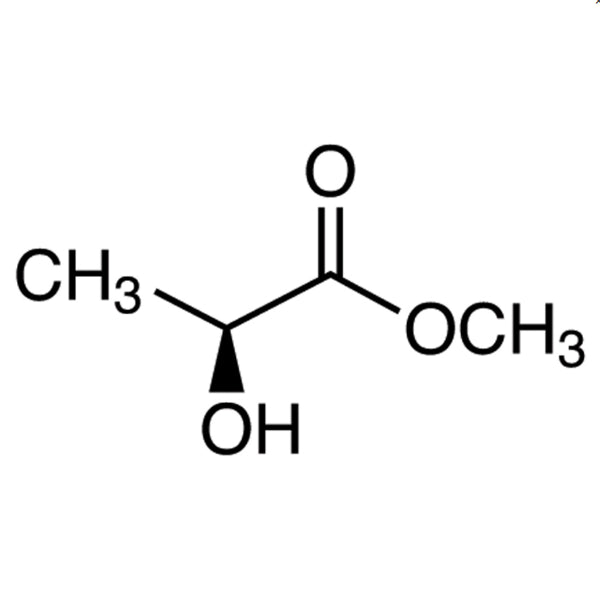
Methyl L-(-)-Lactate is the methyl ester of L-lactic acid, positioned as a chiral building block carrying a single stereogenic centre at the second carbon atom. Within one remarkably compact molecule it presents two distinct functional groups — a secondary hydroxyl and an ester — which allows the structure to be modified in stages without sacrificing the stereochemical information already embedded in it. In the organic synthesis laboratory its role is to supply a ready-made chiral framework drawn from the natural chiral pool, so that researchers are not obliged to construct an asymmetric centre from scratch through reaction sequences that are long, expensive, and frequently poor in selectivity.
The characteristic that makes this material such a widely chosen starting point is the presence of two reactive groups of differing reactivity, which lets the chemist direct transformations selectively. The hydroxyl group can be protected, oxidised, converted into a leaving group, or used as a grafting point, while the ester group can be reduced, converted to an amide, or transesterified. Because the two handles respond to different conditions, multi-step routes can be planned with confidence that one site will react while the other remains untouched. Its liquid form makes volumetric measurement and mixing straightforward at both small and intermediate scale.
In Indonesian laboratories, Methyl L-(-)-Lactate is typically encountered in university organic chemistry research groups, pharmaceutical and natural product synthesis programmes, and institutional research centres working on enantioselective methodology. It suits laboratories that need dependable access to a defined configuration without maintaining an in-house asymmetric synthesis capability. Being a liquid supplied in standard packaging, it integrates easily into existing fume hood workflows and ordinary solvent-handling routines used in teaching and research settings.
TCI brochures (PDF)
- Chiral Building Blocks 2025-04-14 · p. 8
- Chiral pool synthesis — provides a naturally derived stereogenic centre at the outset, removing the need to install asymmetry through lengthy catalytic or auxiliary-based sequences of uncertain selectivity.
- Pharmaceutical intermediate preparation — the defined L configuration is carried forward into target molecules where biological activity depends on the correct spatial arrangement at that carbon.
- Selective functional group manipulation — the secondary hydroxyl and the ester differ enough in reactivity that each can be addressed independently within a planned multi-step route.
- Protecting group and derivatisation chemistry — the free hydroxyl serves as a convenient site for protection, oxidation, conversion to a leaving group, or grafting of additional fragments.
- Ester transformation studies — the methyl ester can be reduced, amidated, or transesterified, giving access to alcohols, amides, and alternative esters that retain the original stereochemistry.
| Brand | TCI |
|---|---|
| CAS number | 27871-49-4 |
| Molecular formula | — |
| Purity | — |
| Category | Chemistry > Asymmetric Synthesis > Chiral Building Blocks |
| Pack sizes | available in standard TCI research-scale packaging; please confirm the size required when ordering |
| Physical form | liquid |
| Storage | keep in a cool, dry place in a tightly closed original container |
- Product code: L0163
Store the container tightly closed in a cool, dry, well-ventilated area away from direct sunlight, heat sources, and strong oxidising agents. The original supplier packaging is the most suitable container; if transfer is necessary, use clean and dry chemically compatible glassware and label it clearly with the product name and CAS number. Handle inside a fume hood and wear appropriate personal protective equipment, including safety goggles, chemical-resistant gloves, and a laboratory coat. Because the material is a liquid with a free hydroxyl group, keep the closure secure to limit moisture uptake and evaporation. Avoid contact with skin and eyes, do not inhale vapours, and consult the manufacturer's safety data sheet before first use and before disposal.
—
Product Categories
Produk Terkait
-
MethylD-(+)-Lactate TCI L0136
Regular price From Rp 1.115.100,00Regular priceRp 779.100,00Sale price From Rp 1.115.100,00 -
EthylL-(-)-Lactate TCI L0162
Regular price From Rp 505.050,00Regular priceRp 352.800,00Sale price From Rp 505.050,00 -
Benzyl(S)-(-)-Lactate TCI L0161
Regular price From Rp 2.411.850,00Regular priceRp 1.686.300,00Sale price From Rp 2.411.850,00 -
LithiumL-Lactate TCI L0144
Regular price Rp 1.353.450,00Regular priceRp 946.050,00Sale price Rp 1.353.450,00 -
(R)-(-)-2-Butanol TCI B0926
Regular price From Rp 1.749.300,00Regular priceRp 1.223.250,00Sale price From Rp 1.749.300,00 -
(S)-(+)-2-Butanol TCI B0925
Regular price From Rp 1.749.300,00Regular priceRp 1.223.250,00Sale price From Rp 1.749.300,00 -
(S)-(-)-1-PhenylethylAlcohol TCI P0796
Regular price From Rp 1.431.150,00Regular priceRp 1.000.650,00Sale price From Rp 1.431.150,00 -
(R)-(+)-1-PhenylethylAlcohol TCI P0795
Regular price From Rp 1.220.100,00Regular priceRp 852.600,00Sale price From Rp 1.220.100,00