

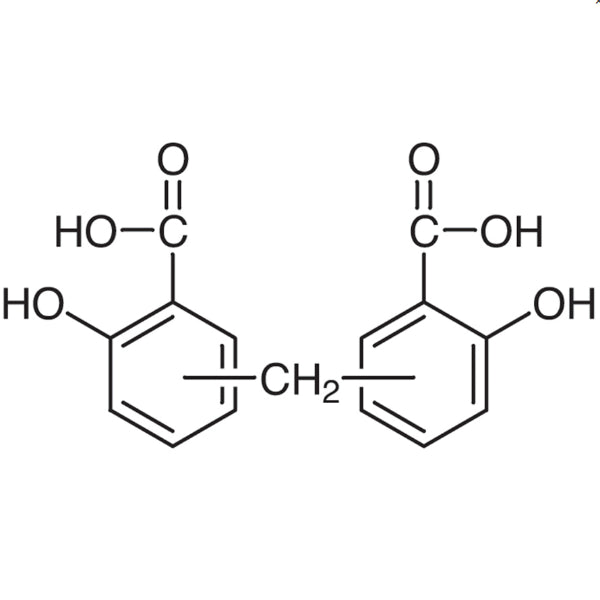
TCI M0221 Methylenedisalicylic Acid (mixture of isomers) is an aromatic, salicylic acid–based compound in which two rings are bridged by a methylene group, and it is supplied as a mixture of positional isomers, as is customary for condensation products of this type. In the laboratory, this material serves as a monomeric reagent and intermediate for polymer chemistry, particularly in research on phenolic resins and on materials that depend on multiple functional groups. The presence of two carboxyl groups and two phenolic hydroxyl groups within a single molecule makes it an attractive starting point for researchers who want to build polymer networks, study crosslinking reactions, or prepare more complex salicylate derivatives for further synthesis at research scale.
The characteristic that makes this material a preferred choice lies in its multifunctional structure. The carboxylate groups allow the formation of salts, esters, and amides through well-established reaction pathways, while the phenolic hydroxyl groups provide hydrogen-bonding capability and at the same time act as reactive sites toward electrophiles and activating reagents. The methylene bridge between the two rings gives a framework that is relatively rigid yet still retains some conformational freedom, so the molecule can be incorporated into a network without imposing excessive strain. Because the product is supplied as a mixture of isomers, it also reflects the realistic composition of condensation-derived materials rather than a single idealized structure.
In Indonesian laboratories, this reagent is generally used in university research groups, polymer and materials science laboratories, and institutional R&D units working on resin formulation and derivative synthesis. It is typically handled at bench scale, where small quantities are weighed out for reaction screening, crosslinking studies, or the preparation of intermediates. Researchers usually order it alongside other monomeric building blocks so that structure–property relationships can be compared systematically within a single experimental series.
TCI brochures (PDF)
- Monomers 2025-05-28 · p. 35
Related TCI products
- TCI D4383 879360-14-2 Decahydro-1,4-naphthalenedicarboxylic Acid (mixture of isomers)
- TCI V0195 106-87-6 3-(Oxiran-2-yl)-7-oxabicyclo[410]heptane (mixture of isomers)
- TCI T4428 13929-58-3 1,4,4a,5,8,8a-Hexahydro-1,4:5,8-dimethanonaphthalene (mixture of isomers) (stabilized with BHT)
- TCI T4004 43048-08-4 Tricyclodecanedimethanol Dimethacrylate (mixture of isomers) (stabilized with MEHQ)
- TCI T4002 42594-17-2 Tricyclo[5210~2,6~]decanedimethanol Diacrylate (mixture of isomers) (stabilized with MEHQ)
- TCI B3852 56602-77-8 Bis(aminomethyl)norbornane (mixture of isomers)
- Phenolic resin research: the combination of phenolic hydroxyl groups and a methylene bridge makes this compound directly relevant to studies of resin formation, curing behaviour, and network structure.
- Crosslinking studies: with four reactive sites available per molecule, it functions as a multifunctional node that allows researchers to investigate network density and connectivity in polymer systems.
- Monomer for polycondensation: the carboxyl groups participate in ester and amide-forming condensation reactions, making the material useful for preparing polyesters, polyamides, and related research polymers.
- Synthesis of salicylate derivatives: chemists use it as a starting material to build more complex salicylic acid derivatives, exploiting the distinct reactivity of its carboxyl and phenolic functions.
- Structure–property investigations: because it is supplied as a mixture of isomers, it is useful for examining how isomeric composition influences polymerisation behaviour and the properties of the resulting material.
| Brand | TCI |
|---|---|
| CAS number | 27496-82-8 |
| Molecular formula | — |
| Purity | — |
| Category | Materials Science > Polymer/Macromolecule Reagents > Monomers |
| Pack sizes | available in standard research and laboratory pack sizes; please confirm the currently offered packaging when ordering |
| Physical form | — |
| Storage | store in a tightly closed container in a cool, dry, well-ventilated place away from light |
- Product code: M0221
- Composition: supplied as a mixture of positional isomers
Store this reagent in its original tightly closed container, kept in a cool, dry, and well-ventilated area, protected from direct sunlight and from sources of heat or ignition. Glass containers with chemically resistant closures are suitable for repackaging small working quantities, and containers should be clearly labelled with the product name and CAS number. Handle the material inside a fume hood while wearing safety goggles, chemical-resistant gloves, and a laboratory coat, and avoid generating or inhaling dust during weighing and transfer. Keep the container closed when not in use to limit moisture uptake, and always consult the manufacturer's Safety Data Sheet before use and before disposal of any residues.
—
Produk Terkait
-
Decahydro-1,4-naphthalenedicarboxylicAcid(mixtureofisomers) TCI D4383
Regular price Rp 3.605.700,00Regular priceRp 2.521.050,00Sale price Rp 3.605.700,00 -
3-(Oxiran-2-yl)-7-oxabicyclo[410]heptane(mixtureofisomers) TCI V0195
Regular price From Rp 3.870.300,00Regular priceRp 2.705.850,00Sale price From Rp 3.870.300,00 -
1,4,4a,5,8,8a-Hexahydro-1,4:5,8-dimethanonaphthalene(mixtureofisomers)(stabilizedwithBHT) TCI T4428
Regular price From Rp 4.056.150,00Regular priceRp 2.836.050,00Sale price From Rp 4.056.150,00 -
TricyclodecanedimethanolDimethacrylate(mixtureofisomers)(stabilizedwithMEHQ) TCI T4004
Regular price From Rp 1.273.650,00Regular priceRp 890.400,00Sale price From Rp 1.273.650,00 -
Tricyclo[5210~2,6~]decanedimethanolDiacrylate(mixtureofisomers)(stabilizedwithMEHQ) TCI T4002
Regular price From Rp 1.273.650,00Regular priceRp 890.400,00Sale price From Rp 1.273.650,00 -
Bis(aminomethyl)norbornane(mixtureofisomers) TCI B3852
Regular price From Rp 1.033.200,00Regular priceRp 738.150,00Sale price From Rp 1.033.200,00 -
4,4'-Bicyclohexanol(mixtureofisomers) TCI B1621
Regular price From Rp 1.618.050,00Regular priceRp 1.146.600,00Sale price From Rp 1.618.050,00 -
1-(Acryloyloxy)-3-(methacryloyloxy)-2-propanol(mixtureofisomers)(stabilizedwithMEHQ) TCI A1988
Regular price From Rp 662.550,00Regular priceRp 478.800,00Sale price From Rp 662.550,00

![TCI V0195 106-87-6 3-(Oxiran-2-yl)-7-oxabicyclo[410]heptane (mixture of isomers)](http://amiscientific.com/cdn/shop/files/TCI2510V0195_3aa28874-d531-4bb9-b2d4-108ada4523c3.jpg?v=1792664894&width=533)
![106-87-6 3-(Oxiran-2-yl)-7-oxabicyclo[4.1.0]heptane (mixture of isomers) - AMI Scientific](http://amiscientific.com/cdn/shop/files/TCI2510V0195.jpg?v=1767145750&width=533)


![TCI T4002 42594-17-2 Tricyclo[5210~2,6~]decanedimethanol Diacrylate (mixture of isomers) (stabilized with MEHQ)](http://amiscientific.com/cdn/shop/files/TCI2510T4002_9fe2b8ed-669e-49b9-884b-b9b83c6a51ac.jpg?v=1792664453&width=533)
![42594-17-2 Tricyclo[5.2.1.0~2,6~]decanedimethanol Diacrylate (mixture of isomers) (stabilized with MEHQ) - AMI Scientific](http://amiscientific.com/cdn/shop/files/TCI2510T4002.jpg?v=1767144579&width=533)


