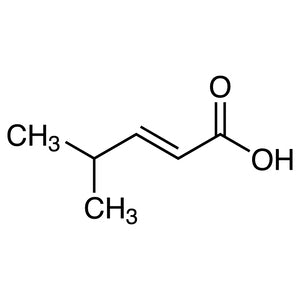
4-Methyl-2-pentenoic Acid (TCI M0268) is an alpha,beta-unsaturated carboxylic acid carrying an isopropyl branch at the chain terminus, supplied in stabilized form with HQ (hydroquinone) to prevent polymerization during storage. The compound is a non-heterocyclic building block that unites two important reactive elements within one small molecule: a carboxylic acid group and a carbon-carbon double bond conjugated to it. In the laboratory, this combination makes it an efficient starting material for constructing branched carbon chains, unnatural amino acids, and a range of unsaturated carbonyl compounds.
The characteristic that determines its selection is the Michael acceptor behaviour of the conjugated double bond, which leaves it ready to accept nucleophilic attack at the beta position, while the carboxylate group can be esterified, amidated, or reduced independently. The isopropyl branching adjacent to the double bond provides a distinctive steric environment that proves useful in selectivity studies, particularly in asymmetric hydrogenation and catalytic conjugate addition. The presence of hydroquinone as an inhibitor keeps the liquid polymer-free and easy to pipette, and the liquid form simplifies volumetric dispensing.
In Indonesian laboratories, this building block is generally used in synthetic organic chemistry groups at universities and research institutes, as well as in process development work where a small branched unsaturated acid is needed as a scaffold. Because it is supplied as a stabilized liquid, it fits routine bench work in which small portions are withdrawn repeatedly from the same bottle over an extended project. Its role is typically that of an intermediate rather than an end product, feeding subsequent coupling, addition, or functional-group interconversion steps.
- Conjugate addition and Michael reaction studies, where the double bond conjugated to the carboxylic acid readily accepts nucleophilic attack at the beta position under catalytic or stoichiometric conditions.
- Asymmetric hydrogenation research, in which the isopropyl branch near the double bond creates a distinctive steric environment that makes this substrate informative for probing catalyst facial selectivity.
- Synthesis of unnatural amino acids, using the unsaturated acid backbone as the carbon framework onto which nitrogen functionality is introduced through addition chemistry at the beta carbon.
- Construction of branched carbon chains, since the terminal isopropyl group is already installed and saves the synthetic steps otherwise needed to build that branching.
- Preparation of unsaturated carbonyl derivatives, because the carboxylate group can be esterified, amidated, or reduced independently of the conjugated double bond in the same molecule.
| Brand | TCI |
|---|---|
| CAS number | 10321-71-8 |
| Molecular formula | — |
| Purity | — |
| Category | Chemistry > Building Blocks > Non-Heterocyclic Building Blocks |
| Pack sizes | available in the catalogue pack sizes supplied by TCI for this article number |
| Physical form | liquid, stabilized with HQ (hydroquinone) |
| Storage | keep the stabilizer intact by storing the bottle closed and avoiding conditions that promote polymerization |
Store the bottle tightly closed in a cool, well-ventilated chemical store away from heat, direct sunlight, and ignition sources, since the stabilizer is what keeps the conjugated liquid free of polymer during prolonged storage. Keep the material in its original supplier container, or transfer to glass or another compatible container resistant to organic acids; avoid reactive metal vessels. Handle in a fume hood with gloves, safety glasses, and a laboratory coat, as unsaturated carboxylic acids are corrosive and irritating to skin, eyes, and the respiratory tract. Withdraw portions with clean dry pipettes to avoid introducing moisture or contaminants, close the bottle promptly after each use, and segregate the material from strong bases and oxidizing agents. Consult the supplier safety data sheet before first use.
—
Produk Terkait
-
TCI B5774 5,10-Bis(4,4,5,5-tetramethyl-1,3,2-dioxaborolan-2-yl)naphtho[1,2-c:5,6-c']bis([1,2,5]oxadiazole)
Regular price Rp 10.255.350,00Regular price -
Dihydroiodide TCI B6569
Regular price From Rp 1.936.200,00Regular price -
Trifluoromethanesulfonate TCI B7003
Regular price From Rp 1.936.200,00Regular price
![5,10-Bis(4,4,5,5-tetramethyl-1,3,2-dioxaborolan-2-yl)naphtho[1,2-c:5,6-c']bis([1,2,5]oxadiazole) - TCI B5774 - AMI Scientific](http://amiscientific.com/cdn/shop/files/TCI2510B5774.jpg?v=1769180228&width=533)