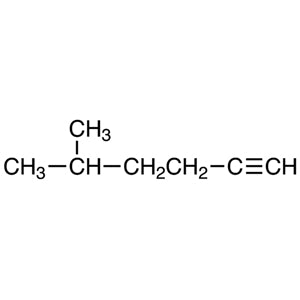
5-Methyl-1-hexyne (TCI M0271) is a branched terminal alkyne built on a seven-carbon chain with a free ethyne group at one end. The compound extends the family of alkyne building blocks by offering a longer chain than pentyne, which makes it a sensible choice whenever a researcher needs a slightly larger lipophilic spacer between the reactive group and the rest of the molecule. In synthetic laboratories, this material serves as a source of alkyne fragments that can be coupled, cycloadded, or converted into a wide range of other functional groups.
The reasons for selecting it are as strong as those for any other terminal alkyne, but with a different chain profile. Its acetylenic hydrogen can be deprotonated by strong bases to form an acetylide that reacts with aldehydes, ketones, epoxides, and alkyl halides. The terminal group meets the requirements of the Sonogashira reaction and of copper-catalysed azide–alkyne cycloaddition. The methyl branch at the fifth position contributes lipophilic character and prevents the chains from packing too tightly in the resulting materials, a property that is exploited in ligand design and in the construction of functional molecules.
The material presents as a volatile and highly flammable liquid. Indonesian laboratories working in organic synthesis, medicinal chemistry research, and materials development use this class of terminal alkyne as a routine reagent on the bench, where the free ethyne terminus provides a predictable entry point into coupling and cycloaddition chemistry. Its handling follows the same practices already established for volatile, low-boiling hydrocarbons in university, government, and industrial research settings across the country.
TCI brochures (PDF)
- Click Chemistry 2026-09-08 · p. 10
- Sonogashira cross-coupling — the free terminal alkyne group satisfies the structural requirement of this palladium- and copper-mediated reaction with aryl and vinyl halide partners.
- Copper-catalysed azide–alkyne cycloaddition — the unsubstituted ethyne terminus makes this compound a direct click chemistry partner for building triazole linkages in conjugates.
- Acetylide formation with carbonyl electrophiles — deprotonation by a strong base generates a nucleophilic acetylide that adds cleanly to aldehydes and ketones.
- Ring opening of epoxides and alkylation — the same acetylide species reacts with epoxides and alkyl halides to extend carbon chains with defined alkyne placement.
- Ligand and functional molecule design — the fifth-position methyl branch imparts lipophilic character and discourages overly tight chain packing in the resulting materials.
| Brand | TCI (Tokyo Chemical Industry) |
|---|---|
| CAS number | 2203-80-7 |
| Molecular formula | — |
| Purity | — |
| Category | Chemistry > Building Blocks > Non-Heterocyclic Building Blocks |
| Pack sizes | available in the standard TCI catalogue packaging for this item; please confirm the pack size when ordering |
| Physical form | volatile, highly flammable liquid |
| Storage | keep in a cool, well-ventilated area away from ignition sources |
- Catalogue number: M0271
Because this material is a volatile and highly flammable liquid, store it in a cool, well-ventilated flammables cabinet, well away from open flames, hot surfaces, sparks, and other ignition sources. Keep the container tightly closed in its original packaging to limit vapour loss, and use only containers and closures compatible with low-boiling hydrocarbons. All transfers and reaction set-ups should be carried out in a functioning fume hood, with the operator wearing safety glasses, a laboratory coat, and chemically resistant gloves. Ground and bond containers when transferring larger volumes to control static discharge, keep an appropriate fire extinguisher accessible, and consult the manufacturer's safety data sheet before first use.
—
Product Categories
Produk Terkait
-
1-Hexyne TCI H0140
Regular price From Rp 1.590.750,00Regular priceRp 1.111.950,00Sale price From Rp 1.590.750,00 -
6-Chloro-1-hexyne TCI C1493
Regular price Rp 1.298.850,00Regular priceRp 908.250,00Sale price Rp 1.298.850,00 -
1-Phenyl-1-hexyne TCI P0360
Regular price Rp 2.439.150,00Regular priceRp 1.705.200,00Sale price Rp 2.439.150,00 -
3-Hexyne TCI H0430
Regular price From Rp 1.035.300,00Regular priceRp 723.450,00Sale price From Rp 1.035.300,00 -
2-Hexyne TCI H0429
Regular price From Rp 637.350,00Regular priceRp 445.200,00Sale price From Rp 637.350,00 -
1,3,5-Triethynylbenzene TCI T2760
Regular price From Rp 3.578.400,00Regular priceRp 2.502.150,00Sale price From Rp 3.578.400,00 -
1-Butyl-4-ethynylbenzene TCI B2301
Regular price From Rp 980.700,00Regular priceRp 685.650,00Sale price From Rp 980.700,00 -
3,3-Dimethyl-1-butyne TCI B1114
Regular price From Rp 3.446.100,00Regular priceRp 2.409.750,00Sale price From Rp 3.446.100,00