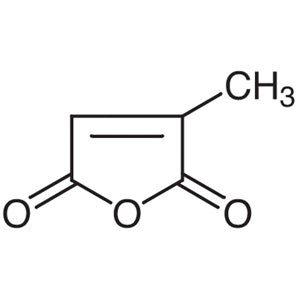
TCI M0365 Citraconic Anhydride is an unsaturated cyclic acid anhydride, the anhydride form of citraconic acid, which is also known as methylmaleic acid. Its five-membered ring carries two carbonyl groups, a structural feature that makes the compound highly reactive toward nucleophiles such as amines, alcohols, and water. In the laboratory it serves as a non-heterocyclic building block that forms amide and ester bonds while simultaneously introducing a free carboxyl group in a single reaction step, shortening synthetic routes that would otherwise require several separate stages.
The property that most often drives its selection is its ability to perform reversible amine modification. Reaction with primary amino groups, for example the lysine side chains of a protein, produces derivatives that can be cleaved again under mildly acidic conditions, restoring the amine group to its original state. This behaviour makes the reagent an important tool in protein modification work and in temporary functional group protection. The double bond within the ring additionally opens opportunities for addition reactions and copolymerisation, broadening the range of chemistry a single reagent can support.
In Indonesian laboratories the material is typically handled in synthetic chemistry, polymer, and biochemistry groups where a compact bifunctional acylating agent is needed. Its liquid form makes volumetric dispensing straightforward, which suits bench-scale work where small and repeatable portions are measured out. That same form demands water-free handling, since anhydrides hydrolyse readily, so it is normally used within workflows that already maintain dry solvents and dry glassware.
- Reversible protein modification: primary amino groups on lysine side chains are acylated and can later be released under mildly acidic conditions, returning the protein amine to its original state.
- Temporary functional group protection: the reagent masks amine functionality during a synthetic sequence and is removed afterwards without requiring harsh deprotection chemistry that could damage sensitive substrates.
- Amide bond construction: reaction with amines forms the amide linkage and delivers a free carboxyl group in the same step, shortening multi-stage synthetic routes considerably.
- Ester synthesis: alcohols open the anhydride ring to give the ester together with a pendant carboxylic acid, providing a difunctional product from one simple operation.
- Copolymerisation and addition chemistry: the unsaturated double bond in the ring participates in addition reactions and allows the unit to be incorporated into copolymer backbones.
| Brand | TCI |
|---|---|
| CAS number | 616-02-4 |
| Molecular formula | — |
| Purity | — |
| Category | Chemistry > Building Blocks > Non-Heterocyclic Building Blocks |
| Pack sizes | available in the standard TCI catalogue packaging; please confirm the required size when ordering |
| Physical form | liquid, which allows convenient volumetric dispensing |
| Storage | keep tightly closed and protected from moisture, as the anhydride hydrolyses on contact with water |
Store the container tightly closed in a cool, dry, well-ventilated place away from moisture and incompatible nucleophilic materials such as amines and alcohols. Original manufacturer bottles are the preferred container; if transfer is necessary, use clean, thoroughly dried glassware with chemically resistant closures. Because the compound reacts readily with water, dispense it using dry syringes or pipettes and reseal promptly to limit exposure to atmospheric humidity. Work in a fume hood, wear appropriate gloves, safety glasses, and a laboratory coat, and avoid contact with skin, eyes, and clothing. Consult the manufacturer safety data sheet before use and dispose of residues according to institutional chemical waste procedures.
—
Product Categories
Produk Terkait
-
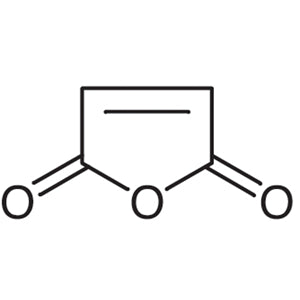
MaleicAnhydride TCI M0005
Regular price From Rp 505.050,00Regular priceRp 368.550,00Sale price From Rp 505.050,00 -
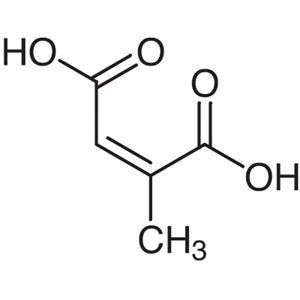
CitraconicAcid TCI C0363
Regular price From Rp 557.550,00Regular priceRp 405.300,00Sale price From Rp 557.550,00 -
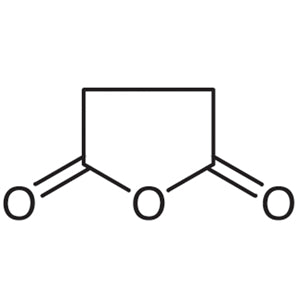
SuccinicAnhydride TCI S0107
Regular price From Rp 530.250,00Regular priceRp 386.400,00Sale price From Rp 530.250,00 -
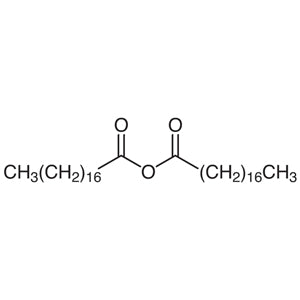
StearicAnhydride TCI S0083
Regular price From Rp 2.518.950,00Regular priceRp 1.776.600,00Sale price From Rp 2.518.950,00 -
PalmiticAnhydride TCI P0008
Regular price From Rp 2.623.950,00Regular priceRp 1.850.100,00Sale price From Rp 2.623.950,00 -
MyristicAnhydride TCI M0484
Regular price From Rp 3.790.500,00Regular priceRp 2.665.950,00Sale price From Rp 3.790.500,00 -
LauricAnhydride TCI L0017
Regular price From Rp 2.173.500,00Regular priceRp 1.535.100,00Sale price From Rp 2.173.500,00 -
DecanoicAnhydride TCI C0020
Regular price From Rp 2.041.200,00Regular priceRp 1.442.700,00Sale price From Rp 2.041.200,00