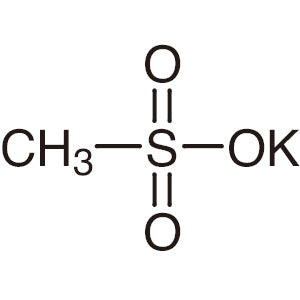
Potassium Methanesulfonate (KMS), with the CAS number 2386-56-3, is a versatile chemical compound widely used in laboratory settings for its reactivity and utility in various chemical reactions. As the potassium salt of methanesulfonic acid, KMS plays a crucial role in organic and analytical chemistry by participating in substitution and nucleophilic reactions. Its ability to act as both an acid and a base makes it a valuable reagent in synthetic processes. This compound is particularly useful in reactions that require acidic or basic conditions, where it can serve as a catalyst or a source of ions.
KMS is preferred for its chemical stability, reactivity, and compatibility with a wide range of solvents. It is a white, crystalline solid that dissolves readily in water, making it easy to handle and incorporate into experimental procedures. Its non-heterocyclic nature ensures minimal unwanted interactions with other compounds, reducing the risk of side reactions. This characteristic is especially important in complex synthetic pathways where purity and selectivity are critical. Additionally, its stability under normal storage conditions allows for long-term use without significant degradation.
In Indonesian laboratories, KMS is commonly used in organic and analytical research. It is a staple in academic and industrial research settings, supporting a variety of chemical syntheses and analytical techniques. Due to its reliability and effectiveness, KMS is a trusted reagent for both teaching and research purposes. Its widespread application highlights its importance in the chemical sciences, making it an essential component of many laboratory workflows.
- Organic synthesis reactions benefit from KMS due to its ability to act as a versatile acid and base, facilitating substitution and nucleophilic mechanisms in various synthetic pathways.
- Analytical chemistry applications utilize KMS for its stability and solubility, making it suitable for use in titration and ion-exchange processes.
- Catalytic processes in chemical reactions often employ KMS as a catalyst or co-catalyst, enhancing reaction rates and selectivity in complex synthetic systems.
- In the preparation of organic compounds, KMS is used to provide a controlled acidic environment, which is essential for certain functional group transformations.
- Routine laboratory experiments in both academic and industrial settings rely on KMS for its predictable behavior and compatibility with a wide range of solvents and reagents.
| Brand | TCI |
|---|---|
| CAS number | 2386-56-3 |
| Molecular formula | — |
| Purity | — |
| Category | Chemistry > Building Blocks > Non-Heterocyclic Building Blocks |
| Pack sizes | Available in various quantities as per standard chemical supply specifications |
| Physical form | White crystalline solid |
| Storage | Store in a cool, dry place away from moisture and direct sunlight |
KMS should be stored in a cool, dry environment to maintain its chemical integrity and prevent degradation. It is recommended to keep it in airtight containers to minimize exposure to moisture, which can affect its solubility and reactivity. Due to its high solubility in water, it is important to ensure that the storage area is well-ventilated to prevent the formation of airborne particles. While KMS is generally stable under normal conditions, it should be handled with care to avoid contamination. In laboratory settings, it is advisable to use appropriate personal protective equipment, such as gloves and safety goggles, when handling this compound. Proper storage and handling practices ensure the safety of laboratory personnel and the effectiveness of the compound in experimental applications.
—
Produk Terkait
-
TCI B5774 5,10-Bis(4,4,5,5-tetramethyl-1,3,2-dioxaborolan-2-yl)naphtho[1,2-c:5,6-c']bis([1,2,5]oxadiazole)
Regular price Rp 10.255.350,00Regular price -
Dihydroiodide TCI B6569
Regular price From Rp 1.936.200,00Regular price -
Trifluoromethanesulfonate TCI B7003
Regular price From Rp 1.936.200,00Regular price
![5,10-Bis(4,4,5,5-tetramethyl-1,3,2-dioxaborolan-2-yl)naphtho[1,2-c:5,6-c']bis([1,2,5]oxadiazole) - TCI B5774 - AMI Scientific](http://amiscientific.com/cdn/shop/files/TCI2510B5774.jpg?v=1769180228&width=533)