

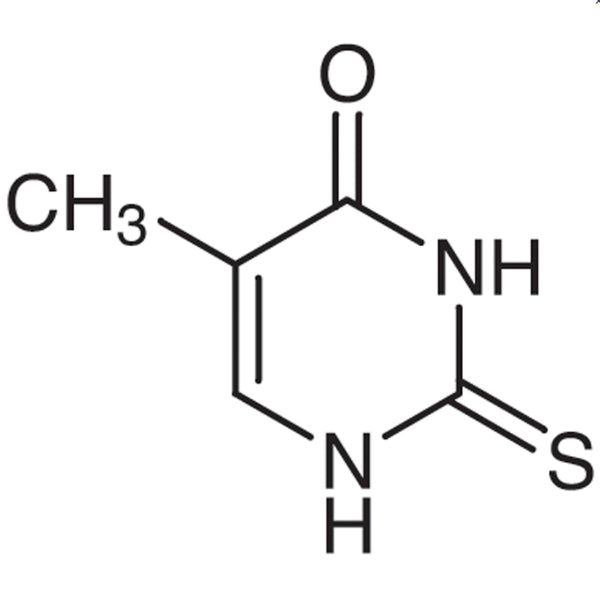
TCI M0994 5-Methyl-2-thiouracil is a pyrimidine nucleobase analogue in which the oxygen atom at position 2 has been replaced by a sulfur atom, while a methyl group is carried at position 5 in the same manner found in thymine. This sulfur substitution is not a minor modification, because it alters the electronic character, the hydrogen-bonding capability, and the light-absorption behaviour of the pyrimidine framework. In biochemistry and medicinal chemistry laboratories, the compound serves as a base analogue for studying molecular recognition in nucleic acids, and equally as a building block for the synthesis of more complex heterocyclic derivatives.
The most prominent property of this compound is the presence of a thiocarbonyl group that is considerably more nucleophilic and far more readily polarised than the carbonyl group of ordinary uracil. As a consequence, the sulfur atom becomes the preferred reaction site for selective alkylation, and at the same time acts as a capable donor in the formation of complexes with metal ions. The shift in ultraviolet absorption brought about by the sulfur substitution also makes this compound useful as a photoreactive marker in nucleic acid structural studies. Its form as a stable solid simplifies weighing and storage.
In Indonesian laboratories, 5-methyl-2-thiouracil is typically encountered in university biochemistry and medicinal chemistry groups, in research institute settings, and in synthetic laboratories preparing heterocyclic derivatives. Because it is supplied as a stable solid, it is well suited to routine analytical-balance weighing and to preparation of stock solutions as required by the experimental protocol, and it can be kept alongside other reagents in a standard chemical store without special infrastructure.
TCI brochures (PDF)
- Nucleosides, Nucleotides, Nucleic Acids and Related Reagents 2026-03-23 · p. 8
- Nucleic acid base analogue studies, where the sulfur-for-oxygen replacement at position 2 changes hydrogen-bonding capability and allows researchers to probe how bases are recognised within nucleic acid structures.
- Photoreactive labelling in nucleic acid structural work, taking advantage of the ultraviolet absorption shift produced by the thiocarbonyl group to mark and follow structural features under light.
- Heterocyclic synthesis, where the molecule serves as a building block for preparing more complex heterocyclic derivatives in medicinal chemistry and general synthetic organic programmes.
- Selective alkylation chemistry, since the thiocarbonyl sulfur is markedly more nucleophilic than a carbonyl oxygen and therefore acts as the preferred and predictable site of reaction.
- Metal complexation experiments, in which the polarisable sulfur atom behaves as a good donor for forming coordination complexes with metal ions under laboratory conditions.
| Brand | TCI |
|---|---|
| CAS number | 636-26-0 |
| Molecular formula | — |
| Purity | — |
| Category | Life Science > Biochemicals and Reagents > Nucleosides, Nucleotides, Oligonucleotides |
| Pack sizes | available in the standard TCI catalogue pack sizes; please confirm the required size when ordering |
| Physical form | stable solid |
| Storage | store in a closed container under normal laboratory reagent conditions |
Store the material in its original tightly closed container, kept in a cool, dry place away from direct sunlight, moisture, and incompatible chemicals. Amber glass or the supplier's own container is suitable, and the cap should be replaced immediately after each weighing to limit exposure to atmospheric moisture. Handle the solid in a well-ventilated area or fume hood, using gloves, safety glasses, and a laboratory coat, and avoid raising dust during transfer or weighing. Use a clean, dry spatula for each withdrawal to prevent cross-contamination of the bulk material, label all prepared solutions clearly, and consult the manufacturer's safety data sheet before first use and before disposal of any residues.
—
Produk Terkait
-
4-Thiouracil TCI T2757
Regular price Rp 2.835.000,00Regular priceRp 1.998.150,00Sale price Rp 2.835.000,00 -
2-Thiouracil TCI T0224
Regular price From Rp 1.298.850,00Regular priceRp 924.000,00Sale price From Rp 1.298.850,00 -
6-Propyl-2-thiouracil TCI P0533
Regular price Rp 3.100.650,00Regular priceRp 2.184.000,00Sale price Rp 3.100.650,00 -
6-Phenyl-2-thiouracil TCI P0236
Regular price From Rp 1.723.050,00Regular priceRp 1.220.100,00Sale price From Rp 1.723.050,00 -
6-Methyl-2-thiouracil TCI M0443
Regular price From Rp 795.900,00Regular priceRp 572.250,00Sale price From Rp 795.900,00 -
6-Azauracil TCI A0558
Regular price From Rp 610.050,00Regular priceRp 442.050,00Sale price From Rp 610.050,00 -
AdenineSulfateDihydrate TCI A0151
Regular price From Rp 3.074.400,00Regular priceRp 2.165.100,00Sale price From Rp 3.074.400,00 -
AdenineHydrochlorideHemihydrate TCI A0150
Regular price From Rp 717.150,00Regular priceRp 516.600,00Sale price From Rp 717.150,00


