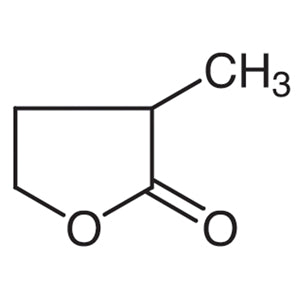
TCI M1100 alpha-Methyl-gamma-butyrolactone is a five-membered cyclic ester that carries a methyl group on the alpha carbon, the carbon positioned directly adjacent to the carbonyl group. The compound belongs to the gamma-butyrolactone family, a class well known in organic laboratories because the ring is stable enough to be handled easily yet can still be opened under the right conditions. As a non-heterocyclic building block, this material supplies a four-carbon, oxygen-terminated framework ready to be elaborated into functionalised chains, while also serving as a classical substrate for the study of enolate reactions.
The property that makes this lactone valuable is its controlled reactivity at two distinct points. The alpha carbon can be deprotonated with a strong base to form an enolate, which is then reacted with an electrophile to construct a quaternary centre that is difficult to build by other means, because one methyl group already occupies that position. The lactone carbonyl, meanwhile, can be attacked by nucleophiles to open the ring into hydroxyamides, hydroxyesters, or diols after reduction. Its liquid form is stable at room temperature and it mixes readily with many common organic solvents, which keeps reaction set-up straightforward.
In Indonesian laboratories this building block is typically used in synthetic organic chemistry groups at universities and research institutes, where it supports methodology work on enolate alkylation and ring-opening routes. It also finds a place in industrial and contract research settings that prepare functionalised intermediates on a small scale. Because it is a single-component liquid reagent supplied by TCI, it fits easily into bench-scale schemes where a reliable, well-characterised starting material is required.
- Enolate alkylation studies: the alpha methyl group already occupies one position, so deprotonation and reaction with an electrophile cleanly builds a quaternary carbon centre for methodology research.
- Ring-opening synthesis of hydroxyamides: nucleophilic attack at the lactone carbonyl by amines opens the five-membered ring to give hydroxyamide products with a defined four-carbon backbone.
- Preparation of hydroxyesters: alcohols acting as nucleophiles at the carbonyl carbon open the lactone ring, giving hydroxyester intermediates useful for further chain elaboration in multistep routes.
- Diol preparation via reduction: reductive opening of the lactone ring converts the material into a diol, providing a simple route to difunctional oxygen-containing fragments.
- Building-block chemistry for functionalised chains: the oxygen-terminated four-carbon framework serves as a compact, non-heterocyclic scaffold that can be developed into longer functionalised carbon chains.
| Brand | TCI |
|---|---|
| CAS number | 1679-47-6 |
| Molecular formula | — |
| Purity | — |
| Category | Chemistry > Building Blocks > Non-Heterocyclic Building Blocks |
| Pack sizes | available in the catalogue pack sizes offered by TCI for this item |
| Physical form | liquid, stable at room temperature, miscible with many common organic solvents |
| Storage | keep in a tightly closed container in a cool, dry, well-ventilated place |
Store the container tightly closed in a cool, dry and well-ventilated area, away from direct sunlight, heat sources, and incompatible materials such as strong bases and strong oxidising agents. Glass bottles with chemically resistant closures are suitable for this liquid; transfer with clean, dry glassware to avoid contamination and moisture ingress. Handle inside a fume hood, wearing safety glasses, chemically resistant gloves, and a laboratory coat. Because the alpha carbon is readily deprotonated by strong bases, keep the material separated from such reagents during storage. Close the container promptly after each use, label all decanted portions, and consult the supplier safety data sheet before first handling and before disposal.
—
Produk Terkait
-
TCI B5774 5,10-Bis(4,4,5,5-tetramethyl-1,3,2-dioxaborolan-2-yl)naphtho[1,2-c:5,6-c']bis([1,2,5]oxadiazole)
Regular price Rp 10.255.350,00Regular price -
Dihydroiodide TCI B6569
Regular price From Rp 1.936.200,00Regular price -
Trifluoromethanesulfonate TCI B7003
Regular price From Rp 1.936.200,00Regular price
![5,10-Bis(4,4,5,5-tetramethyl-1,3,2-dioxaborolan-2-yl)naphtho[1,2-c:5,6-c']bis([1,2,5]oxadiazole) - TCI B5774 - AMI Scientific](http://amiscientific.com/cdn/shop/files/TCI2510B5774.jpg?v=1769180228&width=533)