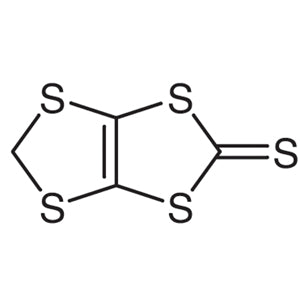
TCI M1112 is 4,5-Methylenedithio-1,3-dithiole-2-thione, a sulfur-rich heterocyclic compound recognised as an important precursor in functional materials chemistry. The 1,3-dithiole-2-thione framework is a classic starting point for constructing tetrathiafulvalene systems, the family of electron-donor molecules that forms the foundation of research into organic conductors and charge-transfer materials. The additional methylenedithio bridge at the four and five positions enriches the structure with further sulfur atoms, so this molecule is frequently chosen when researchers wish to strengthen the interactions between stacked molecules. In the laboratory it serves as a specialised building block that common reagents cannot readily replace.
The property that makes this compound attractive is the high density of sulfur atoms packed into a single small molecule. Those sulfur atoms carry easily polarisable orbitals and are able to form intermolecular sulfur–sulfur contacts, an interaction that strongly determines the conduction pathways within crystals of organic materials. The thione group at the two position is reactive and can be converted into a ketone group or joined through coupling reactions to produce symmetrical tetrathiafulvalene systems. This combination of a reactive handle and an extended sulfur framework gives synthetic chemists a dependable entry point into donor molecule design.
In Indonesian laboratories, material of this kind is typically handled by university research groups and institutional laboratories working on organic electronic materials, synthetic heterocyclic chemistry, and postgraduate thesis projects. Because it is a specialised building block rather than a general-purpose reagent, it is usually ordered in the small quantities appropriate to exploratory synthesis, then stored carefully so that a single pack can support several rounds of experimental work over an extended research programme.
TCI brochures (PDF)
- Molecular Conductors 2025-11-13 · p. 6
Related TCI products
- TCI B2228 132765-35-6 4,5-Bis(2-cyanoethylthio)-1,3-dithiole-2-thione
- TCI B1778 49638-64-4 4,5-Bis(methylthio)-1,3-dithiole-2-thione
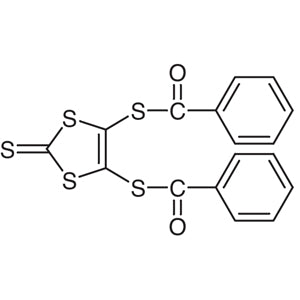
- TCI B1199 68494-08-6 4,5-Bis(benzoylthio)-1,3-dithiole-2-thione
- TCI P1635 202126-48-5 5-Propyl-1,3-dithiolo[4,5-d][1,3]dithiole-2-thione
- TCI H1163 202126-51-0 5-Hexyl-1,3-dithiolo[4,5-d][1,3]dithiole-2-thione
- TCI E0429 59089-89-3 4,5-Ethylenedithio-1,3-dithiole-2-thione
- Tetrathiafulvalene synthesis: the 1,3-dithiole-2-thione core is the classic starting framework for building TTF systems, making this compound a direct entry point for donor molecule preparation.
- Organic conductor research: the extended sulfur framework supports the intermolecular sulfur–sulfur contacts that define conduction pathways in crystals of organic conducting materials under investigation.
- Charge-transfer material development: as an electron-donor precursor, it allows researchers to assemble the donor components required for charge-transfer systems studied in functional materials chemistry.
- Heterocyclic building block chemistry: the reactive thione group at the two position can be converted to a ketone or coupled, giving synthetic flexibility to heterocyclic route design.
- Molecular stacking studies: the additional methylenedithio bridge introduces further sulfur atoms, so the compound is chosen when stronger interactions between stacked molecules are the experimental objective.
| Brand | TCI |
|---|---|
| CAS number | 70800-59-8 |
| Molecular formula | — |
| Purity | — |
| Category | Chemistry > Building Blocks > Heterocyclic Building Blocks |
| Pack sizes | available in the research-scale pack sizes listed for this catalogue item |
| Physical form | — |
| Storage | keep in the original closed container under the conditions stated on the manufacturer label |
- Chemical name: 4,5-Methylenedithio-1,3-dithiole-2-thione
Store the container tightly closed in a cool, dry and well-ventilated area, away from direct sunlight, heat sources and incompatible materials, and follow any specific storage conditions printed on the manufacturer label. Keep the compound in its original supplier container, or in a clean, chemically compatible and clearly labelled vessel if transfer is required. Handle the material inside a functioning fume hood, wearing safety glasses, suitable gloves and a laboratory coat, as sulfur-containing compounds of this type may carry an unpleasant odour. Weigh and transfer with clean, dry equipment to avoid contamination, close the container immediately after use, and consult the manufacturer safety data sheet before handling and for waste disposal guidance.
—
Produk Terkait
-
4,5-Bis(2-cyanoethylthio)-1,3-dithiole-2-thione TCI B2228
Regular price Rp 4.479.300,00Regular priceRp 3.147.900,00Sale price Rp 4.479.300,00 -
4,5-Bis(methylthio)-1,3-dithiole-2-thione TCI B1778
Regular price Rp 3.658.200,00Regular priceRp 2.573.550,00Sale price Rp 3.658.200,00 -
4,5-Bis(benzoylthio)-1,3-dithiole-2-thione TCI B1199
Regular price From Rp 2.782.500,00Regular priceRp 1.961.400,00Sale price From Rp 2.782.500,00 -
5-Propyl-1,3-dithiolo[4,5-d][1,3]dithiole-2-thione TCI P1635
Regular price From Rp 2.252.250,00Regular priceRp 1.590.750,00Sale price From Rp 2.252.250,00 -
5-Hexyl-1,3-dithiolo[4,5-d][1,3]dithiole-2-thione TCI H1163
Regular price Rp 8.347.500,00Regular priceRp 5.852.700,00Sale price Rp 8.347.500,00 -
4,5-Ethylenedithio-1,3-dithiole-2-thione TCI E0429
Regular price From Rp 1.988.700,00Regular priceRp 1.405.950,00Sale price From Rp 1.988.700,00 -
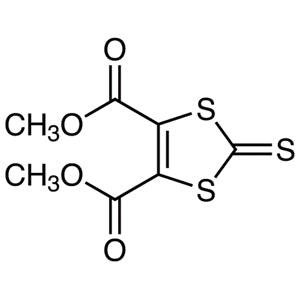
Dimethyl1,3-Dithiole-2-thione-4,5-dicarboxylate TCI D2127
Regular price From Rp 2.173.500,00Regular priceRp 1.535.100,00Sale price From Rp 2.173.500,00 -
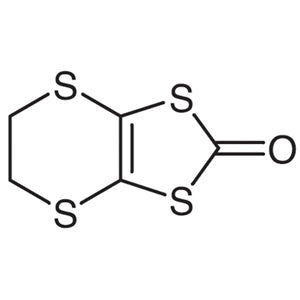
4,5-Ethylenedithio-1,3-dithiol-2-one TCI E0460
Regular price From Rp 3.260.250,00Regular priceRp 2.295.300,00Sale price From Rp 3.260.250,00


![TCI P1635 202126-48-5 5-Propyl-1,3-dithiolo[4,5-d][1,3]dithiole-2-thione](http://amiscientific.com/cdn/shop/files/TCI2510P1635_804f8840-b532-42c3-b9b9-2439d4211cd4.jpg?v=1792652952&width=533)
![202126-48-5 5-Propyl-1,3-dithiolo[4,5-d][1,3]dithiole-2-thione - AMI Scientific](http://amiscientific.com/cdn/shop/files/TCI2510P1635.jpg?v=1767135018&width=533)
![TCI H1163 202126-51-0 5-Hexyl-1,3-dithiolo[4,5-d][1,3]dithiole-2-thione](http://amiscientific.com/cdn/shop/files/TCI2510H1163_a57bead6-980e-4143-bbc3-ee58f9bcd99f.jpg?v=1792644393&width=533)
![202126-51-0 5-Hexyl-1,3-dithiolo[4,5-d][1,3]dithiole-2-thione - AMI Scientific](http://amiscientific.com/cdn/shop/files/TCI2510H1163.jpg?v=1767117558&width=533)