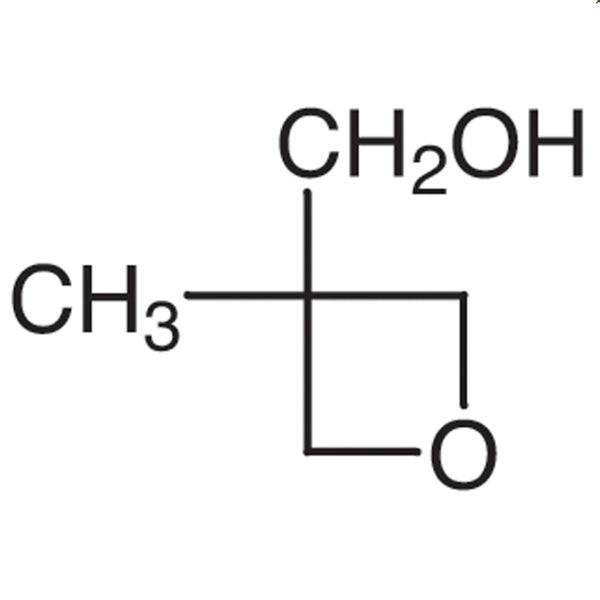
TCI M1136 3-Methyl-3-oxetanemethanol is an alcohol that carries a four-membered oxetane ring within its structure. The oxetane ring is a small cyclic ether that holds a considerable amount of ring strain, and it is precisely that strain which makes the compound interesting both as a reactive group and as a structural motif. The molecule also bears a free primary hydroxyl group that is ready to react without disturbing the ring itself, so researchers can attach the oxetane ring to other molecules through esterification, etherification, or reaction with isocyanates, and then exploit the ring in a subsequent step.
The usefulness of this building block rests on two properties at once. First, the oxetane ring can be opened through cationic polymerization, which makes the compound an important raw material in the preparation of polymers and resins that cure under ultraviolet light. Second, in medicinal chemistry the oxetane ring is valued as a replacement for gem-dimethyl and carbonyl groups, because it occupies a similar spatial volume while improving solubility in water and altering the metabolic profile of a molecule. Its primary hydroxyl group is reactive yet not excessively hindered on steric grounds, so coupling reactions proceed smoothly.
In Indonesian laboratories this compound is typically encountered in synthetic organic chemistry groups, polymer and coating research units, and pharmaceutical discovery programmes that build candidate molecules from defined fragments. It is handled on the bench as a starting material for multi-step routes, where the free hydroxyl group is coupled first and the strained ring is carried forward intact. Its role is that of a versatile intermediate rather than a finished formulation, supplied for research and development work.
- Cationic photopolymerization and UV-curable resin development, where the strained oxetane ring opens under acid initiation to build polymer networks that harden on exposure to ultraviolet light.
- Medicinal chemistry fragment design, where the oxetane ring substitutes for a gem-dimethyl or carbonyl group to occupy similar space while improving aqueous solubility of the candidate molecule.
- Esterification chemistry, in which the free primary hydroxyl group is acylated cleanly without disturbing the four-membered ring, delivering oxetane-bearing esters for later transformation.
- Etherification and alkylation routes, where the relatively unhindered primary alcohol allows oxetane motifs to be grafted onto larger scaffolds through straightforward coupling steps.
- Reaction with isocyanates to form carbamate linkages, letting researchers install the oxetane ring into urethane-type structures and then exploit ring strain in a subsequent stage.
| Brand | TCI (Tokyo Chemical Industry) |
|---|---|
| CAS number | 3143-02-0 |
| Molecular formula | — |
| Purity | — |
| Category | Chemistry > Building Blocks > Non-Heterocyclic Building Blocks |
| Pack sizes | available in standard TCI research-scale packaging; please confirm the currently listed sizes when ordering |
| Physical form | — |
| Storage | keep in a cool, dry place in a tightly closed original container, away from heat and ignition sources |
- Catalogue number: M1136
Store the container tightly closed in a cool, dry and well-ventilated area, away from heat, open flames, and sources of ignition, and keep it in the original supplier packaging or another compatible tightly sealed vessel that protects the contents from moisture. Handle the material inside a fume hood while wearing safety goggles, chemical-resistant gloves, and a laboratory coat, and avoid contact with skin, eyes, and clothing as well as inhalation of vapour. Because the strained oxetane ring is susceptible to acid-catalysed ring opening, keep the compound away from strong acids and strong oxidising agents. Always consult the manufacturer safety data sheet before use, and dispose of residues and contaminated materials according to institutional chemical waste procedures.
—
Produk Terkait
-
TCI B5774 5,10-Bis(4,4,5,5-tetramethyl-1,3,2-dioxaborolan-2-yl)naphtho[1,2-c:5,6-c']bis([1,2,5]oxadiazole)
Regular price Rp 10.255.350,00Regular price -
Dihydroiodide TCI B6569
Regular price From Rp 1.936.200,00Regular price -
Trifluoromethanesulfonate TCI B7003
Regular price From Rp 1.936.200,00Regular price
![5,10-Bis(4,4,5,5-tetramethyl-1,3,2-dioxaborolan-2-yl)naphtho[1,2-c:5,6-c']bis([1,2,5]oxadiazole) - TCI B5774 - AMI Scientific](http://amiscientific.com/cdn/shop/files/TCI2510B5774.jpg?v=1769180228&width=533)